The same Lipstick Tubes drawing can get two very different quotes: Factory A quotes $0.80 per piece, while Factory B quotes $0.60. That 20% gap usually isn’t a concession on profit. It is a shift in process cost. We have reviewed hundreds of RFQs for lipstick tubes, compact cases, and cushion compacts. When a quote comes in more than 15% below the market, nine times out of ten the supplier has cut corners in one of five areas: material, mold, surface treatment, tolerance, or hidden costs buried behind the unit price.
A low price is not wrong by itself. Normal price pressure and an abnormally low quote are two different things. The key question is where that 20% was saved. A lipstick tube starts with ABS resin injection molding, then goes through electroplating for a bright metallic finish, and finally moves into assembly. Every step has a real cost. If one step is too cheap, that is where the risk sits. The five areas below break this down one by one. Each section includes simple inspection actions that can be used as soon as a quotation sheet and sample arrive.
Quick check: the five traps behind a low quote
| Trap | Where corners are cut | How to check | Cost of the shortcut |
|---|---|---|---|
| 1. Material substitution | Electroplating-grade ABS replaced with standard ABS; imported resin replaced with Chinese resin; sprue material or regrind added | Request the COA and check butadiene content; inspect transparent parts against light for haze; disassemble the outer shell and test electroplating adhesion | Peeling electroplating, uncontrolled batch color difference ΔE, yellowing within six months |
| 2. Mold downgrade | S136 steel replaced with 2083; refurbished molds sold as new; false mold cycle claims | Lock the steel grade and guaranteed mold cycles in the contract; require a mold life guarantee clause | Flash and sink marks long before expected mold life, then a second mold must be built |
| 3. Surface treatment cutbacks | Cu/Ni/Cr triple plating made thinner; UV coating without primer; vacuum metallization base coat or top coat reduced | Use 3M 600 tape pull tests, cross-cut tests, and visual inspection under light | Rust after 8 hours in salt spray, major failure in wear and weather resistance |
| 4. Relaxed tolerances | Center post clearance out of spec, no Cpk control, no sampling inspection on critical dimensions | Request a Cpk ≥ 1.33 report; measure gaps with the three-pin method; run a 1.2 m drop test | Loose fit, sticking, hinge noise, and breakage after drops |
| 5. Hidden costs | Mold cost buried in unit price, sample charges not credited back, inflated scrap allowance, MOQ traps | Run the total-cost math: goods + mold + sampling + loss allowance, divided by quantity; lock eight key clauses into the contract | Low unit price but higher total cost, and future orders get locked in |
1. Is the ABS on the quotation sheet electroplating-grade or standard grade?
Material is the easiest place to hide cost-cutting because the appearance looks the same. The difference only shows up when the properties are checked at the resin level.
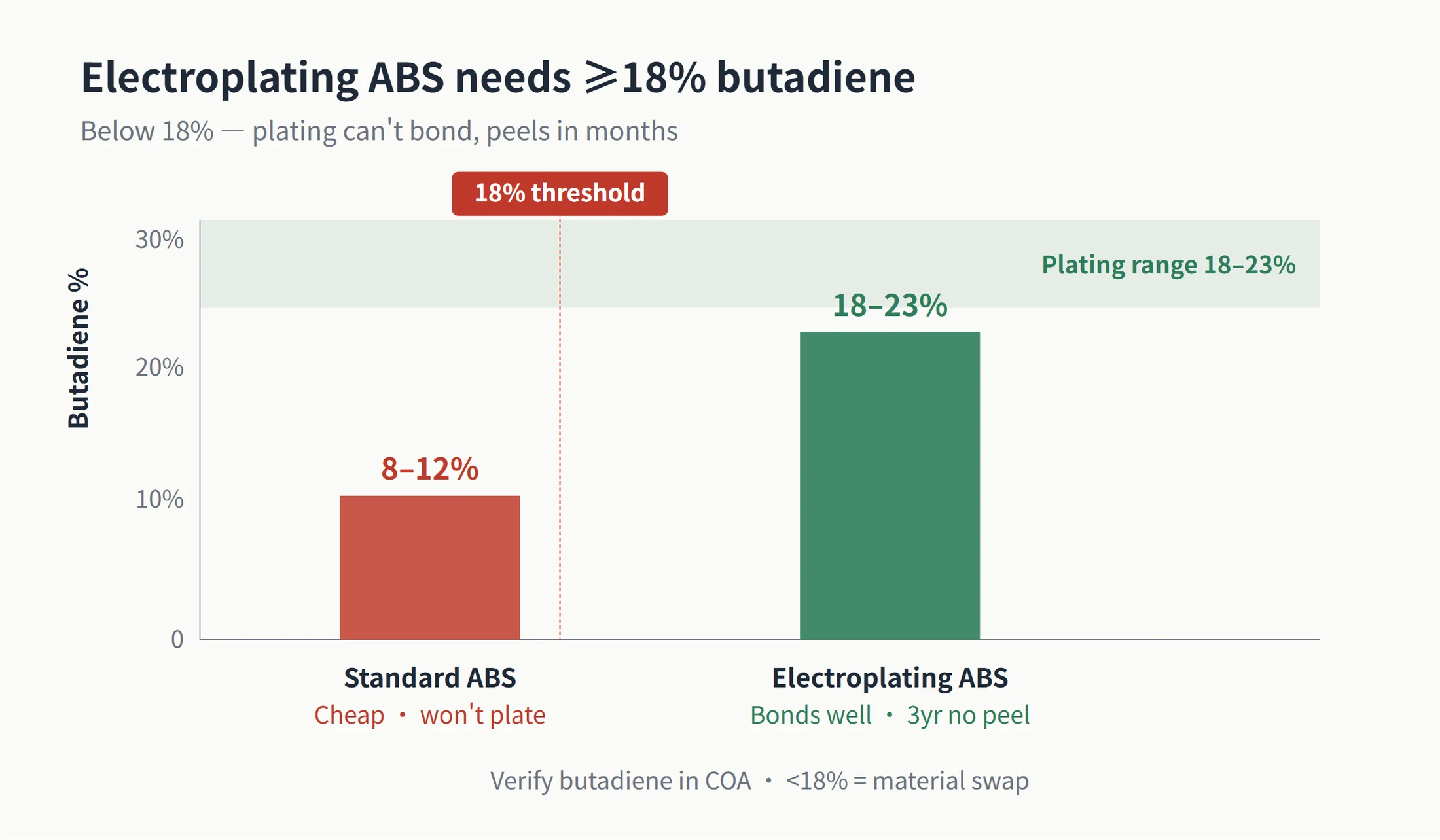
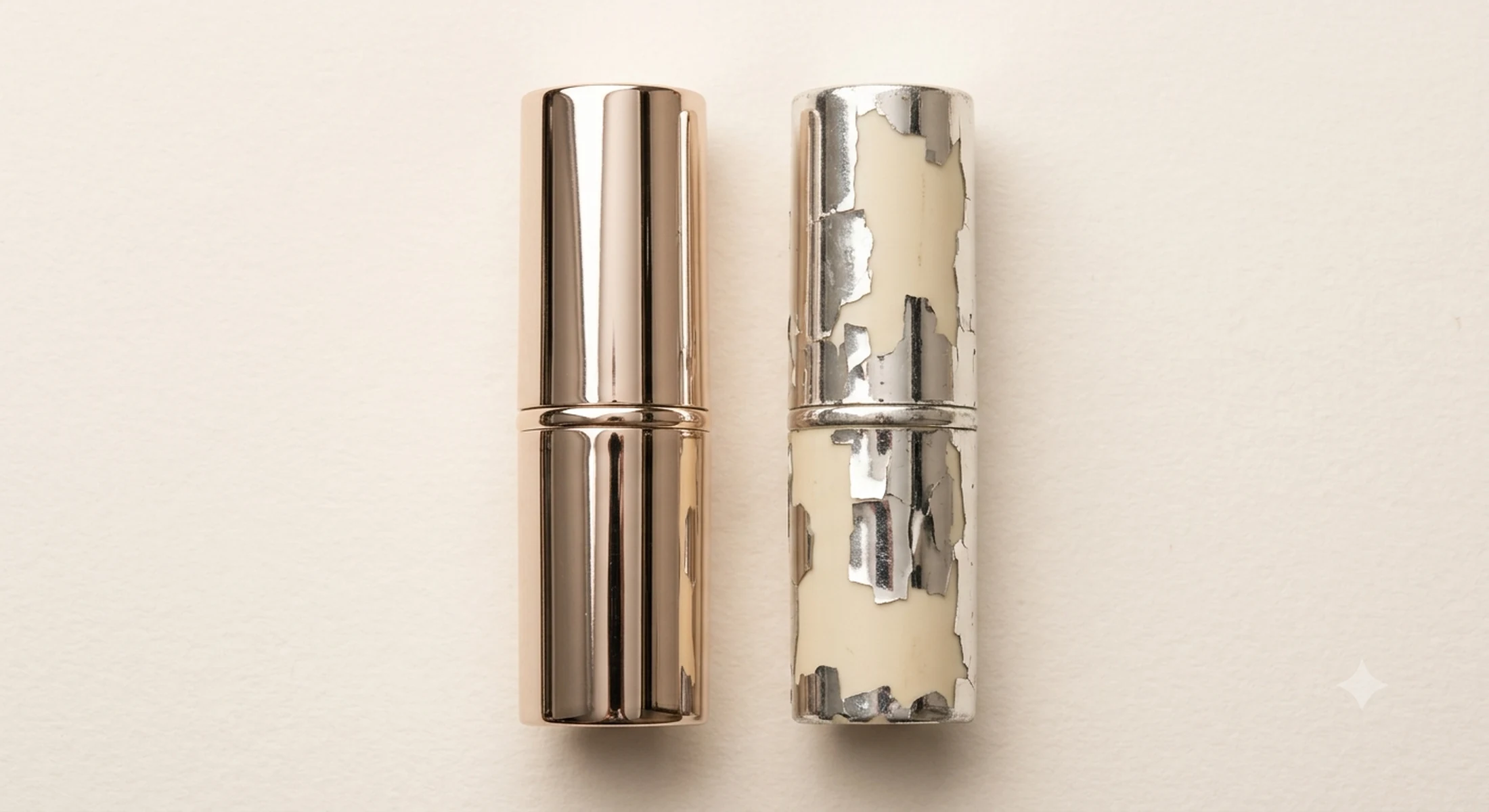
Whether ABS can take electroplating depends on butadiene content. For electroplating-grade ABS, the hard threshold is 18% to 23% butadiene. Below that level, the plating layer will not anchor properly to the substrate and will start peeling over time. Standard ABS is cheaper, but using it for electroplated parts is a built-in failure risk. These two grades look the same from the outside. Both are plastic shells. The difference is that parts made with electroplating-grade ABS can hold plating for three years without peeling, while standard ABS parts may start losing chrome in patches within six months. That price gap is exactly what a low quote is saving.
There is another, more concealed tactic. A supplier uses imported resin such as Chi Mei or Formosa Plastics during sampling, then quietly switches to Chinese resin in the second year of mass production. The part looks fine when it arrives, but batch color difference ΔE drifts out of control, electroplating adhesion drops, and the parts yellow after six months. By the time consumer complaints come back, the savings are already gone from your side and captured on theirs. That is why a proper contract should lock the resin grade and material code, forbid unauthorized resin changes in mass production, and require new sample approval for any substitution.
Then there is regrind. In this industry, a common rule is simple: transparent parts should not contain regrind. Once AS resin or PMMA is mixed with reground gate waste, haze and black specks appear right away and are visible to the naked eye. Regrind in ABS parts is harder to spot by appearance alone, but it reduces strength, electroplating adhesion, and batch color consistency. For transparent parts, no regrind is standard practice. For ABS parts, testing is the only reliable answer.
The simplest inspection step is to hold the sample against the light. If a transparent part looks hazy or has black specks, it has likely been mixed with regrind. For an electroplated ABS outer shell, ask the supplier for the material COA and check whether butadiene reaches 18%. Then run a 3M 600 tape test. If the electroplating layer peels off with one pull, the part is likely made from standard ABS or resin mixed with regrind. The minimum baseline to write into the contract is clear: electroplating-grade ABS, butadiene ≥ 18%, no regrind, and no material substitution in mass production.
2. Mold cost is a major item. How do you tell a new mold from a refurbished mold or downgraded steel?
In private mold cosmetic packaging, mold cost is a major line item. It is also where the biggest downgrade space exists. For a private mold lipstick tube shell with a center post and an aluminum-plastic composite structure, the normal market range is about $1,777.78 to $3,703.70. For a Lip Gloss Tubes project, it is about $1,037.04 to $1,481.48. MOQ usually starts at 12,000 to 50,000 pieces, and mold lead time is typically 25 to 45 days. If a quotation falls well below that range, the next question is where the supplier cut mold cost.
Mold steel is the first downgrade point. For the same lipstick tube mold, S136 mirror-finish steel and 2083 standard stainless mold steel can differ in service life by 30% to 40%. In the trade, S136 downgraded to 2083 usually means a 30% to 40% reduction in mold life. NAK80 downgraded to 718H typically cuts 20% to 30%. The cheaper quote often comes from exactly this type of steel downgrade. Surface finish, corrosion resistance, and mold cycles all take the hit. The proper approach is to specify the exact steel grade in the contract. Wording like “high-quality mold steel” is too vague and should not be accepted.
The second trap is selling a refurbished mold as a new mold. If mold wear is not severe, laser cladding and re-nitriding can put the mold back into service. That is normal refurbishment. Even then, the mold life usually returns to only 60% to 70% of the original level. The real problem is when a factory refurbishes a used mold from another project and sells it to you as brand new. Then it collapses after 100,000 shots. The way to judge this is simple: once cumulative mold cycles exceed 80% of the original design life, refurbishment no longer makes much sense. A new mold delivery should include a mold history record that shows cavity wear and cumulative cycles.
The third issue is false reporting of mold cycles. Mold life has defined grades. Under the SPI mold standard, class 101 to 105 relates to steel grade and design cycle life. A proper lipstick tube mold can usually run 300,000 to 800,000 shots. A compact powder case mold can run 500,000 to 1,000,000. Some factories use class 104 aluminum molds or soft steel molds and present them as production molds. The first tens of thousands of parts may look fine, but the mold starts producing flash and sink marks long before half of its claimed life. The way to control this is to write a guaranteed mold cycle clause into the contract, such as “300,000 guaranteed shots; if not met, the supplier repairs the mold at no charge.”
| Mold type | Mold life | Precision | Cost | Buying judgment |
|---|---|---|---|---|
| New mold—S136 / NAK80 | 300,000-800,000 shots | High | High | Best choice for production; lock the steel grade in the contract |
| Refurbished mold | 60%-75% of original life | Medium | Medium | Selling it as a new mold is fraud; require a mold history record |
| Shared mold / stock mold | Depends on remaining life | Depends on original mold | Low | Good for sampling and validation, not for exclusive mass production |
| Downgraded steel mold—2083 / 718H | 20%-40% shorter life | Medium to low | Low | A common source of abnormally low quotes |
Do not miss the mold ownership clause. Once the mold payment is completed, the mold should belong to you, not the factory. If that point is not stated clearly, your mold remains under someone else’s control, and future orders can be locked in even if you want to change suppliers.
3. Where did the Cu/Ni/Cr triple plating thickness go?
The metallic look depends almost entirely on electroplating and spray coating. A difference of a few microns often cannot be seen at first. It only shows up after a few months. That makes surface treatment one of the most common places for low-price quotes to cut cost.
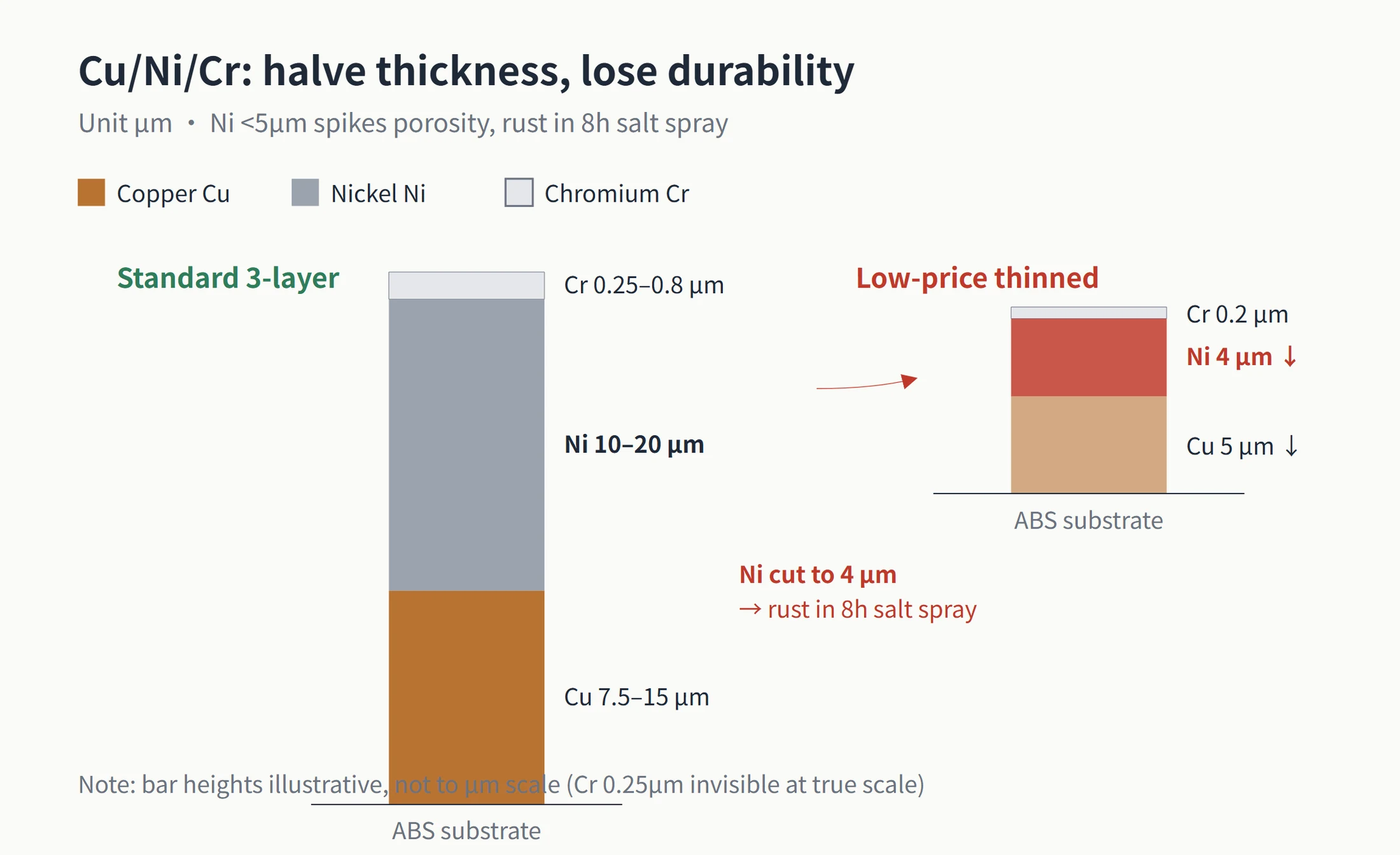
Decorative chrome on plastic parts relies on Cu/Ni/Cr triple plating. Under ASTM B604 (Standard Specification for Decorative Electroplated Coatings), the copper layer should be 7.5 to 15 microns, the nickel layer 10 to 20 microns, and the chromium layer 0.25 to 0.8 microns. Skip one layer or cut one in half, and performance drops fast. If the nickel layer falls below 5 microns, porosity rises sharply. Rust spots can appear after only 8 hours in a salt spray test. By the time the parts sit in your warehouse or reach end users, blistering and peeling are already on the way. Those few microns cannot be saved without giving up durability.
That bright metallic finish seen on many Metal Cosmetic Packaging parts often comes from vacuum metallization, where a 30 to 100 nm aluminum layer is applied and then protected by a base coat and top coat. The shortcut is usually in the coating stack around that metal layer. Skip the base coat, and adhesion can decline by 70% to 90%. Cut curing time and hardness can fall from H to B. Then lipstick oils can wipe the gloss away in normal use. The surface may look fine at delivery, but the problem appears after a few months.
UV coating has several similar risks. Remove one primer layer, and interlayer shear strength declines by 70% to 90%, allowing metal ion migration into the top coat. Reduce curing time, and pencil hardness can fall by two to three grades. Solvent resistance can fail in fewer than ten wipe cycles. Residual monomer can go over the limit and lead to yellowing. None of this is obvious at incoming inspection unless you test for it.
There are standard ways to check electroplating and coating adhesion. Apply 3M 600 tape and peel it off to see whether the plating layer, printing, or hot stamping comes off. Use a cross-cut test and check whether the result reaches 4B or above under ASTM D3359 (Standard Test Method for Measuring Adhesion by Tape Test). Then run 10 thermal shock cycles from -40 °C to 85 °C. If the low-priced part has skipped process steps, these tests will expose it quickly. The simplest on-site check is even easier: hold the sample under light to look for plating peel, then scratch lightly with a fingernail to see whether the chrome layer comes off. No instrument is needed for that first screen.
4. Can the tolerances on the drawing actually be delivered?
Tolerance control is one of the easiest areas for a low-price factory to loosen and one of the hardest for buyers to catch. A good appearance does not mean good function. If a lipstick tube squeaks when twisted or feels loose, the root cause is usually tolerance control.
The most critical internal part in a lipstick tube is the center post assembly, which includes the bead, fork, and spiral components. It is typically made from POM (polyoxymethylene) and controls the lift mechanism. If tolerance control is loose here, the whole tube fails. These center post components are usually outsourced and assembled by the cosmetic packaging factory, so this article does not go deeper into that part.
The main point here is the dimensional tolerance of the outer shell and the inspection actions around it. Common shortcuts from low-price suppliers include no Cpk control, no sampling inspection on critical dimensions, and no torque or drop testing. Once shell fit tolerances are relaxed, the lipstick tube cap no longer closes tightly, the compact powder case hinge becomes loose, and the snap fit stops working properly. In the hands of end users, that becomes hinge noise, loose closure, or caps falling off.
Proper incoming quality control clauses should include the following: critical dimensions with Cpk ≥ 1.33; fit clearance measured by the three-pin method or a pneumatic gauge; spiral torque controlled at 0.15 to 0.35 N·m; a 1.2 m drop test onto concrete; and environmental aging at 50 °C and 95% RH for 72 hours. Put these terms into the contract and inspect by AQL sampling standards. Low-price shipments usually show their true quality once these requirements are enforced.
There is also a very basic but effective method: take the sample apart. Open the lipstick tube and feel whether it has a counterweight inside. Many low-end parts simply remove the iron weight insert, making the tube feel too light. Measure the aluminum shell thickness. Check whether the compact case hinge feels loose. Inspect whether the makeup mirror is clear. None of these points show up clearly in a drawing or quotation sheet, but disassembly reveals them fast. Whether the counterweight is there, whether the aluminum shell is thick enough, and whether the hinge has been fatigue-tested can all be judged better from one sample teardown than from ten pages of pricing.
| Inspection item | Acceptance limit | How to measure | What happens if it is skipped |
|---|---|---|---|
| Cpk | ≥ 1.33 | Request the supplier’s report | Batch tolerance drift and low yield |
| Spiral torque | 0.15-0.35 N·m | Torque gauge | Too tight to turn, or too loose and self-sliding |
| Drop test | No breakage after 1.2 m drop onto concrete | Drop test | Consumers drop it once, and it breaks |
| Aging | 50 °C / 95% RH / 72 h | Constant temperature and humidity chamber | Sticking or deformation after months of storage |
| Disassembly | Counterweight / aluminum shell thickness / hinge condition | By hand + caliper | Feels light, loose, and low-grade |
5. The money outside the quotation sheet: MOQ, loss allowance, and the other mold-cost equation
A low unit price does not mean a low total cost. This is what makes low-price quotes so misleading. Buyers focus on saving $0.20 per lipstick tube, then discover later that the full program costs more than the quote from a serious supplier.
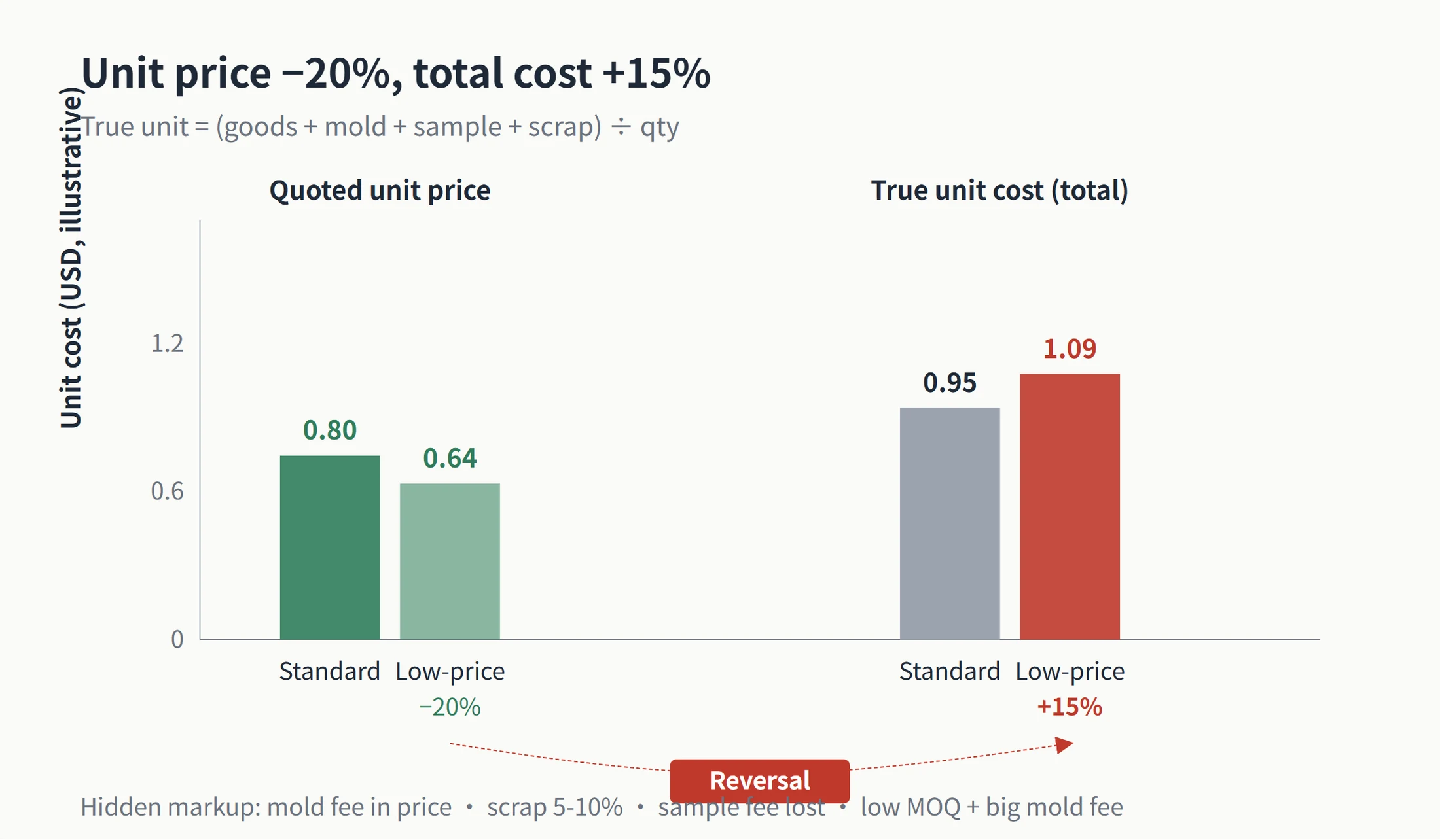
The first hidden cost is the mold cost buried in the unit price. Some quotations do not list the mold fee separately. Instead, they spread it into the piece price. The unit price may not look high, but you are paying for the mold on every piece, and the more you buy, the more you overpay. The normal practice is to list the mold cost separately and transfer mold ownership to the buyer after payment. Some suppliers also pair a very low MOQ with an extremely high mold fee. Mold costs can account for half of the total or even more. An MOQ of one piece sounds attractive, but once the mold fee and minimum spend are included, it can cost more than a standard quote with a 12,000-piece MOQ.
The second hidden cost is the sample fee. The supplier charges for samples, then does not credit that amount back when the production order is placed. Many buyers sign without checking this clause. In effect, they pay the sample cost twice. The contract should state clearly that the sample fee is credited back once production reaches a defined quantity, or that the sample fee is waived from the start.
The third point, and often the most important one to watch, is the loss allowance. Normal industry loss rates are only 1% to 3%. Some suppliers inflate that to 5% to 10%. The extra percentage is simply a disguised price increase. An inflated loss allowance often means the supplier is passing its own poor yield cost on to you. Yield in electroplating and spray coating directly affects unit price. A serious factory keeps yield data transparent. Some factories overstate their yield, then recover the real scrap cost either through the unit price of accepted parts or through the loss allowance charged to the buyer. The cost still comes out of the same place. Keeping the contractual loss allowance at no more than 3% is the normal industry baseline.
The last point is false yield reporting and total-cost calculation. Cosmetic packaging follows a clear cost pattern: small lots should cost 40% to 60% more than large-volume production because mold cost allocation is heavier. If someone quotes a small batch below the normal market level for large volumes, they are likely recovering the difference through lower-grade material or reduced process steps. The total-cost method is simple: add the goods value, mold cost, sample fee, and loss allowance, then divide by quantity. That gives the real cost per piece, which can then be compared across suppliers.
Before signing, lock down these eight contract clauses: mold ownership after payment; the number of free mold repairs, usually one to two times; mold life guarantee, such as free repair if a 300,000-shot guarantee is not met; golden sample approval signed by both parties; tiered pricing; refund mechanism; a loss allowance cap of no more than 3%; and a warranty period of 12 months after receipt. If these clauses are vague, the quote is not worth signing even if it looks cheap.
| Hidden-cost item | Normal industry practice | Trap wording | How to prevent it |
|---|---|---|---|
| Mold cost | Listed separately, ownership transfers after payment | Buried in unit price and not listed | List it separately in the contract and state buyer ownership |
| Loss allowance | 1%-3% | Inflated to 5%-10% | Cap it at ≤ 3% in the contract |
| Sample fee | Credited back on production order or waived | Charged and not credited back | State the credit-back condition in the contract |
| MOQ | 12,000-50,000 pieces for private molds | MOQ of 1 piece with an extremely high mold fee | Compare total cost, not just unit price |
| Yield | Transparent and traceable | Overstated yield, with loss passed to buyer | Request yield data and link it to loss allowance |
| Warranty | 12 months after receipt | Not stated or shortened | Write the warranty period clearly into the contract |
Ask these three questions before accepting any quote
The next time a quotation looks unusually attractive, do not sign right away. Break it down into five dimensions: material, mold, surface treatment, tolerance, and hidden cost. Then ask three questions. Is the ABS on the quotation sheet electroplating-grade or standard grade? Is the mold newly built or refurbished? Are the loss allowance and mold cost hiding another layer of expense?
When a price is lower, the savings have to come from somewhere. It is either material, mold, or process. It does not appear out of nowhere. Once the numbers are broken down and the total cost is calculated, it becomes clear who is genuinely offering value and who is cutting corners. If you have drawings or a sample list for Lipstick Tubes, Compact Powder Cases, or cushion compacts, send the information over. Sambound can review process feasibility first, then check these five dimensions one by one together. A low quote that is truly workable can move forward. The traps that should be avoided can be screened out before the order is signed.