For the first batch of cosmetic packaging, the priority is not the look. The first question is whether the batch can actually be produced in small volumes.
Sambound has handled many first orders from influencers. In eight out of ten cases, the first thing they say is, “I want a lipstick that reflects my style.” What really stops them is never that the shade is not unique enough or the pack is not photogenic enough. The real barriers are minimum order quantity, mold cost, and sampling lead time. For the first batch, there are only three priorities: lock in the product category, work within the MOQ, and secure sampling. Once those three are under control, then it makes sense to talk about appearance and texture.
The beauty market has seen aggressive reshuffling over the past two years. In 2025, nearly 60 brands exited the market, and influencer-led beauty brands have been under the same pressure. That is why the first batch needs tighter risk control. Start with small-volume validation on a public mold. Do not put everything into a custom mold from day one.
Lock in the product category before discussing packaging
Many people start by asking, “How should I choose the packaging?” That question cannot be answered on its own. Lipstick Tubes, compact cases, and eyeshadow palettes each follow entirely different structural and cost logic. You need to decide which one or two core categories will lead the first launch. Only then does the packaging discussion become practical.
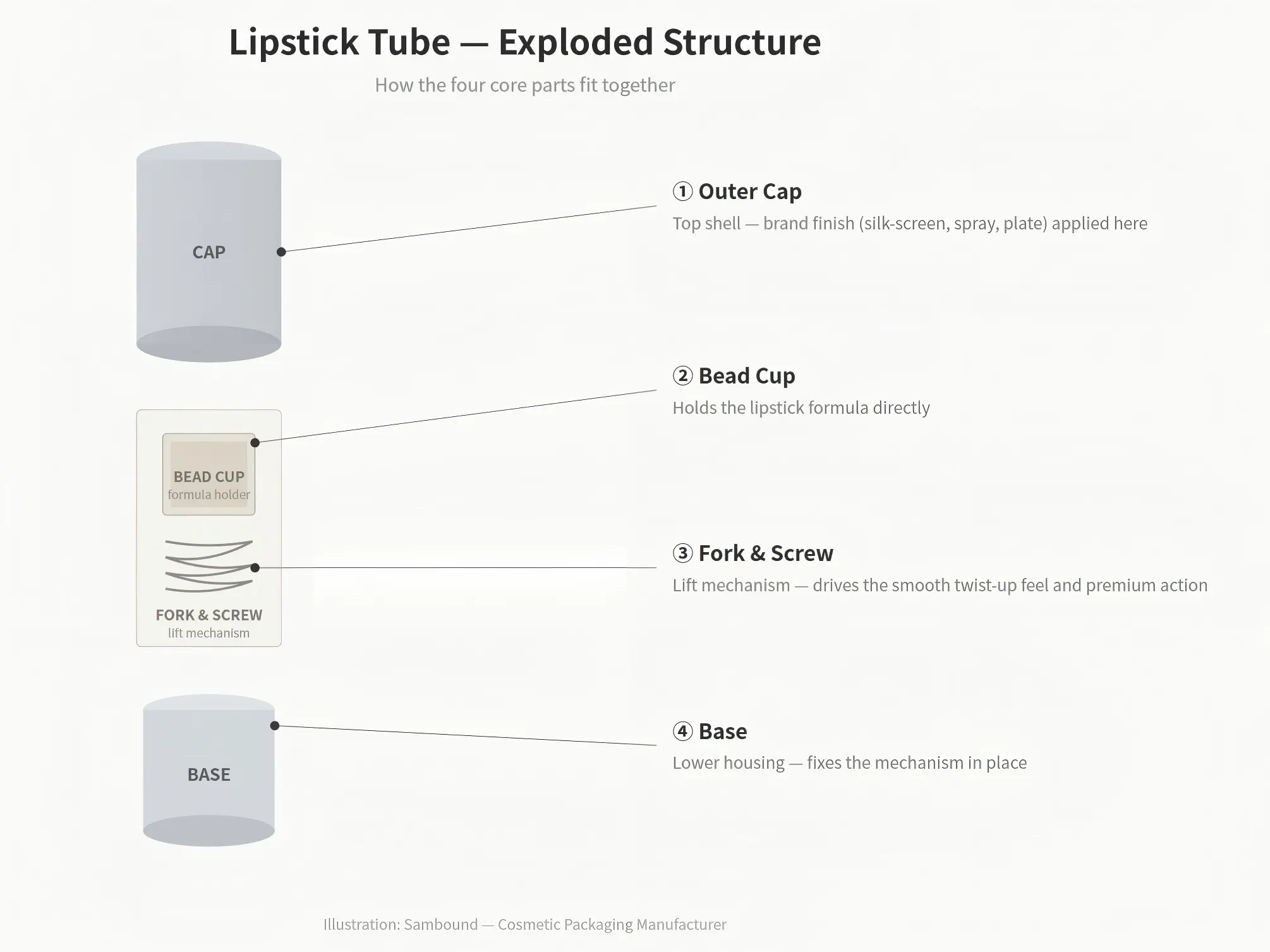
Lipstick tubes are one of the most process-sensitive categories in color cosmetics packaging. A single tube includes an outer cap, a base, and a central mechanism often called the inner core assembly—the bead cup, fork, and screw-lift system. The bead cup holds the formula directly. The fork and screw structure controls the up-and-down movement. The quality of this assembly determines whether the lipstick twists smoothly and whether it feels premium in use. Compact cases and eyeshadow palettes are a different story. Their key challenge is assembly across multiple parts, including mirrors, hinges, magnets, and pans. That means more components and longer processing steps. Cushion compacts also need a sealing ring to keep the foundation from drying out.
Choosing the category matters because it directly sets the process difficulty and the target unit price range for the batch. An all-plastic lipstick tube has a lower cost and fewer assembly steps, so both the unit price and tooling cost sit in one tier. An aluminum-plastic composite tube with an aluminum shell and anodized brushed finish moves both texture and cost up a level. Assembly can reach five or six steps, and the surface-finishing chain is also longer. For multi-component categories such as compacts and cushion cases, the cost driver is not the plastic part itself. It is the sourcing and assembly labor for mirrors, hinges, magnets, and sealing rings.
For a first launch, the safest entry point is to start with the one or two categories you understand best and that are most likely to sell in volume. Do not try to launch lipstick, compact cases, and eyeshadow palettes all at once. Once the number of SKUs goes up, every category needs its sample, its compatibility validation, and its production scheduling. Time and cash pressure rise fast. It is far better to make one or two SKUs solid than to spread resources across a full but half-finished lineup.
Public mold or custom tooling: which path makes sense for a first batch?
There is broad agreement in the packaging industry: do not rush into a custom mold for the first batch.
The threshold for a private mold is clear. In most cases, the MOQ needs to reach 12,000 to 50,000 units before the tooling cost can be spread out. This is not one factory setting a barrier. It is the volume range the industry works with. For a custom lipstick tube mold, the going rate in China is roughly RMB 15,000 to RMB 50,000, or about US$2,222 to US$7,407. If the whole pack needs to be exclusive, international quotes can run from US$15,000 to US$50,000 or more. For a new brand that has not yet proven demand, that is a serious commitment. If the first batch does not sell, the mold cost just sits there.
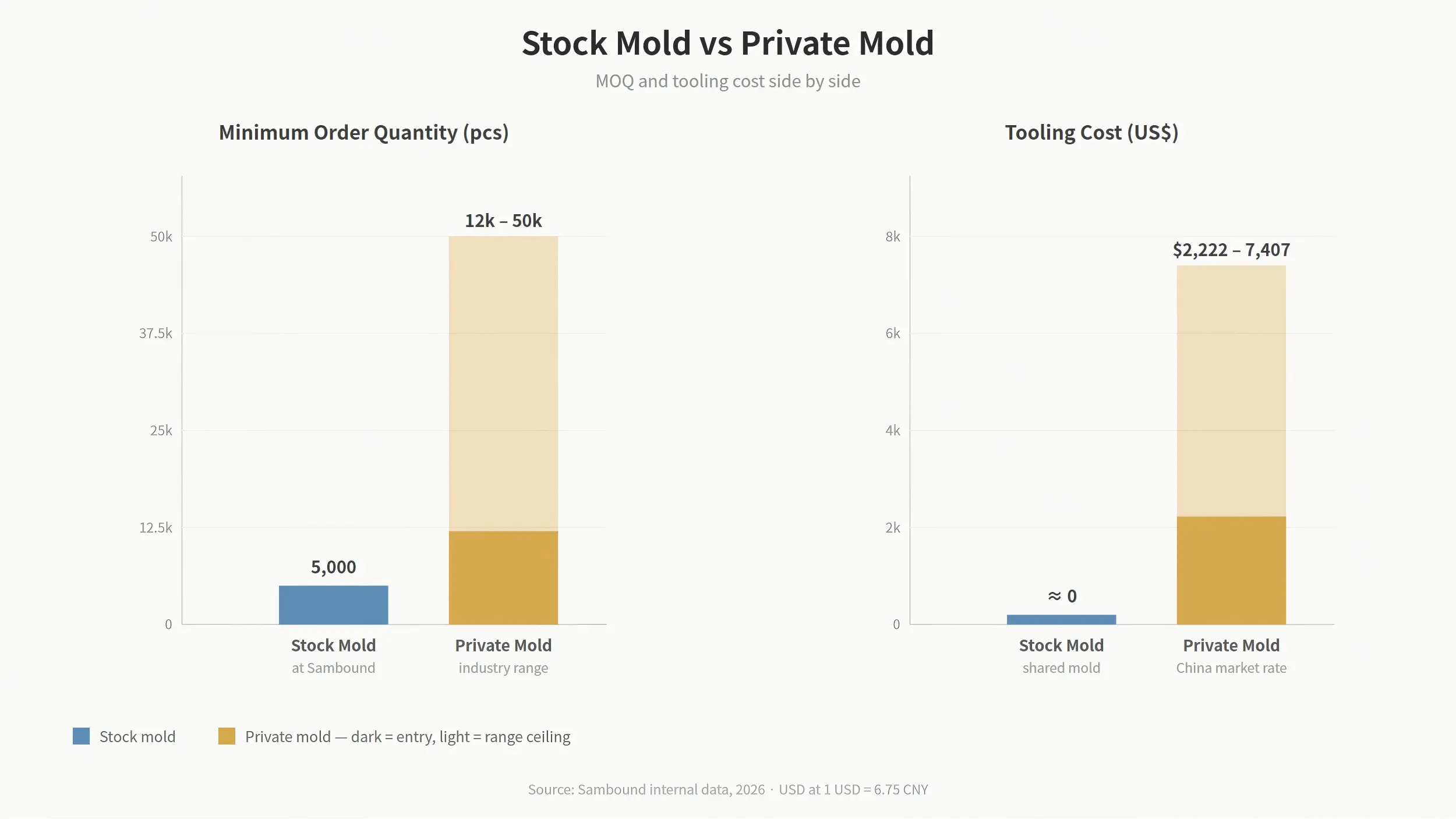
Public molds are much more flexible. A project can often start from a few hundred to a few thousand units. If the MOQ does not support a private mold, the standard industry move is to start with a public mold. Changing the color, printing the logo, adding a surface finish, and light customization can still create a strong brand identity. Once sales build, the brand can move up to an exclusive custom mold with much lower risk.
Independent beauty founders overseas run the numbers the same way. A proper A-grade first launch, including development, packaging, and production, usually starts at no less than US$60,000, with a 20% range up or down. There is also a leaner route, where founders test the market with a few hundred units on a budget of several thousand to US$20,000. The difference between these two paths is not whether one is better. It comes down to how much risk the brand can carry and how accurate its sales forecast is. The logic is the same for domestic influencer brands: validate on a small batch first, then discuss exclusivity after the market confirms it. The deciding factor in a first batch is never whether the packaging is exclusive enough. It is whether the lipstick actually sells. If it does not sell, even an expensive private mold is just a sunk cost. If it does sell, the cost of modifying a public mold is minor.
What really limits small-batch MOQ
At Sambound, the MOQ for public molds is 5,000 units, and the sample lead time for a public mold is 7 days. For smaller content creators just getting started, that volume may still feel high. It is better suited to influencers who already have a measurable follower base and selling power and who want to launch a real first batch for market distribution. It is not aimed at someone who only wants to test a few hundred units.
This is not about keeping people out. It is the reality of manufacturing. A 5,000-unit MOQ reflects the minimum economic batch size tied to mold cavity count, injection molding cycle time, and assembly-line scheduling. Below that level, machine startup and setup costs get spread across too few units, and the unit price becomes unreasonable. That ends up hurting the brand. Suppliers claiming “100-unit MOQ” are usually either relabeling ready-made stock or piecing orders together in a workshop setting. In either case, consistency for mass production cannot be guaranteed.
So if an influencer has already validated follower purchasing power and wants to launch a serious first product batch, starting at 5,000 units is actually a practical fit. With a 7-day sample cycle on a public mold and years of ODM custom production experience, Sambound can move quickly from style selection to sample confirmation. If the project is still in the very early stage—tens or hundreds of units—the more realistic path is to start with ready-stock private labeling, test demand, and come back to discuss formal public-mold mass production once sales data from livestreams or campaigns becomes stable.
How to shape a brand look on a public mold with a limited budget
Using a public mold does not mean the packaging has to look the same as everyone else’s. There are only a few common modification routes, and they are all relatively low-cost.
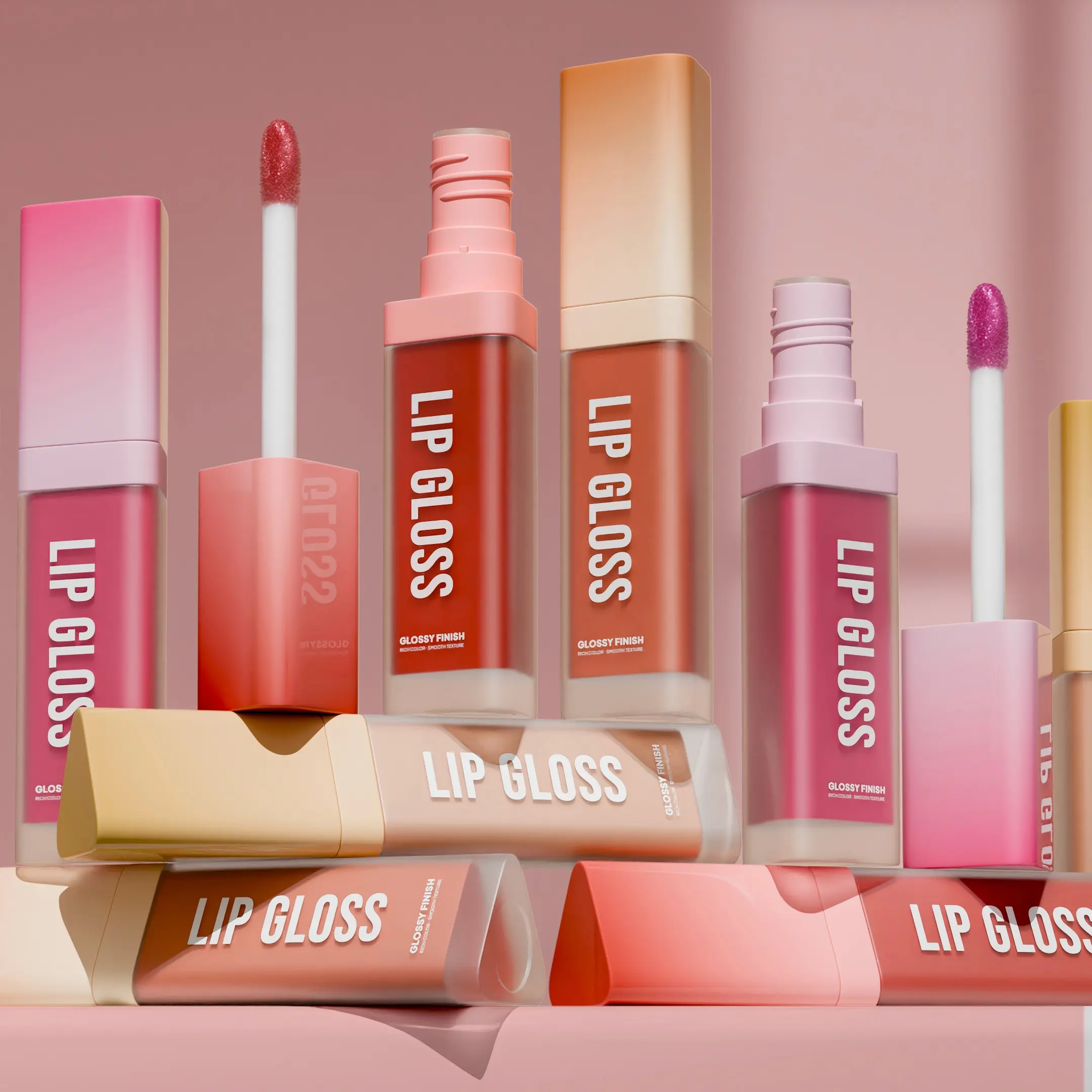
Logo printing by silk screen usually costs a few hundred RMB per color—about US$44 per color. A full spray-color change usually adds around RMB 1 to 4 per unit, or about US$0.15 to US$0.59 per piece. If the brand wants an electroplated look, the added cost is usually RMB 3 to 8 per unit, or about US$0.44 to US$1.19 per piece. Combine these three methods, and the same public-mold lipstick tube can take on a completely different brand tone through silk-screen logo printing and gradient spray coating. The total added cost is still only a few yuan per unit. A ready-stock public-mold lipstick tube generally runs from a few jiao up to more than RMB 3 per piece—roughly US$0.04 to US$0.44. Compact cases and eyeshadow palettes usually range from more than RMB 3 to over RMB 10 per piece—about US$0.44 to US$1.48—depending on structure and surface finish. Even after modification costs are added, the unit cost usually remains manageable.
There is one risk here that needs to be stated clearly up front. Materials such as PP and PE have low surface energy. Before any surface treatment is applied, they must go through corona or plasma pretreatment. Without that step, paint adhesion is effectively zero, and the finish can peel after a few months of filling and use. This is one of the most common failure points in small-batch packaging modifications. It is also a good way to tell whether a Cosmetic Packaging Manufacturer really understands the process. A reliable supplier will ask about material type and finishing method during the quotation stage and include pretreatment in the process plan, rather than taking the order first and discovering later that the coating will not hold.
First-batch product testing: SKU count, safe shades, and validation all matter
Experienced founders tend to agree on one point: do not launch a full shade range in the first batch. Start with 3 to 5 SKUs and choose 3 safe shades—classic red, rosy beige, tomato red, and other broadly accepted colors. Use existing stock colors available on the public mold first. Do not jump straight into the MOQ trap for custom masterbatch colors. Custom color masterbatch comes with its minimum volume requirements. Chasing that volume for a single exclusive shade can become another cost sink for a small first order.
Testing cannot be skipped, whether the project uses a public mold or a private mold. Packaging is not something that can be approved by appearance alone. Compatibility, sealing, and drop testing all need to pass. The formula and packaging need to sit for three months at 40 °C and 75% humidity to check for reactions. The pack needs to survive repeated drops from a height of over 1 meter without cracking or separating. Airtight formats also have to pass vacuum leak testing. Even if the project uses a public mold, the packaging still has to be validated together with the formula, filling method, applicator, and sealing system. Appearance alone is not enough to sign off and move to mass production. Liquid products such as lip gloss, foundation, and mascara all react differently with plastic, coatings, and applicators. If a problem shows up after bulk production, the loss will be far greater than the cost of early testing.
When it makes sense to move up to a private mold
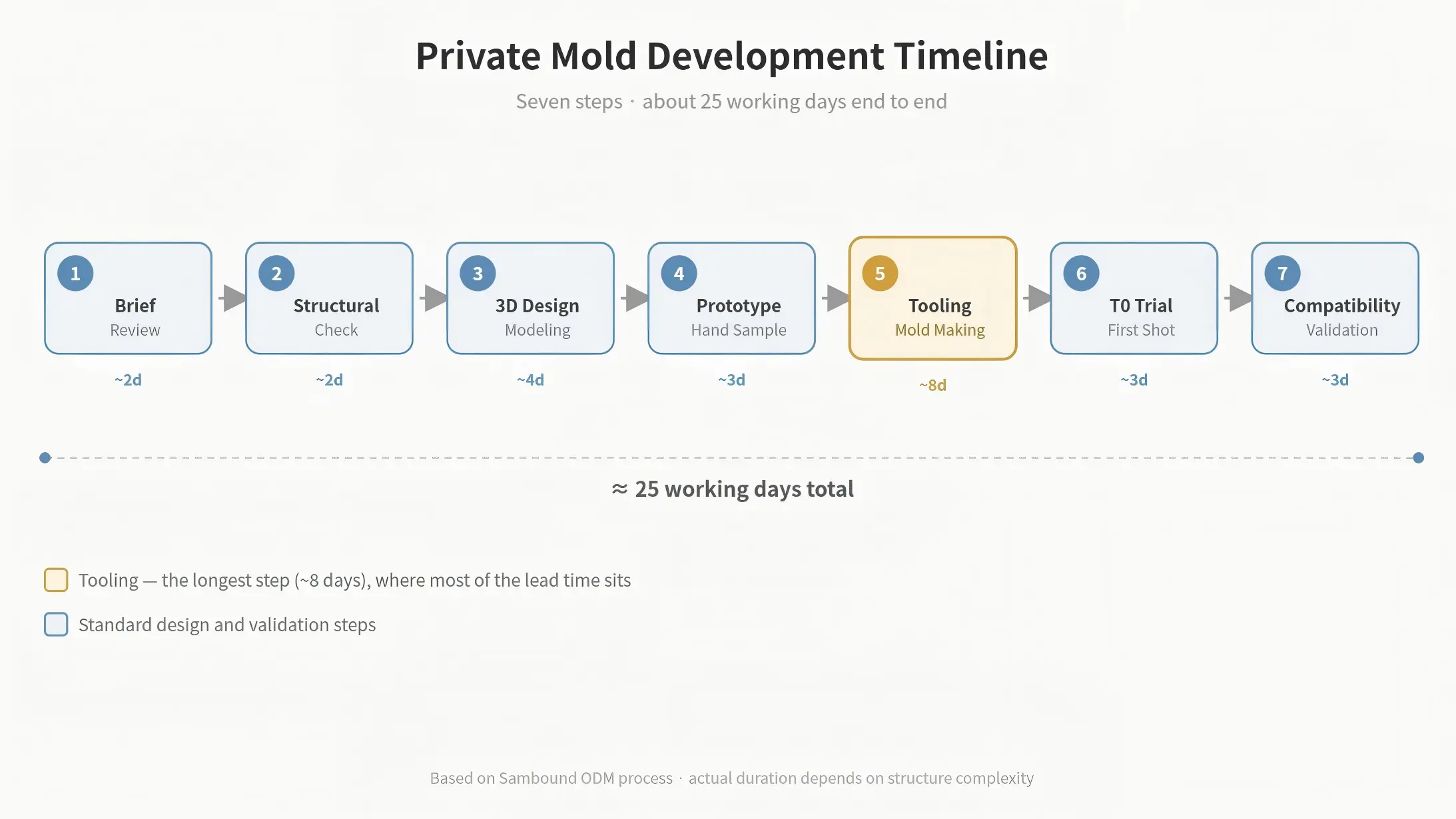
It makes sense to upgrade to a private mold only after a specific SKU has reached stable monthly sales, repeat-purchase data is in hand, and the brand is confident that the format deserves long-term development. Private-mold development follows a full chain: brief review, structural check, 3D design, prototype, tooling, T0 trial, and compatibility validation. The full process takes about 25 working days. The investment includes both tooling cost and time. That investment only makes sense when sales volume can support it, which is why the industry generally recommends starting with a public mold for the first batch.
If the first batch is meant to start with a small-volume public-mold approach, send us the product category, target volume range, and key launch shades. Sambound can review whether the project is feasible and how to modify the pack for the fastest sample turnaround. That is a far more practical starting point than opening with one question: whether an exclusive design can be made.