Both private molds and public molds produce injection-molded parts. The difference is not quality. The difference is who owns the mold and who carries that cost.
Tooling costs can differ by tens of thousands to hundreds of thousands of yuan. Minimum order quantities can differ by as much as 10x. Lead times can differ by a full month. For the same lipstick tube, choosing a private mold or a public mold creates two completely different cost structures in terms of cash outlay, inventory commitment, and waiting time.
Comparing only the unit price without breaking down these two cost structures is misleading. It hides tooling cost inside the quoted piece price, and in the end you can’t tell which option is truly more expensive. Tooling cost, MOQ, lead time, and hidden costs are four separate accounts. They need to be calculated one by one to see at what annual volume a private mold actually breaks even.
The first step is to look at purchase volume. A simple table makes the comparison clear:
| Comparison Factor | Private Mold (Exclusive Custom) | Public Mold (Standard Ready-Made) |
|---|---|---|
| Tooling Cost | $2,222-$14,815+ | $0 (sample fee only: $444-$1,185) |
| MOQ | 12,000-50,000 pcs | 12,000 pcs (ready stock can be as low as 100-1,000 pcs) |
| Lead Time | 2-3 months | 2-3 weeks |
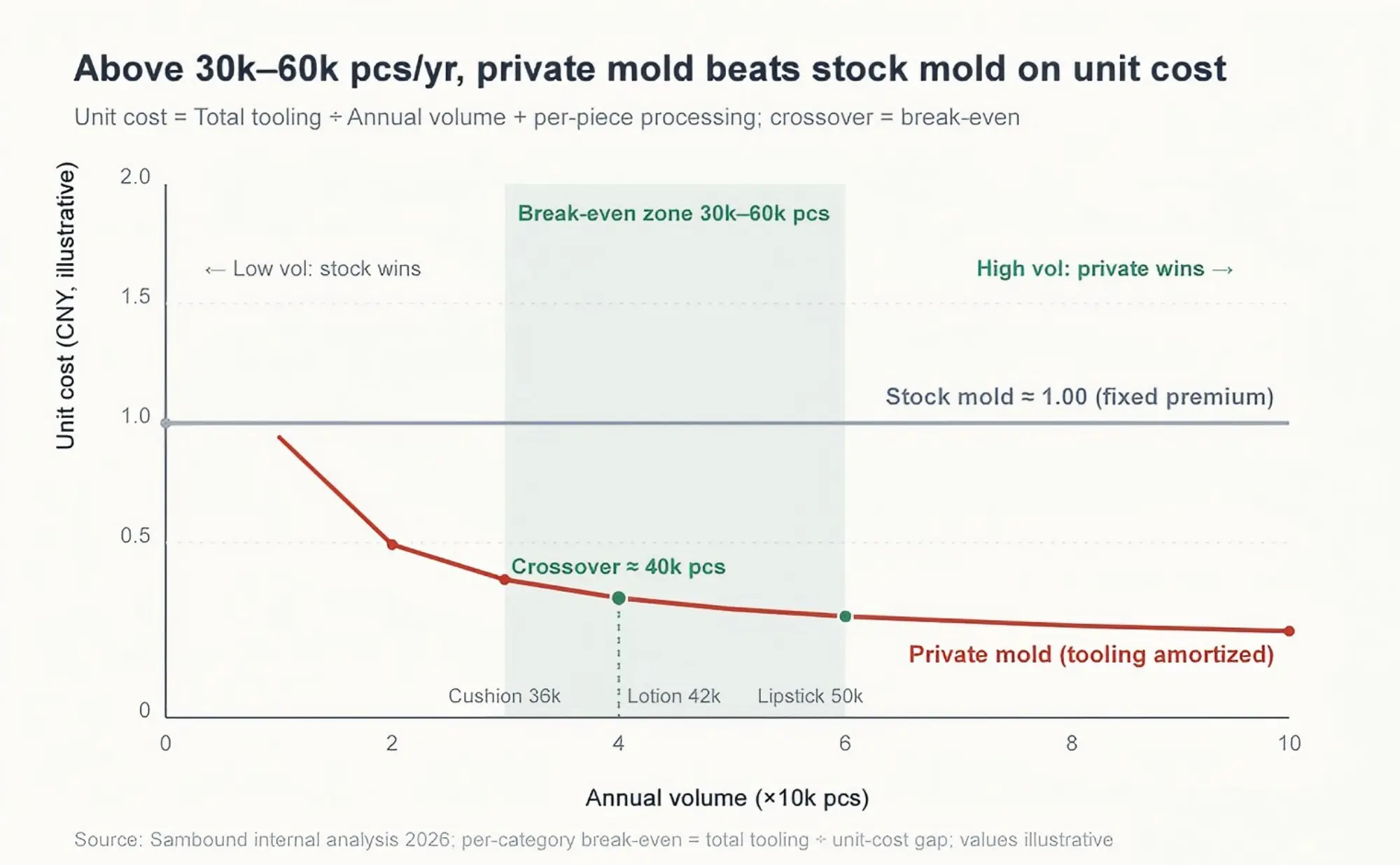
Tooling cost can differ by dozens of times, MOQ by 10x, and lead time by a month. Once amortized, a private mold can bring the unit cost down to 35%-55% below a public mold. But if volume hasn’t reached the break-even point of 30,000-60,000 units, forcing a private mold can cost more instead. Keep this summary table in mind. The next sections break down the four cost accounts one by one.
What Exactly Is the Difference Between Private Mold and Public Mold?
A public mold, also called a standard mold or stock mold, is developed by the packaging factory and reused for multiple customers. For a Cosmetic Packaging Manufacturer, this kind of mold is the foundation for spreading tooling cost across many orders. What you can change is limited to color, logo printing or hot stamping, and surface finish such as painting or plating. The structure and outer shape cannot be changed.
A private mold, also called an exclusive mold or custom mold, is built entirely to your drawings—from 3D design and prototype to tooling and mold trial. Mold ownership usually belongs to you. Once that is clearly stated in the contract, other customers cannot use it.
A public mold means using someone else’s mold. A private mold means paying for a dedicated toolset of your own. That one difference changes the next three accounts completely.
Tooling Cost Comparison
Private mold tooling cost varies widely by product category. The following ranges reflect the 2026 China market for injection-molded cosmetic packaging parts:
| Product Category | Private Mold Tooling Cost Range | Why the Cost Varies So Much |
|---|---|---|
| Lipstick Tubes outer shells and simple caps | $2,222-$7,407 | Single-piece injection molding, relatively simple structure |
| Compact Powder Cases and cushion compacts | $4,444-$11,852 | Lid, base, hinge, magnet, and pan all require separate molds, with more components involved |
| Complex multi-component Eyeshadow Palettes and magnetic refillable structures | $14,815 and up | Multi-cavity tooling, mirror polish, and precision magnetic assembly increase process complexity |
One boundary needs to be clear here: these figures apply to molds for injection-molded packaging parts only. In a lipstick tube, the inner mechanism that rotates and lifts the bullet—the cup, fork, screw, and related transmission parts—is a purchased component made by a specialized mechanism supplier. It is not tooled by the cosmetic packaging injection molder. For compact cases and cushion compacts, mirrors are purchased glass parts. Magnets and brush fibers are also purchased components. So when discussing tooling cost here, the calculation covers only the injection-molded shell parts. Purchased components are separate.
For a public mold, tooling cost is usually $0. The mold already exists. You only pay a sample fee of $444-$1,185, plus color matching and small-batch trial production charges. Customization is limited to color, logo, and surface finish. Screen printing a logo typically costs about $44-$119 per color. Changing the full-body spray color costs about $0.22-$0.59 per piece. Changing the surface by electroplating costs about $0.44-$1.19 per piece.
The gap between $2,222-$14,815+ for a private mold and $0 for a public mold is that one-time tooling investment. Why is it expensive? Four factors drive the cost: cavity count, surface finish, steel grade, and tolerance. An 8-cavity mold costs more than a 2-cavity mold, but lowers the unit cost. SPI A-grade mirror polishing costs more than a standard texture. S136 mirror-polish steel costs more than standard P20 steel and also lasts longer. Tight tolerances on critical features such as threads and seals also raise the cost.
MOQ Comparison
| Type | MOQ | Why the Gap Is So Large |
|---|---|---|
| Private mold | 12,000-50,000 pcs | The tooling cost has to be amortized over enough volume |
| Public mold (factory-owned existing mold) | About 12,000 pcs (Sambound standard) | It runs through normal factory scheduling with no separate tooling required |
| Public mold ready stock / small mixed orders in the market | 100-1,000 pcs | Stock inventory for small-batch market testing |
The MOQ gap is even more direct than the tooling gap. Private molds usually start at 12,000 to 50,000 pieces because the tooling cost does not work at lower volume. Public mold stock is much more flexible. A few hundred or a few thousand pieces may be enough to get started. This is not a restriction from one specific factory. It is standard practice across the industry. Once a mold goes on the machine, the run has to be large enough to make sense. If a factory only runs small-batch injection molding, roughly 40% of one day can be spent just on machine setup and mold changeover.
Sambound’s MOQ for private mold projects is 12,000 pieces. For public molds, the first order can start at 3,000 pieces, though 12,000 pieces is still the standard volume.
Lead Time Comparison
| Type | Sampling | Mass Production Lead Time | Why the Gap Is So Large |
|---|---|---|---|
| Public mold | Sample in 7 days | 10-15 days | The mold is ready and can go straight into production |
| Private mold | 25-30 working days for tooling | Plus mold trial, mold adjustment, and sample approval | The process is longer: tooling → T0/T1 trial → compatibility validation → production |
Lead time differs just as sharply. A public mold can deliver samples in 7 days and move into production in about 10 to 15 days. Shipment can happen within two to three weeks. For a private mold, tooling alone takes more than 25 working days. Add T0/T1 mold trials, modifications, and sample approval, and the total timeline usually reaches two to three months.
Why is the difference so large? A private mold follows the full development chain: requirement review, structural review, 3D design, prototype sampling, tooling, T0/T1 mold trial, formula compatibility validation, and mass production. In a full ODM workflow for color cosmetics packaging, a public mold skips that entire front-end sequence and starts directly from an existing tool. For schedule-sensitive projects such as holiday limited editions or Singles’ Day pre-sale launches, that one-month gap often decides whether the launch window can be met.
Hidden Costs: The Biggest Trap When Comparing Unit Price
The public mold unit price looks lower on paper. But if the following costs are not calculated before tooling starts, the final result can flip the other way.
Modification cost. A private mold does not stop costing money once it is built. Minor revisions such as small dimensional adjustments cost about $296-$741. Mid-level changes such as structural updates or capacity adjustments cost about $1,185-$2,963. Major cosmetic rework can reach $2,222-$5,926. Replacing a mold core costs about $741-$2,222. The DFM step before tooling starts cannot be skipped. Saving a few days up front can cost 10 times more when a change is made later.
Mold ownership. There are three common models. If you pay the full tooling cost, the mold is yours. The contract must state in black and white that ownership belongs to the buyer and the factory cannot use it internally or transfer it to another customer. Some projects use a shared-cost model, where you pay 60%-70% up front and the balance is refunded after the order volume target is met. The riskiest option is ultra-low-cost or free tooling. In that case, the factory may modify your private mold slightly and use it for competing products at any time. True exclusivity is almost nonexistent under that arrangement. This is a common problem in the industry.
Mold life and maintenance. A mold is not a one-time asset. It has a service life. Under SPI classification, a Class 101 mold can run more than 1 million cycles. In actual cosmetic packaging practice, lipstick tubes typically run 300,000-800,000 cycles, while compact cases run 500,000-1,000,000 cycles. Annual maintenance also costs 3%-5% of mold value. Preventive maintenance is usually required every 200,000 cycles, at about 8%-12% of mold value each time. If the mold is stored outside your own facility, storage fees also apply—about $296-$1,185 per mold set per year.
Add these items together and you get the real total cost of a private mold. A compact case with a tooling cost of $7,407 may reach a three-year total holding cost of $10,370-$11,852 once ownership protection, maintenance, and storage are included.
How to Calculate the Break-Even Point
When does a private mold make financial sense? There is a break-even point.
If the calculation is based only on tooling amortization, break-even usually starts above 50,000 to 100,000 units. But once the price premium of public molds and the added selling power of an exclusive design are included, some projects begin to make sense at 2,000 to 10,000 units. In cosmetic packaging, the common break-even range is 30,000-60,000 units, depending on the product category and piece price. Low-price items such as cream jars and cushion compacts often break even around 30,000-40,000 units. Mid- to higher-value items such as lotion bottles and lipstick tubes often break even around 40,000-50,000 units. The formula is simple: total tooling investment divided by the unit price difference between the public mold and the private mold.
In practice, there are three common scenarios:
- Annual volume under 10,000 units, SKU still being adjusted, first trial run → Choose a public mold plus revision charges. Starting with a few hundred or a few thousand units is enough. The tooling cost will not amortize at this stage, so the public mold is the safest option financially.
- Annual volume above 50,000 units, stable SKU, exclusive look required → Choose a private mold. Once volume passes the break-even point, the unit cost can be 35%-55% lower than a public mold, while mold ownership remains exclusive.
- Middle range: annual volume of 10,000-50,000 units, with interest in testing an exclusive concept → Start with a public mold to validate the market, then move to a private mold for the second order. This two-step approach is usually the safest.
Once a private mold is fully amortized, its unit cost can be 35%-55% lower than a public mold. The higher the volume, the lower the allocated cost per piece. That is why major brands keep investing in private molds. The numbers support it. But if volume is not there yet, forcing a private mold only makes the project more expensive because the tooling cost cannot be recovered.
Frequently Asked Questions
How much does private mold tooling usually cost?
It depends on the product category. Lipstick tube outer shells and simple caps usually range from $2,222 to $7,407. Compact cases and cushion compacts usually range from $4,444 to $11,852 because they use more components and separate molds. Complex multi-component eyeshadow palettes and magnetic refillable structures start at $14,815 and up. These figures do not include tooling for the lipstick inner mechanism, because that mechanism is a purchased component.
What is the lowest MOQ for a public mold?
For existing public molds owned by a packaging factory, MOQ is usually around 12,000 pieces under Sambound’s standard. Ready-stock mixed orders in the market can go as low as 100-1,000 pieces, which works for small-batch testing. Private mold MOQ is usually 12,000-50,000 pieces.
How much longer does a private mold take than a public mold?
For a public mold, sampling takes 7 days and production takes around 10 to 15 days, so shipment can happen within two to three weeks. For a private mold, tooling takes 25-30 working days, and mold trial, mold adjustment, and sample approval come on top of that. The total timeline is usually two to three months. The difference comes from the full development workflow, not just production scheduling.
Can a project start with a public mold and switch to a private mold later?
Yes. This is often the safest two-step approach. The first batch can use a public mold with a few hundred or a few thousand pieces to test market response. Once volume is proven, a private mold can be opened to amortize tooling cost. When annual volume exceeds 50,000 units and the SKU has stabilized, the tooling cost becomes much easier to recover.
Send over your product category, annual volume, and target selling price, and we can calculate the break-even volume by dividing total tooling investment by the unit price difference. That number is more useful than any quotation sheet.