Buyers looking for a Vietnam factory to “avoid tariffs” need to run the numbers first. For a Cosmetic Packaging Manufacturer, HTSUS code HS 3923.50 covers plastic stoppers, caps, and closures. If the goods are of Vietnamese origin, the combined duty rate is about 25%. If they are of Chinese origin, the combined rate is about 40%. The gap is 15 percentage points, not 50, and certainly not zero. The old idea of “zero tariff” collapsed when the U.S.-Vietnam agreement took effect in July 2025. The 20% reciprocal tariff, the baseline rate for Vietnam exports to the United States, pushed Vietnam-made goods back into a very familiar duty range.
That does not mean Vietnam has no value. The real question is not which country is cheaper. The real question is which part of the order belongs in Vietnam and which part belongs in China after you weigh two factors together: order complexity × tariff sensitivity. Once that math is clear, Vietnam and China stop being an either-or choice. They become different process positions within the same supply chain.
1. The Tariff Gap Is 15 Percentage Points, Not 50—How to Calculate Duties for Three Order Types
When cosmetic packaging is exported to the United States, the customs classification usually falls under HTSUS (Harmonized Tariff Schedule of the United States) code HS 3923.50—closures such as stoppers, caps, and seals used on items like Lipstick Tubes, cushion compacts, and powder cases. Once the duty structure under this code is broken down, the 2026 picture is clear.
Type 1: China-origin goods shipped directly to the United States. The MFN (Most Favored Nation) base duty rate is 5.3% for HS 3923.50 closures, based on the USITC 2026 HTS revision. Moreover comes the 25% Section 301 duty under Lists 1-3 for China-origin imports, plus the 10% “fentanyl tariff” under the 2025 IEEPA framework. The combined rate is about 40%. From 2018 through 2026, that structure has not changed. In September 2024, USTR locked in the 25% rate for Lists 1-3 in its four-year review. In 2025, the U.S. Court of Appeals for the Federal Circuit upheld the legality of List 3 and List 4A. Any talk of “easing U.S.-China tariffs” only affected the IEEPA portion. It did not touch the 25% under Lists 1-3.
Type 2: Vietnam-origin goods shipped directly to the United States. The same 5.3% MFN base duty applies, plus the 20% Reciprocal Tariff that took effect in July 2025. The combined rate is about 25%. That is the new baseline for 2026. If a buyer still assumes “Vietnam means zero tariff” based on pre-2024 logic, the FOB calculation will be off by at least 15 percentage points.
Type 3: China-made components shipped to Vietnam for assembly and then exported to the United States. If CBP (U.S. Customs and Border Protection) determines that this is transshipment, the applicable add-on is not the 20% reciprocal tariff but a 40% transshipment penalty. The combined rate rises to about 45%—5 percentage points higher than direct China-origin goods. The compliance threshold in origin engineering is the “Substantial Transformation” principle used by CBP. The processing must create a new and different article with a different name, character, or use. Putting a China-made lipstick tube shell into a Vietnam packing box does not meet that test. In December 2025, the Ceratizit case involved China-made tungsten carbide falsely declared as Taiwan origin, and CBP imposed a public penalty of $54.4 million.
| Order Type | MFN Base Duty | Add-ons | Combined Duty Rate (HS 3923.50) |
|---|---|---|---|
| China origin | 5.3% | Section 301 25% + IEEPA 10% | About 40% |
| Vietnam origin (compliant) | 5.3% | Reciprocal Tariff 20% | About 25% |
| Exported from Vietnam but identified as transshipment | 5.3% | Transshipment penalty 40% | About 45% |
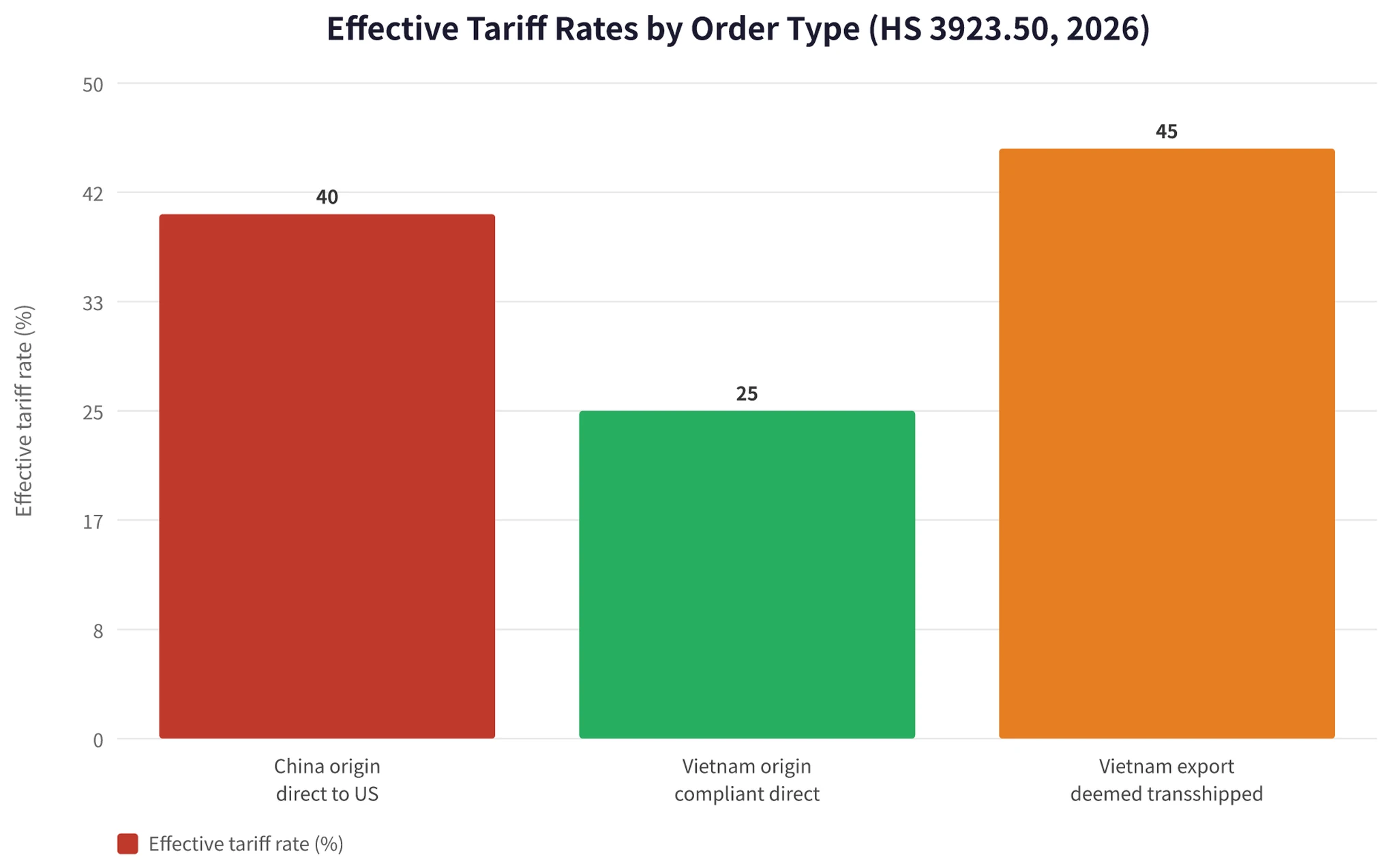
The 15-point duty gap is real. The business challenge is not the tariff itself. The real issue is making sure “Made in China” does not become “Made in Vietnam” on the Vietnam certificate of origin without meeting the legal threshold. Once that line is crossed, no tariff strategy will hold up.
2. The Capacity Ceiling in Vietnam—What Is Missing Behind 85 Injection Molding Machines
After tariffs, the next issue is capacity. Vietnam’s exports to the United States rose 26.4% year on year in the first eight months before 2025, which looks like a major production surge. But the growth was driven mainly by electronics and textiles that had already completed relocation. In categories still dominated by China, including cosmetic packaging, incremental order inflow into Vietnam remains limited.
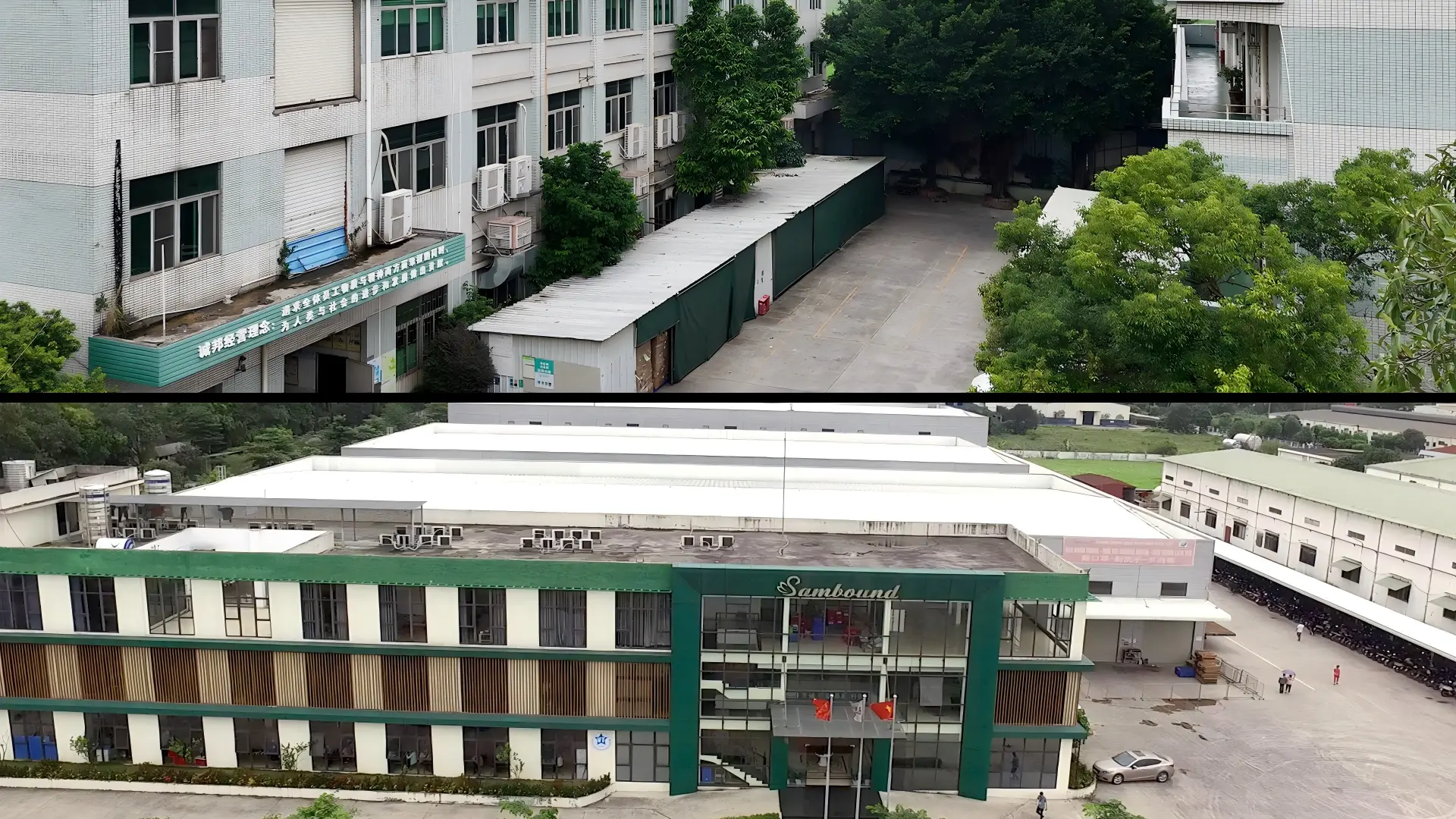
Vietnam’s local injection molding capacity is expanding. Hai Duong Province is a northern Vietnam cluster for injection molding and packaging, about 50 km from Hai Phong Port, which makes ocean export convenient. Large China-invested packaging plants have expanded there in recent years. One example is a Vietnam Hai Duong operation with a 36,000 m² plant, 85 injection molding machines, more than 2,000 employees, and independent operations. In Southeast Asia, that is already a mid-to-upper-tier integrated capacity setup.
But the real limit is not plant size. It is process-chain maturity. Cosmetic packaging is not a single process. Beyond injection molding, it also includes electroplating, vacuum metallization, spray coating, screen printing, hot stamping, and assembly. Today, the Vietnam factories that can truly complete the full chain of “injection molding + electroplating + screen printing + assembly” within one plant are still concentrated among Vietnam operations of large China-invested groups. Purely local Vietnamese packaging factories are still not at the same process depth. That is a factual observation, not a value judgment.
Vietnam’s labor-cost advantage is real. Manufacturing workers in Vietnam earn about $304-340 per month. Based on the nationwide Q1 2025 average of VND 8.3 million, that is about $321, or around $3 per hour. In China, plastic forming workers in Shenzhen at the P50 median earn about RMB 5,923 per month, which converts to about $845, or about $6.5 per hour. Vietnam’s labor cost is roughly half of China’s. But two points matter:
- Vietnam’s minimum wage rises another 7.2% in January 2026, and annual growth in manufacturing wages is running at 6-7%. The cost advantage is narrowing. This is no longer the 1:3 cost gap many China-invested factories saw when they moved into Vietnam in 2019.
- Cheap labor does not automatically mean lower unit cost. Rework, scrap, and cross-factory scheduling caused by an immature process chain give back part of the labor savings.
| Dimension | Typical China Factory | Typical Vietnam Factory |
|---|---|---|
| Plant size | About 25,000 m² | About 27,000-36,000 m² (China-invested operations in Vietnam) |
| Injection molding machines | 75 machines (Haitian/Toyo) | 60-85 machines, depending on the factory |
| Full process chain (electroplating/spray coating/screen printing) | Complete | Usually complete only in Vietnam plants of large China-invested groups |
| Monthly worker wage | $789-1043 | $304-340 |
| Annual wage growth | 5-8% | 6-7% (plus 7.2% minimum wage increase in 2026) |
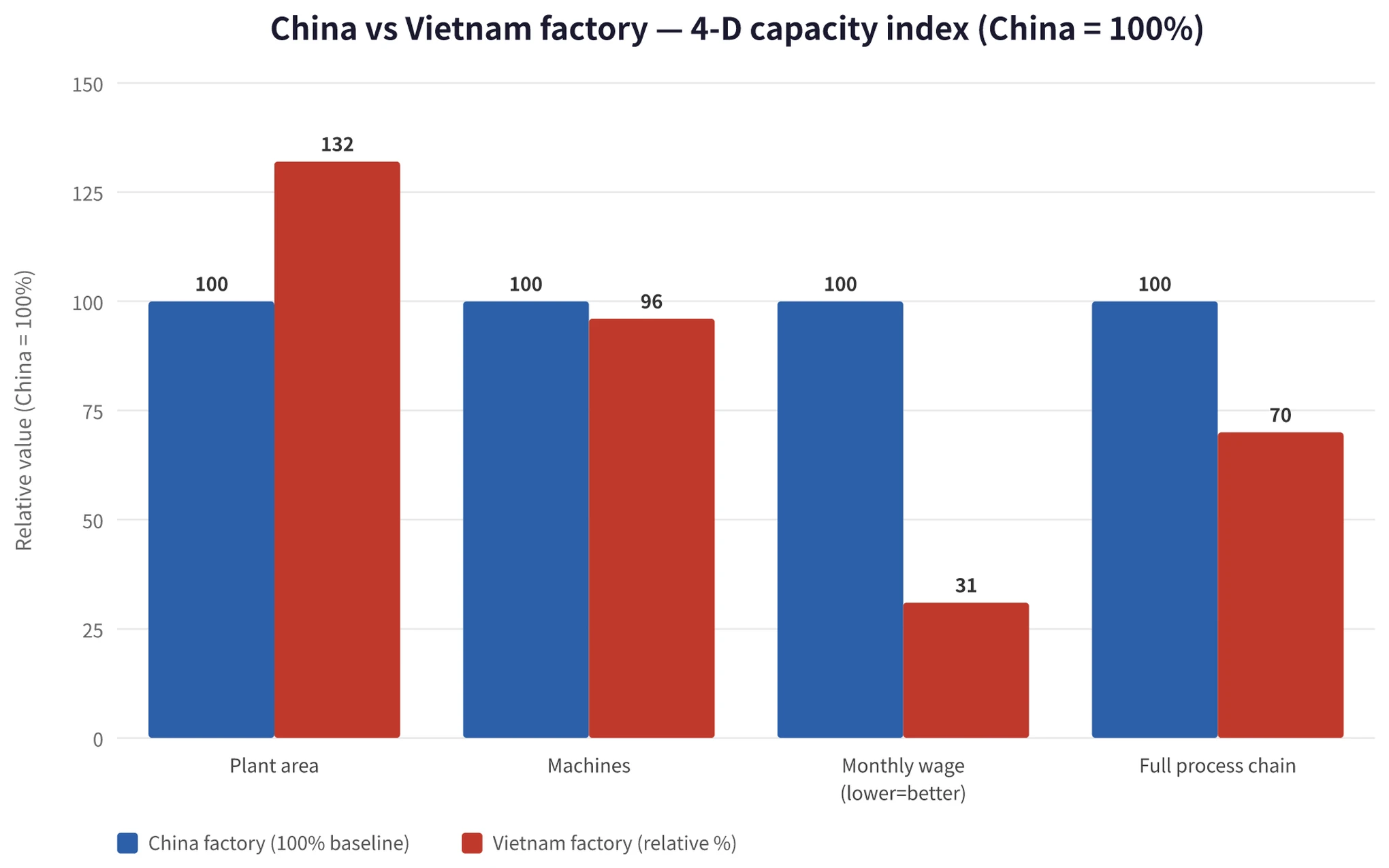
What can 85 injection molding machines handle? Standard lipstick tube shells, basic cushion compact designs, and large-volume Compact Powder Cases orders. Vietnam can do those. Private mold development, complex electroplating such as dual-layer or gradient finishes, multi-color screen printing, and synchronized multi-SKU production are another matter. The number of capable factories drops sharply. Capacity is not just about machine count. It is about how many process steps the factory can actually cover.
3. China’s Two Moats—Mold Development and Surface Finishing
Two strengths of China packaging factories are often underestimated: mold development and surface finishing. Neither can be built overnight. Both come from 20 years of accumulation.
On mold development, leading packaging factories in China typically have a 20-person design team and a 100-person mold manufacturing team, with a monthly mold output of 100-120 sets. Shared mold samples can be delivered in 7 days, and private mold development usually takes 25-30 days. That engineering capability is built on three to four decades of mold-industry depth in Dongguan, Suzhou, and Ningbo. CMM inspection, CNC machining, and trial molding parameter tuning are all mature. Few local Vietnam factories can complete the full mold-development cycle on their own. For private molds, buyers usually need either a China-invested Vietnam plant or a China base to open the mold first and then ship it to Vietnam.
Then there is surface finishing. Vacuum metallization, two-tone spray coating, screen-print registration accuracy, and hot-stamping alignment all depend on the product of three things: operator familiarity with the process, equipment condition, and the strictness of finished-goods inspection. China’s large packaging factories have built up 20 years of process databases—on which plating chemistry works reliably on which plastic substrate and which screen-print ink stays stable at which temperature. That database cannot simply be moved. A Vietnam factory can set up an electroplating line quickly, but getting stable good-part yield above 95% takes time. During that ramp-up period, scrap is a real cost.
Large packaging factories can reach a daily injection molding output of 800,000 to 1 million pcs. That is not just because they have many machines. It comes from optimized mold count, parallel process flow, and mold-change time. A Vietnam factory with a similar equipment scale often runs 30-50% lower daily output because mold-change times are longer and worker experience in fast machine setup is still being built.
China also has its weaknesses. Labor costs continue to rise, and environmental compliance costs are higher than in Vietnam. But for process-intensive orders, private mold projects, and multi-SKU synchronized production, China’s process depth in 2026 is still beyond what Vietnam can match in the short term.
4. Lead Times Depend on Batch Structure—Neither Poor for 10,000-Piece Orders nor Slow for 1 Million-Piece Containers
Ocean freight from China’s major ports—Shanghai, Shenzhen, and Ningbo—to the U.S. West Coast, including Los Angeles and Long Beach, typically takes 18-25 days. To the U.S. East Coast, including New York and Savannah, it takes 30-40 days. From Hai Phong or Ho Chi Minh City in Vietnam, shipping to the U.S. West Coast takes 20-30 days. To the U.S. East Coast, it usually takes 32-45 days with transshipment through Singapore or Busan. Vietnam is 5-7 days slower than China. That is a port-to-port difference, not “half a month later.”
| Port of Loading | U.S. West Coast (LA/LB) | U.S. East Coast (NY/SAV) |
|---|---|---|
| Shanghai | 18-22 days | 30-38 days |
| Shenzhen | 20-25 days | 32-40 days |
| Hai Phong (Northern Vietnam) | 20-28 days | 33-42 days |
| Ho Chi Minh City (Southern Vietnam) | 22-30 days | 35-45 days |
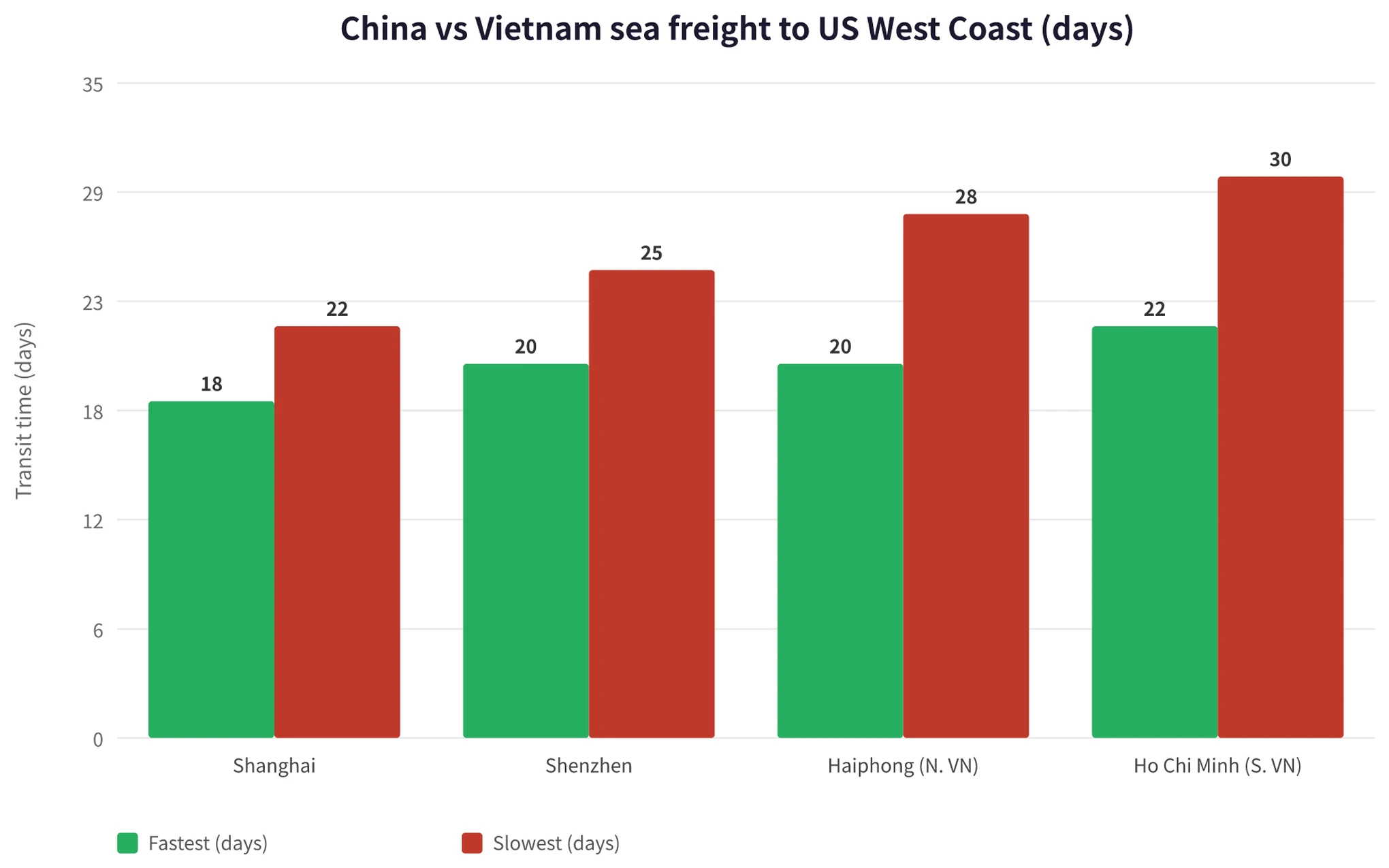
The 5-7 day gap matters in two situations.
First, urgent replenishment orders. During peak season, when a buyer needs one or two extra containers on short notice, those few extra days can make the difference between holding inventory and running out of stock. But with reasonable inventory planning, a 5-7 day gap can be covered through a stocking strategy.
Second, process-intensive orders. For an electroplated lipstick tube with a private mold, the typical cycle in China is 55-65 days from mold opening to first-batch delivery. That includes 25-30 days for mold development, 25-30 days for mass production, and 7 days for sampling. In Vietnam, the same type of order usually still requires the private mold to be opened in China first because local mold-engineering capability is often not enough. After that, the mold must be shipped to Vietnam for injection molding and electroplating. In this case, the total cycle is not just 5-7 days slower. It can become 5-10 days longer overall.
| Order Type | Typical China Lead Time | Typical Vietnam Lead Time | Real Gap |
|---|---|---|---|
| Shared mold + standard electroplating (high volume) | 35-45 days | 40-50 days | Vietnam is 5-7 days slower |
| Private mold + complex electroplating (mid volume) | 55-65 days | 60-75 days | Vietnam is not always slower; it depends on where the mold is made |
| Small replenishment orders (10,000-20,000 pcs) | 25-35 days | 30-40 days | Vietnam is 5-7 days slower |
The lead-time gap changes completely with the order type. A simple “Vietnam is 5-7 days slower” is not enough to decide where the order should go.
5. The Unfinished Capacity Equation—Cost, Tariffs, and Compliance Form a Triangle
The tariff, capacity, process, and lead-time issues all connect back to one question: if prices are similar and tariffs are closer than many people think, why split production between two countries at all? Because all three dimensions still matter.
Cost structure differs. Vietnam labor is about half of China’s, but the process chain is less mature. Trial molding yield is lower, scrap is higher, and cross-factory scheduling is more common. The real unit cost of a single lipstick tube at a large China factory is about $0.18-0.25. At a scaled Vietnam factory, it is about $0.16-0.22. The gap is not huge on its face. The larger difference comes from high-knowledge steps such as mold engineering, complex electroplating, and screen-print registration. There, the cost gap can widen to 20-40%.
The real tariff difference is also clear. Under HS 3923.50, the combined duty rate is about 40% for China and about 25% for Vietnam, a 15-point difference. On low-unit-value packaging such as injection-molded caps, that may mean only $0.005-0.01 per piece. On higher-value, process-intensive components such as multi-color electroplated lipstick tubes, it can mean $0.02-0.04 per piece. Orders with high tariff sensitivity gain more from Vietnam. Orders with low tariff sensitivity gain more from process depth than from tariff savings.
Compliance risk also differs. Export compliance from China is a standard operating model. The tariff structure has been stable for eight years, and exporters understand it well. Compliance on Vietnam exports is a newer framework. During 2025-2026, CBP has been issuing more detailed enforcement guidance on substantial transformation, and more ruling cases may appear over the next 12 months. Vietnam manufacturing carries higher compliance complexity than China manufacturing. If the order moves to Vietnam, one more layer of management cost has to be added.
So how should one order be split? The answer depends on how three factors overlap: process complexity × tariff sensitivity × compliance tolerance.
6. Three Order Types × Which Side to Choose—A Decision Table
Orders can be divided into three broad types, each with a different logic for choosing China, Vietnam, or both.
| Order Type | Handled by China Factory | Handled by Vietnam Factory | Split Within an Integrated Group |
|---|---|---|---|
| Shared mold + standard electroplating + high volume (100,000+ pcs) | Process capability is sufficient | More cost-effective because it saves 15 tariff points | Tariff-sensitive items in Vietnam, standard items in China |
| Private mold + complex electroplating + multi-SKU mid-volume (30,000-100,000 pcs) | Has the needed process depth | A single Vietnam factory may not keep up on process capability | Open the mold in China, shift mass electroplating production to Vietnam |
| Small-volume, high-frequency replenishment (≤30,000 pcs) | More MOQ-friendly | Also workable once the process is stable | Choose the side with the more reliable lead time |
A simplified version of the decision logic:
- Low order complexity, high tariff sensitivity → Vietnam
- High order complexity, low tariff sensitivity → China
- High complexity and high volume → split internally within an integrated group
What does an “integrated group” mean in practice? It means a China headquarters + Vietnam branch using the same mold drawings, the same quality system, and the same R&D team. Sambound follows exactly this structure: Dongguan Liaobu handles design, mold development, and complex processes, while Hai Duong handles high-volume standardized orders and tariff-sensitive orders. The process interfaces and quality-control systems are aligned across both factories. A mold opened in China can move to Vietnam without revalidation. The advantage of this structure is not simply that both sides can produce. It is that the group can schedule capacity internally and reduce single-country policy risk. For the buyer, the benefit is one contract and two factories, without building two separate supply chains.
Frequently Asked Questions
Will U.S. customers really specify “Made in Vietnam” on their own?
Yes, but not as often as many assume. After the U.S.-Vietnam agreement took effect in July 2025, the Reciprocal Tariff pushed the absolute duty level on Vietnam-made goods closer to the level China had before 2018, which narrowed the end-retail cost advantage of “Made in Vietnam.” In practice, customers are usually thinking about country-risk diversification — policy risk, pandemic risk, or strike risk tied to a single China-based supply chain—rather than simply assuming Vietnam is cheaper. In contracts that involve Vietnam production, a common origin clause is “country of origin as shown on shipping documents.” That leaves room for the factory and freight forwarder to choose the correct route without hard-coding “Made in Vietnam” into the contract.
Can Vietnam factories build private molds? How do lead times compare with China?
They can, but it depends on the factory. Vietnam branches of large China-invested groups can complete most private mold projects in 25-30 days, which is close to the standard China pace. Purely local Vietnamese packaging factories that can independently complete full private mold development are still limited in number. For complex molds, the safer route is usually to open the mold in China first and then ship it to Vietnam for mass production. In Sambound’s actual Hai Duong workflow, sending a mold from Dongguan Liaobu to Hai Duong, plus setup and tuning in Vietnam, takes about 7-10 days in total. That time should be built into the delivery schedule.
Is it feasible to move finished goods to a Vietnam factory for quality inspection?
Yes, but the workflow needs several verification checkpoints. First, place a China-side quality team at the Vietnam factory, typically with two to three people on site. Second, after the first small lot of 500-1,000 pieces is completed, send it back to China for 100% inspection and cross-check that the Vietnam factory is following the same inspection standard. Third, send 5-10% of finished goods from Vietnam back to China each month for quarterly audit review. Once these three checkpoints are working, the actual good-part yield of Vietnam mass production can stabilize above 95%. That is the real threshold in 2026. It is not a technical problem. It is a process problem.
If both China and Vietnam’s capacities are needed, how should a factory be selected?
Look at three points. First, is the Vietnam branch independently operated and independently licensed for export, rather than just acting as a simple contract processor? Sambound Hai Duong is an independent legal entity with export rights. Second, do the China headquarters and Vietnam branch share one quality system, including the same SOPs and the same QC team? Third, are mold data and product data shared inside one internal system, rather than passed back and forth by email? If all three conditions are met, using both sides is worth considering. If only two are met, the missing point should be strengthened. If only one is met, caution is the better choice.
How to move forward: If order volume is stable, a long-term framework agreement is in place, and tariffs account for more than 15% of the FOB quote, Vietnam is worth evaluating. If the order mix is mainly private molds and complex processes, and tariffs are not the top constraint, a China factory with a complete process chain is still the safer option. If the order structure is complex, SKU count is high, and the volume is also large, then a “China + Vietnam” integrated group is the path that can deliver returns over the next five to ten years. Sambound is already operating on that model—Dongguan Liaobu handles molds, electroplating, and complex orders, while Hai Duong handles high-volume standardized orders and tariff-sensitive orders. Both sides share the same mold drawings and the same quality system, leaving the final production allocation in the buyer’s hands.