Let’s clear up a common misconception first: magnetic and snap closures are not two different container types. Almost all standard eyeshadow palettes on the market are flip-top designs—the lid connects to the base with a hinge and does not come off. The real choice comes down to how the lid stays shut: a magnetic closure uses neodymium (NdFeB) magnets for a soft, quiet snap, while a snap closure relies on mechanical plastic latches that lock with a crisp click. Cost, service life, tactile feel, sealing, drop resistance, and sustainability all stem from this single engineering decision. There is no absolute “better” option—only the right fit for your product positioning.
Our team addresses this comparison several times every week. The answer is never just “personal preference.” Magnetic closures make sense for high-end gift sets, while snap latches work best for high-volume drugstore lines. Once you run the numbers on cost differences, cycle life, drop performance, tropical export risks, and refill systems, the right choice becomes obvious.
Both Styles Share the Same Flip-Top Foundation
To evaluate an eyeshadow palette, break its structure into two layers. The form factor layer defines how the lid and base connect. The industry standard is an integrated flip-top where the lid, base, and hinge are injection-molded as one continuous piece. The closure layer determines how the lid locks when closed. That is where magnetic and snap mechanisms diverge. A magnetic closure is not a separate box style—it is simply a latching method added to a hinged flip-top palette.
Why do many buyers assume “magnetic” means a detachable two-piece box? Because empty magnetic palettes exist on the market. These feature an exposed magnetic sheet inside a tray where aluminum pans stick for custom storage. That is an organizer tool, not a standard finished eyeshadow palette. If you produce pre-filled, hinged cosmetic packaging, “magnetic” refers strictly to the lid closure.
Another distinction to keep in mind: magnetic godet retention (securing the aluminum powder pan) is completely separate from lid closure. Magnetic godets create refillable systems and have nothing to do with how the lid shuts—a snap-closure palette can still use magnetic pans inside.
Why Magnetic Closures Cost More
Industry data indicates that magnetic closures carry a 40% to 50% cost premium over snap closures. That extra spend splits across three areas: manufacturing processes, raw magnet stock, and specialized alignment surfaces.
Manufacturers integrate magnets through four compliant production methods, each with a distinct cost profile:
- Insert Molding: The standard for premium packaging. Operators or robots place magnets into the mold before plastic injection, fully encapsulating them. This method costs more upfront because the tooling requires precise magnet pockets and pre-positioning fixtures.
- Post-Mold Snap-In: Plastic parts mold with dedicated retention clips, and operators press magnets into place afterward. Tooling costs less, but clips can loosen over repeated cycles.
- Post-Mold Press-Fit: Magnets press into tight-tolerance cavities using an interference fit. This keeps tooling simple but demands strict cavity tolerances and resin elasticity. Poor execution leads to loose magnets or cracked parts, as NdFeB is inherently brittle.
- Post-Mold Gluing: Structural adhesive bonds magnets into molded recesses. Tooling remains straightforward, but adhesives can degrade under exposure to cosmetic oils or alcohol, and assembly slows production throughput.
Beyond assembly methods, physical magnets add direct material costs. Standard N35 NdFeB magnets cost a few cents per point, and a pallet typically requires two to four points. Machining precision alignment posts and flush contact surfaces adds further tooling cost. At room temperature, N35 magnetic pull is more than strong enough for cosmetic compacts; jumping to N52 adds unnecessary expense.
Snap closures follow a much leaner cost model. The latch molds directly with the lid, base, and hinge in a single injection cycle. It requires zero extra hardware—only slight mold cavity modifications. That is why snap lids remain so cost-effective: they eliminate extra bill-of-materials items and secondary assembly steps.
Cycle Life Depends on the Hinge, Not the Latch
Many sourcing managers worry that plastic snaps will wear out or magnets will lose their pull. In practice, the primary wear point on a flip-top pallet is the hinge, not the closure mechanism.
Consider the shared hinge designs first. A well-designed polypropylene (PP) living hinge has a theoretical lifespan exceeding 1,000,000 cycles. With a web thickness held at 0.25 mm to 0.38 mm and proper post-mold flex conditioning, the hinge outlasts the cosmetic formula. Steel pin hinges follow a different standard: baseline specifications require 3,000 to 5,000 cycles (QB/T 1685-2006 for cosmetic compacts), while premium brand internal standards demand 10,000 or more cycles.
When evaluating the closures themselves, each has a specific vulnerability:
Snap closures face fatigue. Repeated latching concentrates stress at the cantilever root. Over extended cycles under cyclic load, microscopic stress cracks can develop. In a flip-top pallet, however, the snap only experiences stress at the exact moment of closing. Consumers open and close a daily palette just a few times a day—roughly a thousand cycles a year—staying well below the fatigue threshold of PP resin. When field latches snap, the root cause is almost always an incorrect wall thickness or mold tolerance error rather than a structural design flaw.
Magnetic closures face thermal risk. Magnets undergo zero mechanical friction during closure. At room temperature, NdFeB loses less than 0.1% of its field per decade. “Losing magnetism” simply does not happen under normal indoor conditions. However, high heat can cause permanent demagnetization, which requires careful grade selection.
In short: neither closure mechanism fails under normal consumer use if the hinge geometry and magnet thermal ratings match the operating environment.
Feature-by-Feature Comparison
| Evaluation Dimension | Magnetic Closure | Snap Closure |
|---|---|---|
| Unit Cost | Higher (+40% to 50%) | Near-zero add-on (integrated into molding) |
| Component Life | Zero mechanical wear; sensitive to heat | Root fatigue limit; easily outlasts daily use |
| Tactile Experience | Soft, silent snap with weighted, premium feel | Crisp mechanical click; tactile confirmation |
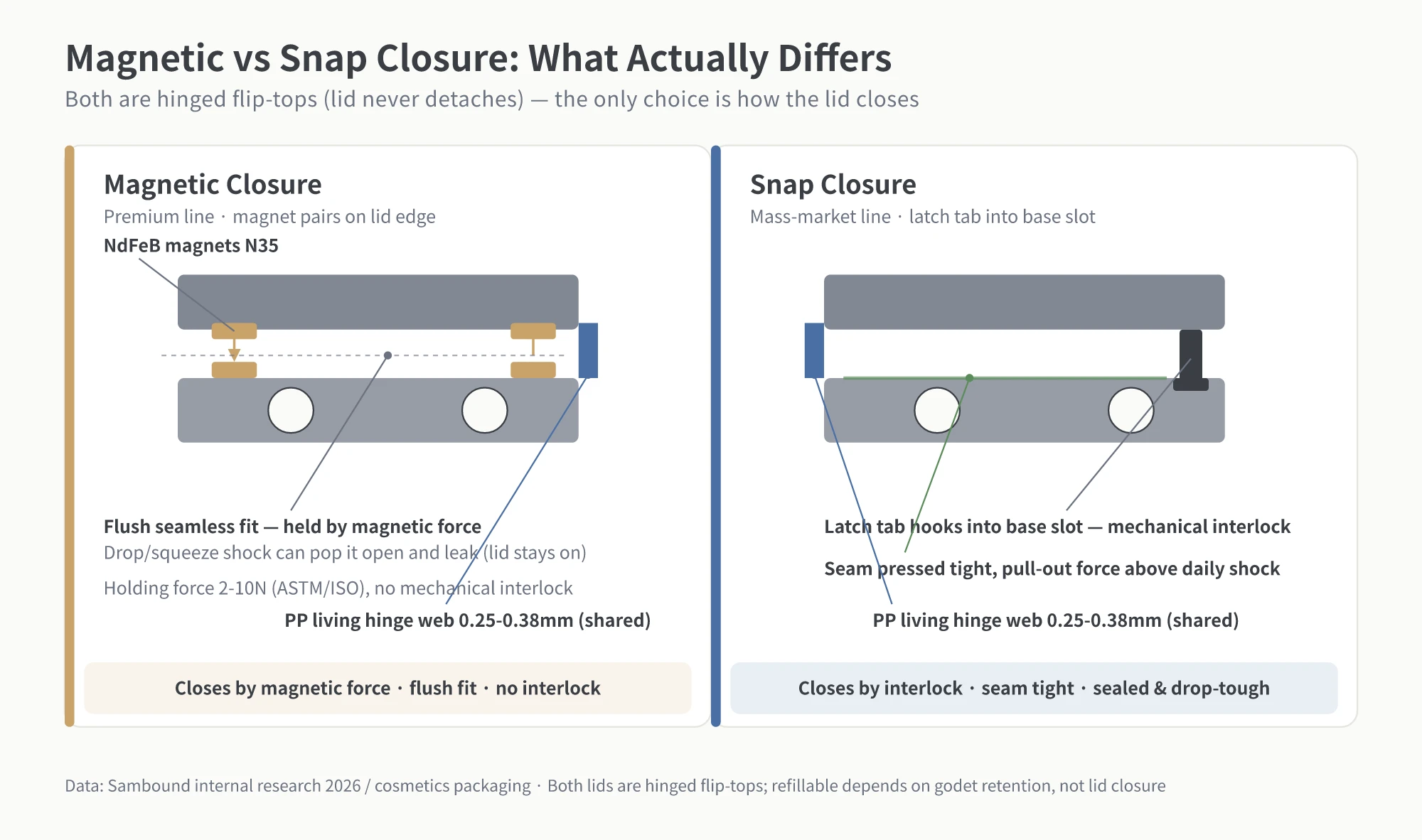
| Sealing & Retention | Flush magnetic hold; can pop open on impact | Mechanical interlock; stays shut under shock |
| Drop Performance | Shock can briefly separate the lid and spill powder | Positive interlock prevents accidental opening |
| Mono-Material Recycling | Magnets and steel plates contaminate the PP stream | All-PP construction enables 100% recycling |
Magnetic designs win on tactile luxury and brand perception. Snap designs lead in cost efficiency, mechanical retention, and impact resistance. Pick the option that matches your product tier.
Magnets Deliver Tactile Luxury
Prestige beauty brands choose magnetic closures primarily for consumer touchpoints, not structural strength.
The smooth, effortless shut; single-handed operation; and added physical weight signal luxury immediately. Packaging research shows consumers consistently rate magnetic compacts as higher value even when the cosmetic formula inside is identical. That 40% to 50% cost premium translates directly into retail price justification.
For holiday limited editions, high-end gift sets, and flagship collections, magnetic closures remain the industry standard among global prestige suppliers.
High-end performance requires strict magnetic pull calibration. Sambound tests and holds compact magnetic pull force between 2 N and 10 N (aligned with ASTM/ISO standards). Anything weaker pops open in a handbag; anything stronger makes the palette frustrating to open. Sourcing teams should verify this specification on prototype samples before approving tooling.
Snap Latches Power Mass-Market Volume
For drugstore retail, mass-market replenishment lines, and fast-moving retail channels, snap closures remain the default choice for three clear reasons.
First, cost efficiency. Because the snap molds directly with the hinge and body, unit costs drop significantly. Across a 12,000-piece minimum order quantity (MOQ) or annual volumes in the hundreds of thousands, saving a few cents per case directly protects gross margins.
Second, manufacturing tolerance forgiveness. Neither lid style leaks powder during normal use because internal godet retention rims and lid baffles shield the pressed cakes. The difference lies in the contact perimeter. A magnetic lid must sit perfectly flat; any warpage or uneven magnet height leaves visible gaps. A snap latch locks via a localized catch, making it far more tolerant of minor dimensional variations during high-speed injection molding.
Third, drop durability. In a vertical drop test, the kinetic shock on a magnetic pallet can overcome the magnetic field for a millisecond. The lid stays attached to the hinge, but the momentary gap lets powder dust escape. A mechanical snap latch resists shock forces far better, keeping the lid locked shut through baggage pressure and transit vibration.
Three Common Pitfalls with Magnetic Palettes
Upgrading to magnetic packaging requires tight quality control. Watch out for these three pitfalls:
Pitfall 1: Cheap surface-pasted magnets. While reputable packaging uses insert molding or pocketed retention, budget suppliers often glue raw magnet discs directly to flat outer walls without recess pockets. These dislodge easily under shear stress inside a makeup bag. To verify quality, check whether magnets are embedded, secured by molded ribs, and bonded with industrial structural adhesives rather than standard double-sided tape.
Pitfall 2: Flawed parting line alignment. Premium magnetic cases look seamless because the magnetic force pulls both halves into uniform contact. If the mold surface warps, or if magnet depths vary by even fractions of a millimeter, the lid will rock or show corner gaps. Cosmetic dust works into those openings over time, creating messy gaps after a month of consumer use.
Pitfall 3: High-temperature demagnetization. This issue catches experienced sourcing teams off guard during overseas shipping.
Selecting Magnets for Tropical Export and High-Heat Transit
Exporting to tropical regions, shipping summer retail inventory, or routing ocean containers through the Middle East and Southeast Asia requires careful magnet specification. Snap closures avoid this issue entirely, but magnetic designs demand attention to thermal limits.
A common mistake is assuming N52 outperforms N35 in high-heat environments.
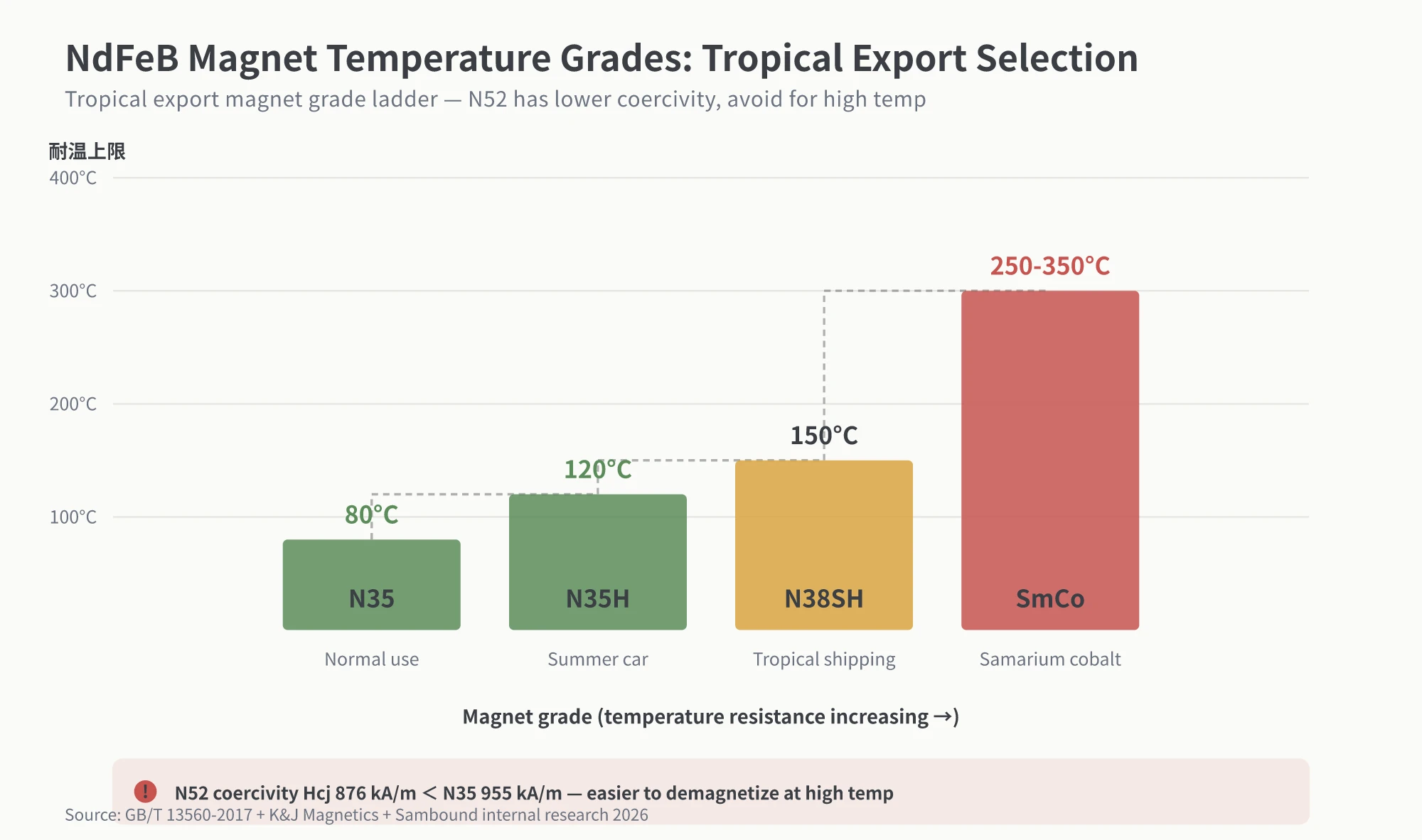
N52 delivers 40% to 50% higher maximum energy product than N35 (49.5 to 52 MGOe vs. 33 to 35 MGOe), providing stronger pull at ambient temperatures. However, standard N52 actually has lower intrinsic coercivity (Hcj) than N35—roughly 876 kA/m for N52 versus 955 kA/m for N35 (GB/T 13560-2017). Lower coercivity means N52 loses its magnetic field more easily under elevated temperatures.
NdFeB thermal behavior follows defined temperature thresholds (validated across GB/T 13560 and IEEE standards):
- Below 80 °C: Annual decay remains below 0.1%. Magnets retain full strength over decades of normal use.
- 80 °C to 150 °C: Pull force dips temporarily by 2% to 5%, recovering once the component cools.
- Above 150 °C: Irreversible magnetic loss begins.
- Curie Temperature (310 °C to 400°CC): Magnetism disappears permanently.
Enclosed shipping containers and vehicle interiors in hot climates reach 60 °C to 85 °C. For these environments, specify heat-resistant grades: upgrade from standard N35 (rated to 80 °C) to N35H (rated to 120 °C) or N38SH (rated to 150 °C). Samarium-Cobalt (SmCo) magnets handle 250 °C to 350 °C, but their steep cost is rarely justified for cosmetic cases.
In addition, specify Ni-Cu-Ni triple plating or epoxy coating on all NdFeB magnets. In humid, coastal climates, uncoated magnets suffer intergranular corrosion, leading to rapid magnetic decay. Standard pull-force tests during factory acceptance cannot detect missing protective plating.
Sustainability: Refillable vs. Recyclable
Sustainable packaging discussions often mix up refillable designs and post-consumer recycled (PCR) stream compatibility.
Refillability depends on godet retention. A stamped metal pan bonds to an internal magnet or drops into a modular tray so consumers can replace individual shades. You can pair a snap-closure lid with a magnetic internal pan base without paying for a magnetic outer lid.
Mono-material recycling depends entirely on the closure. Magnetic palettes cannot enter standard recycling streams because embedded magnets and steel strike plates contaminate recycled PP batches. For true circularity, brands use all-PP snap palettes: a PP living hinge, PP latch, PP godet frame, and ultrasonic assembly. This eliminates metal components.
Decision Matrix for Packaging Sourcing
Choose the closure that matches your brand tier, target margins, and sales channel:
- Prestige Gift Sets, Flagship Collections, and Holiday Limited Editions: Choose magnetic closures. The weighted hand feel and clean snap justify premium retail price points.
- High-Volume Mass Market, Drugstore Lines, and Core SKUs: Choose snap closures. You eliminate hardware costs, improve drop safety, and maximize margin on high-run volumes.
- Refillable Collections: Use magnetic godets inside the tray, but evaluate the lid closure independently. Pair a snap lid with magnetic pans to keep tooling and piece prices balanced.
- Travel-Friendly and Compact Products: Both styles work, but snap closures handle bag compression better. If selecting magnetic, use fully embedded dual-point magnets rather than single-point surface discs.
- High-Heat and Tropical Markets: Snap closures offer complete thermal reliability. If using magnets, specify N35H or N38SH grades with Ni-Cu-Ni corrosion plating.
- Circular Mono-Material Initiatives: Choose all-PP snap closures to meet curbside recycling standards without manual disassembly.
Tooling budgets also factor into this decision. Typical private molds for standard compact powder cases or cushion compacts run between $4,444 and $11,852, while complex multi-cavity eyeshadow palettes or refillable assemblies start around $14,815 across the industry. The tooling break-even point usually falls between 30,000 and 60,000 units. Because magnetic designs require insert-molding tooling modifications, upfront mold costs run higher. Choose your packaging architecture based on confirmed annual volume rather than projected future runs.
Neither closure style is universally superior. Provide your retail price target, distribution channels, projected volume, and export markets to Sambound, and our engineering team will provide tailored closure recommendations, magnet specifications, and testing protocols. Sambound supports standard MOQs starting at 12,000 units, tests magnetic retention between 2 N and 10 N, and verifies hinge durability to 10,000 cycles under brand quality standards. Send us your project requirements to review the ideal structure for your next launch.
Frequently Asked Questions
Do magnetic eyeshadow lids lose their magnetic pull over time?
Not under ambient indoor conditions. NdFeB magnets degrade less than 0.1% per decade below 80 °C, offering a functional lifespan of decades. Thermal exposure is the only real risk. If shipping through hot shipping containers or selling in regions where car interiors reach 60 °C to 85 °C, specify N35H or N38SH thermal grades. Avoid N52, as its lower coercivity makes it more prone to thermal demagnetization.
Will a snap closure loosen or break after repeated use?
Not under regular daily usage. In a hinged flip-top design, the snap latch experiences stress only during the moment of closing. Polypropylene handles millions of flex cycles before fatigue failure. In practice, field failures result from incorrect wall thicknesses or tight mold tooling rather than structural wear. Overall lifespan depends on the hinge: PP living hinges exceed 1,000,000 cycles, while steel pin hinges meet brand standards of 10,000 cycles (compared to the 3,000-to-5,000 industry baseline under QB/T 1685-2006).
Can a magnetic palette pop open and spill powder if dropped?
Yes, under sufficient impact. During a vertical drop, the shock momentum can briefly exceed the magnet’s retention force, causing the lid to part momentarily and release loose powder. The hinge keeps the lid attached, but powder can still escape. Snap closures maintain a positive mechanical interlock that holds up better against drops and bag compression.
What is the cost difference between magnetic and snap closures?
Industry estimates show magnetic closures carry a 40% to 50% total cost premium. That increase covers magnet procurement, insert molding or secondary placement labor, and precision surface alignment. Standard N35 magnets provide plenty of strength at normal temperatures, so upgrading to N52 adds unnecessary cost.
Does a refillable eyeshadow palette require a magnetic lid?
No. Refillability depends on how the godet (the metal powder pan) secures inside the base tray, which usually involves a bottom magnetic sheet. The lid closure is an independent mechanism. You can combine a snap lid with a magnetic pan base to save 40% to 50% on lid component costs. If aiming for 100% mono-material recycling, however, use an all-PP snap palette with non-magnetic mechanical pan clips.
How much does private mold tooling cost for a refillable magnetic palette?
Industry tooling for complex multi-cavity, refillable magnetic palettes typically starts around $14,815, compared to lower tooling costs for simpler snap compacts. The break-even volume for custom tooling generally sits between 30,000 and 60,000 units. For smaller runs, modifying standard stock molds is more economical.
What specifications are essential when exporting magnetic palettes to tropical climates?
Specify three key requirements: upgrade magnet resin grades to N35H (120 °C) or N38SH (150 °C) instead of N52; apply Ni-Cu-Ni triple electroplating or epoxy coatings to prevent intergranular moisture corrosion; and use embedded pockets rather than surface-glued discs. If you prefer to bypass thermal and corrosion testing entirely, a snap closure provides the most reliable alternative for high-heat markets.