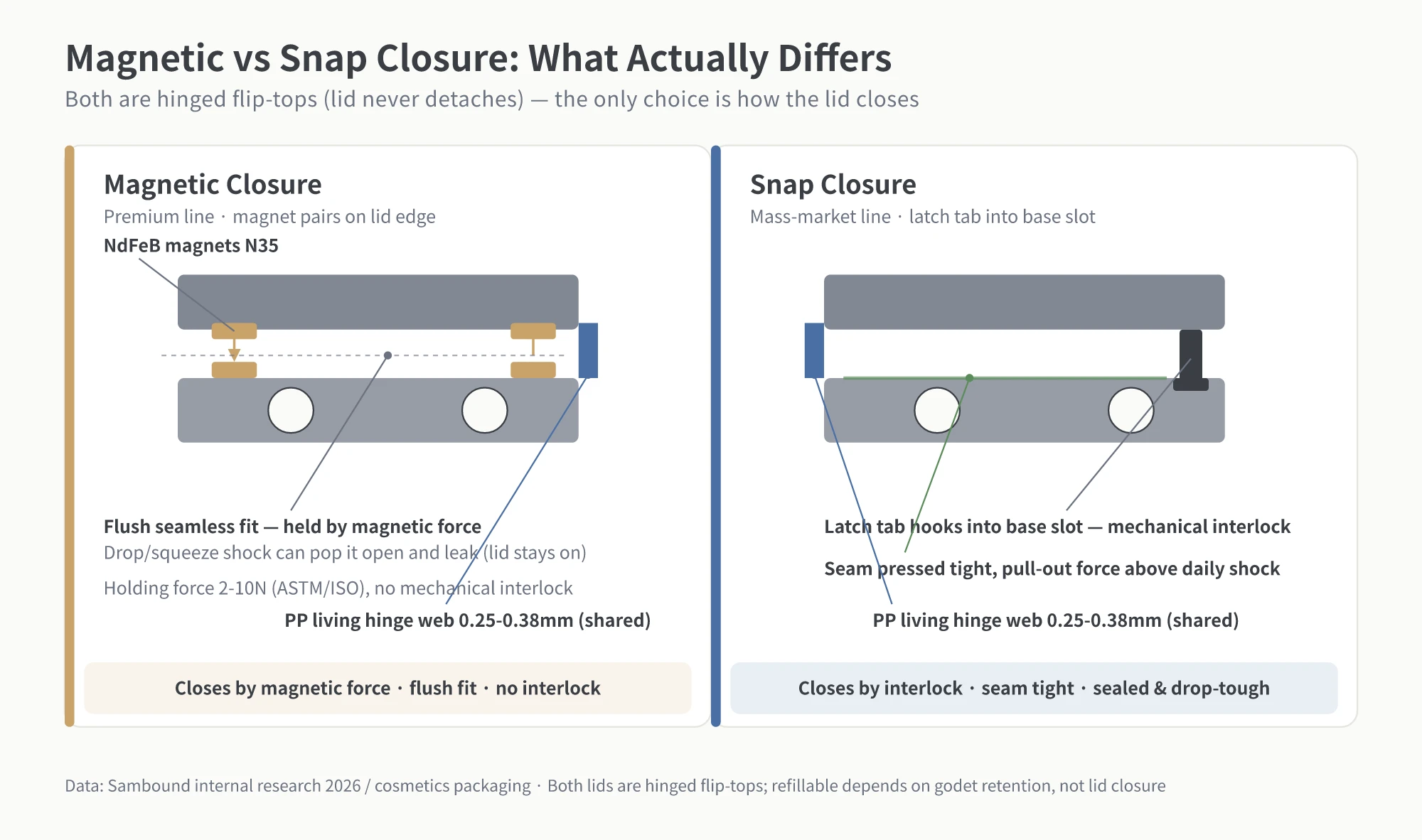
Lassen Sie uns zunächst ein häufiges Missverständnis ausräumen: Magnet- und Schnappverschlüsse sind keine zwei unterschiedlichen Behältertypen. Fast alle handelsüblichen Lidschattenpaletten auf dem Markt sind Klappdeckel-Designs – der Deckel ist über ein Scharnier mit der Basis verbunden und lässt sich nicht abnehmen. Die eigentliche Wahl liegt darin, wie der Deckel geschlossen bleibt: Ein Magnetverschluss verwendet Neodym-Magnete (NdFeB) für ein sanftes, leises Schließen, während ein Schnappverschluss auf mechanische Kunststoffriegel setzt, die mit einem deutlichen Klick einrasten. Kosten, Lebensdauer, Haptik, Dichtigkeit, Fallfestigkeit und Nachhaltigkeit resultieren alle aus dieser einen technischen Entscheidung. Es gibt keine absolut „bessere“ Option – nur die passende Lösung für Ihre Produktpositionierung.
Unser Team befasst sich mehrmals pro Woche mit diesem Vergleich. Die Antwort ist niemals nur „persönliche Präferenz“. Magnetverschlüsse sind sinnvoll für hochwertige Geschenksets, während Schnappverschlüsse am besten für Drogerieprodukte mit hohem Volumen geeignet sind. Sobald man die Zahlen für Kostenunterschiede, Lebensdauer, Fallleistung, Risiken beim Export in tropische Regionen und Nachfüllsysteme betrachtet, wird die richtige Wahl offensichtlich.
Beide Ausführungen basieren auf dem gleichen Klappdeckel-Design
Um eine Lidschattenpalette zu bewerten, unterteilen Sie ihre Struktur in zwei Schichten. DieFormfaktor-Schichtdefiniert, wie Deckel und Boden miteinander verbunden sind. Der Industriestandard ist ein integrierter Klappdeckel, bei dem Deckel, Boden und Scharnier als ein durchgehendes Stück spritzgegossen werden. DieVerschluss-Schichtbestimmt, wie der Deckel im geschlossenen Zustand verriegelt. Hier unterscheiden sich Magnet- und Schnappmechanismen. Ein Magnetverschluss ist kein separater Box-Stil – er ist lediglich eine Verschlussmethode, die einer aufklappbaren Lidschattenpalette hinzugefügt wird.
Warum gehen viele Käufer davon aus, dass „magnetisch“ eine abnehmbare zweiteilige Box bedeutet? Weil leere Magnetpaletten auf dem Markt existieren. Diese verfügen über eine freiliegende Magnetfolie in einer Schale, an der Aluminiumpfännchen für die individuelle Aufbewahrung haften. Das ist ein Organisationswerkzeug, keine standardmäßige fertige Lidschattenpalette. Wenn Sie vorgefüllte, aufklappbare Kosmetikverpackungen herstellen, bezieht sich „magnetisch“ ausschließlich auf den Deckelverschluss.
Ein weiterer wichtiger Unterschied: Die magnetische Godet-Halterung (zur Fixierung des Aluminium-Puderpfännchens) ist völlig unabhängig vom Deckelverschluss. Magnetische Godets ermöglichen Nachfüllsysteme und haben nichts damit zu tun, wie der Deckel schließt – eine Palette mit Schnappverschluss kann dennoch magnetische Pfännchen im Inneren verwenden.
Warum Magnetverschlüsse teurer sind
Branchenzahlen zeigen, dass Magnetverschlüsse einen Kostenaufschlag von 40% bis 50% gegenüber Schnappverschlüssen aufweisen. Diese Mehrkosten verteilen sich auf drei Bereiche: Fertigungsprozesse, Rohmaterial für Magnete und spezialisierte Ausrichtungsflächen.
Hersteller integrieren Magnete mittels vier gängiger Produktionsverfahren, jedes mit einem eigenen Kostenprofil:
- Umspritzen (Insert Molding):Der Standard für Premium-Verpackungen. Bediener oder Roboter platzieren Magnete vor dem Kunststoffspritzguss in die Form, um sie vollständig zu umschließen. Diese Methode verursacht höhere Anfangskosten, da das Werkzeug präzise Magnettaschen und Vorpositionierungsvorrichtungen erfordert.
- Nachträgliches Einrasten (Post-Mold Snap-In):Kunststoffteile werden mit speziellen Halteclips geformt, und Bediener drücken die Magnete anschließend ein. Die Werkzeugkosten sind geringer, aber die Clips können sich bei wiederholtem Gebrauch lockern.
- Nachträgliches Einpressen (Post-Mold Press-Fit):Magnete werden mittels Presspassung in Hohlräume mit engen Toleranzen eingesetzt. Dies vereinfacht den Werkzeugbau, erfordert jedoch strenge Hohlraumtoleranzen und eine hohe Harzelastizität. Eine mangelhafte Ausführung führt zu losen Magneten oder gesprungenen Teilen, da NdFeB von Natur aus spröde ist.
- Verkleben nach dem Formen:Strukturklebstoff verbindet Magnete in geformten Aussparungen. Der Werkzeugbau bleibt unkompliziert, jedoch können Klebstoffe bei Kontakt mit Kosmetikölen oder Alkohol degradieren, und die Montage verlangsamt den Produktionsdurchsatz.
Abgesehen von den Montagemethoden verursachen physische Magnete direkte Materialkosten. Standard-N35-NdFeB-Magnete kosten wenige Cent pro Magnetpunkt, und eine Kompaktdose benötigt typischerweise zwei bis vier Magnetpunkte. Die Bearbeitung von Präzisionsausrichtungsstiften und bündigen Kontaktflächen verursacht zusätzliche Werkzeugkosten. Bei Raumtemperatur ist die Magnetkraft von N35 mehr als ausreichend für Kosmetik-Kompaktdosen; der Wechsel zu N52 führt zu unnötigen Ausgaben.
Schnappverschlüsse folgen einem wesentlich schlankeren Kostenmodell. Der Riegel wird direkt mit dem Deckel, dem Boden und dem Scharnier in einem einzigen Spritzgusszyklus geformt. Es ist keine zusätzliche Hardware erforderlich – lediglich geringfügige Modifikationen der Formkavität. Deshalb bleiben Schnappdeckel so kostengünstig: Sie eliminieren zusätzliche Stücklistenpositionen und sekundäre Montageschritte.
Die Lebensdauer hängt vom Scharnier ab, nicht vom Verschluss
Viele Einkaufsleiter befürchten, dass Kunststoffschnappverschlüsse verschleißen oder Magnete ihre Anziehungskraft verlieren. In der Praxis ist der Hauptverschleißpunkt bei einer Klappdeckel-Kompaktdose dasScharnier, nicht der Verschlussmechanismus.
Betrachten Sie zunächst die gängigen Scharnierkonstruktionen. Ein gut konstruiertes Filmscharnier aus Polypropylen (PP) hat eine theoretische Lebensdauer von über 1.000.000 Zyklen. Bei einer Stegdicke von 0,25 mm bis 0,38 mm und einer ordnungsgemäßen Nachbehandlung zur Flexibilitätskonditionierung überdauert das Scharnier die Kosmetikformulierung. Stahlscharniere mit Stift folgen einem anderen Standard: Basisspezifikationen erfordern 3.000 bis 5.000 Zyklen (QB/T 1685-2006 für Kosmetikdosen), während interne Standards von Premiummarken 10.000 oder mehr Zyklen verlangen.
Bei der Bewertung der Verschlüsse selbst weist jeder eine spezifische Schwachstelle auf:
Schnappverschlüsse sind ermüdungsanfällig.Wiederholtes Verschließen konzentriert die Spannung an der Wurzel des Kragarms. Über längere Zyklen unter zyklischer Belastung können sich mikroskopische Spannungsrisse entwickeln. Bei einer Klapppalette erfährt der Schnappverschluss jedoch nur im genauen Moment des Schließens Spannung. Verbraucher öffnen und schließen eine tägliche Palette nur wenige Male am Tag – etwa tausend Zyklen pro Jahr – und bleiben damit weit unter der Ermüdungsgrenze des PP-Harzes. Wenn Schnappverschlüsse im Feld brechen, liegt die Ursache fast immer in einer falschen Wandstärke oder einem Formtoleranzfehler und nicht in einem strukturellen Konstruktionsfehler.
Magnetverschlüsse bergen ein thermisches Risiko.Magnete unterliegen beim Schließen keiner mechanischen Reibung. Bei Raumtemperatur verliert NdFeB weniger als 0,1% seines Feldes pro Jahrzehnt. Ein „Verlust des Magnetismus“ tritt unter normalen Innenraumbedingungen einfach nicht auf. Hohe Hitze kann jedoch eine dauerhafte Entmagnetisierung verursachen, was eine sorgfältige Auswahl der Güteklasse erfordert.
Kurz gesagt: Keiner der Verschlussmechanismen versagt bei normalem Gebrauch durch den Verbraucher, wenn die Scharniergeometrie und die Temperaturbeständigkeit der Magnete der Betriebsumgebung entsprechen.
Eigenschaften im Vergleich
| Bewertungskriterium | Magnetverschluss | Schnappverschluss |
|---|---|---|
| Stückkosten | Höher (+40% bis 50%) | Nahezu keine zusätzlichen Kosten (in den Formgebungsprozess integriert) |
| Bauteillebensdauer | Kein mechanischer Verschleiß; wärmeempfindlich | Ermüdungsgrenze; überdauert problemlos den täglichen Gebrauch |
| Haptisches Erlebnis | Sanftes, geräuschloses Schließen mit gewichtetem, hochwertigem Gefühl | Klares mechanisches Klicken; taktile Bestätigung |
| Abdichtung & Halt | Bündiger Magnethalt; kann bei Aufprall aufspringen | Mechanische Verriegelung; bleibt bei Stößen geschlossen |
| Sturzfestigkeit | Stoß kann den Deckel kurzzeitig trennen und Puder verschütten | Positive Verriegelung verhindert versehentliches Öffnen |
| Einstoff-Recycling | Magnete und Stahlplatten verunreinigen den PP-Strom | Eine reine PP-Konstruktion ermöglicht 100% Recycling |
Magnetverschluss-Designs punkten bei haptischem Luxus und Markenwahrnehmung. Schnappverschluss-Designs sind führend bei Kosteneffizienz, mechanischem Halt und Stoßfestigkeit. Wählen Sie die Option, die zu Ihrer Produktkategorie passt.
Magnete bieten haptischen Luxus
Prestige-Beauty-Marken wählen Magnetverschlüsse primär für die Kundenkontaktpunkte, nicht wegen der strukturellen Festigkeit.
Das sanfte, mühelose Schließen, die Einhandbedienung und das zusätzliche physische Gewicht signalisieren sofort Luxus. Verpackungsstudien zeigen, dass Verbraucher Magnet-Kompaktdosen durchweg als hochwertiger einstufen, selbst wenn die kosmetische Formulierung im Inneren identisch ist. Dieser Kostenaufschlag von 40% bis 50% lässt sich direkt in der Rechtfertigung des Einzelhandelspreises widerspiegeln.
Für limitierte Weihnachts-Editionen, hochwertige Geschenksets und Flaggschiff-Kollektionen bleiben Magnetverschlüsse der Industriestandard unter globalen Prestigelieferanten.
Hochwertige Leistung erfordert eine präzise Kalibrierung der Magnetzugkraft. Sambound testet und gewährleistet eine Magnetzugkraft von Kompaktpuderdosen zwischen 2 N und 10 N (gemäß ASTM/ISO-Standards). Eine schwächere Kraft würde dazu führen, dass sich die Dose in einer Handtasche öffnet; eine stärkere Kraft würde das Öffnen der Palette erschweren. Beschaffungsteams sollten diese Spezifikation an Prototypenmustern überprüfen, bevor sie die Werkzeuge freigeben.
Schnappverschlüsse für den Massenmarkt
Für den Drogeriehandel, Massenmarkt-Nachfülllinien und schnelllebige Einzelhandelskanäle bleiben Schnappverschlüsse aus drei klaren Gründen die Standardwahl.
Erstens, Kosteneffizienz. Da der Schnappverschluss direkt mit dem Scharnier und dem Gehäuse geformt wird, sinken die Stückkosten erheblich. Bei einer Mindestbestellmenge (MOQ) von 12.000 Stück oder jährlichen Mengen im sechsstelligen Bereich schützt das Sparen weniger Cents pro Einheit direkt die Bruttomargen.
Zweitens, Toleranz gegenüber Fertigungsabweichungen. Keiner der Deckelstile lässt im normalen Gebrauch Puder austreten, da interne Godet-Halteränder und Deckelblenden die gepressten Puder schützen. Der Unterschied liegt im Kontaktbereich. Ein Magnetdeckel muss perfekt flach aufliegen; jede Verformung oder ungleichmäßige Magnethöhe hinterlässt sichtbare Spalten. Ein Schnappverschluss rastet über einen lokalisierten Fangmechanismus ein, wodurch er bei geringfügigen Maßabweichungen während des Hochgeschwindigkeits-Spritzgusses wesentlich toleranter ist.
Drittens: Sturzfestigkeit. Bei einem vertikalen Falltest kann der kinetische Stoß auf eine magnetische Verpackung das Magnetfeld für eine Millisekunde überwinden. Der Deckel bleibt zwar am Scharnier befestigt, doch der kurzzeitige Spalt lässt Puderstaub entweichen. Ein mechanischer Schnappverschluss widersteht Stoßkräften wesentlich besser und hält den Deckel auch bei Gepäckdruck und Transportvibrationen fest verschlossen.
Drei häufige Fallstricke bei Magnetpaletten
Die Umstellung auf magnetische Verpackungen erfordert eine strenge Qualitätskontrolle. Achten Sie auf diese drei Fallstricke:
Fallstrick 1: Billige, oberflächlich aufgeklebte Magnete.Während renommierte Verpackungen Umspritzen oder eine Verankerung in Vertiefungen nutzen, kleben Billiganbieter oft rohe Magnetscheiben direkt auf flache Außenwände ohne Aussparungen. Diese lösen sich unter Scherkräften in einer Kosmetiktasche leicht. Um die Qualität zu überprüfen, prüfen Sie, ob die Magnete eingebettet, durch geformte Rippen gesichert und mit industriellen Strukturklebstoffen anstatt mit handelsüblichem doppelseitigem Klebeband verklebt sind.
Fallstrick 2: Mangelhafte Passgenauigkeit der Trennlinie.Hochwertige Magnetverpackungen wirken nahtlos, da die Magnetkraft beide Hälften in gleichmäßigen Kontakt zieht. Wenn sich die Formoberfläche verzieht oder die Magnettiefen selbst um Bruchteile eines Millimeters variieren, wackelt der Deckel oder zeigt Eckspalten. Kosmetikstaub dringt mit der Zeit in diese Öffnungen ein und erzeugt nach einem Monat Gebrauch durch den Verbraucher unschöne Spalten.
Falle 3: Entmagnetisierung bei hohen Temperaturen.Dieses Problem überrascht erfahrene Beschaffungsteams beim Überseetransport.
Magnetauswahl für tropischen Export und Hochtemperatur-Transport
Der Export in tropische Regionen, der Versand von Sommer-Einzelhandelsware oder die Routenführung von Seecontainern durch den Nahen Osten und Südostasien erfordert eine sorgfältige Magnetspezifikation. Schnappverschlüsse vermeiden dieses Problem vollständig, aber magnetische Designs erfordern Aufmerksamkeit bezüglich thermischer Grenzen.
Ein häufiger Fehler ist die Annahme, dass N52 bei hohen Temperaturen N35 übertrifft.
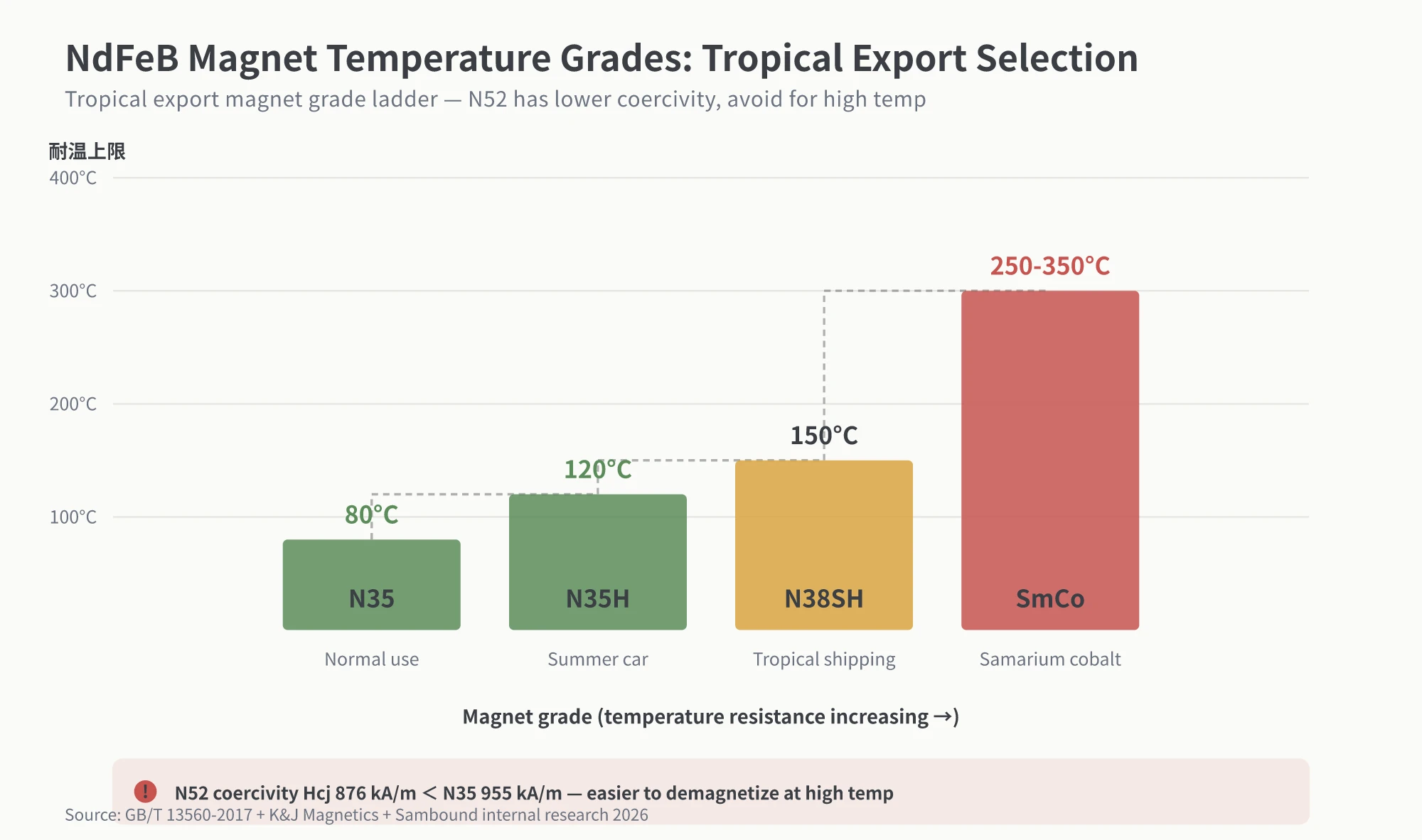
N52 liefert ein 40% bis 50% höheres maximales Energieprodukt als N35 (49,5 bis 52 MGOe gegenüber 33 bis 35 MGOe), was bei Umgebungstemperaturen eine stärkere Anziehungskraft bietet. Standard-N52 weist jedoch tatsächlich aufniedrigereintrinsische Koerzitivfeldstärke (Hcj) als N35 – etwa 876 kA/m für N52 gegenüber 955 kA/m für N35 (GB/T 13560-2017). Eine niedrigere Koerzitivfeldstärke bedeutet, dass N52 sein Magnetfeld bei erhöhten Temperaturen leichter verliert.
Das thermische Verhalten von NdFeB folgt definierten Temperaturschwellen (validiert nach GB/T 13560 und IEEE-Standards):
- Unter 80 °C:Der jährliche Abbau bleibt unter 0,1%. Magnete behalten ihre volle Stärke über Jahrzehnte des normalen Gebrauchs.
- 80 °C bis 150 °C:Die Anziehungskraft sinkt vorübergehend um 2% bis 5% und erholt sich, sobald das Bauteil abkühlt.
- Über 150 °C:Irreversibler Magnetisierungsverlust beginnt.
- Curie-Temperatur (310 °C bis 400 °C):Der Magnetismus verschwindet dauerhaft.
Geschlossene Versandbehälter und Fahrzeuginnenräume in heißen Klimazonen erreichen Temperaturen von 60 °C bis 85 °C. Für diese Umgebungen sollten hitzebeständige Güteklassen spezifiziert werden: Rüsten Sie von der Standardgüte N35 (ausgelegt bis 80 °C) auf N35H (ausgelegt bis 120 °C) oder N38SH (ausgelegt bis 150 °C) auf. Samarium-Kobalt-Magnete (SmCo) halten Temperaturen von 250 °C bis 350 °C stand, doch ihre hohen Kosten sind für Kosmetikverpackungen selten gerechtfertigt.
Spezifizieren Sie zusätzlich eine Ni-Cu-Ni-Dreifachbeschichtung oder eine Epoxidharzbeschichtung für alle NdFeB-Magnete. In feuchten Küstenklimazonen leiden unbeschichtete Magnete unter interkristalliner Korrosion, was zu einem schnellen Magnetisierungsverlust führt. Standard-Zugkrafttests bei der Werksabnahme können fehlende Schutzbeschichtungen nicht erkennen.
Nachhaltigkeit: Wiederbefüllbar vs. Recycelbar
Diskussionen über nachhaltige Verpackungen verwechseln oft nachfüllbare Designs mit der Kompatibilität für Post-Consumer-Recycling (PCR)-Ströme.
Nachfüllbarkeithängt von der Godet-Haltbarkeit ab. Eine gestanzte Metallpfanne haftet an einem internen Magneten oder wird in eine modulare Schale eingesetzt, sodass Verbraucher einzelne Farbtöne ersetzen können. Sie können einen Schnappverschlussdeckel mit einer magnetischen internen Pfannenbasis kombinieren, ohne für einen magnetischen Außendeckel bezahlen zu müssen.
Einstoff-Recyclinghängt vollständig vom Verschluss ab. Magnetische Paletten können nicht in die üblichen Recyclingströme gelangen, da eingebettete Magnete und Stahlkontaktplatten recycelte PP-Chargen kontaminieren. Für eine echte Kreislaufwirtschaft setzen Marken auf reine PP-Schnapppaletten: ein PP-Filmscharnier, einen PP-Riegel, einen PP-Godetrahmen und Ultraschallmontage. Dies eliminiert Metallkomponenten.
Entscheidungsmatrix für Verpackungsbeschaffung
Wählen Sie den Verschluss, der zu Ihrer Markenpositionierung, Ihren Zielmargen und Ihrem Vertriebskanal passt:
- Prestige-Geschenksets, Flaggschiff-Kollektionen und limitierte Weihnachts-Editionen:Wählen Sie Magnetverschlüsse. Das gewichtete Handgefühl und der präzise Schnappverschluss rechtfertigen höhere Verkaufspreise im Premiumsegment.
- Großvolumiger Massenmarkt, Drogerie-Sortimente und Kernprodukte (SKUs):Wählen Sie Schnappverschlüsse. Sie eliminieren Hardwarekosten, verbessern die Fallsicherheit und maximieren die Marge bei hohen Produktionsvolumen.
- Nachfüllbare Kollektionen:Verwenden Sie magnetische Godets im Inneren der Palette, bewerten Sie jedoch den Deckelverschluss separat. Kombinieren Sie einen Schnappdeckel mit magnetischen Pfännchen, um Werkzeug- und Stückkosten ausgewogen zu halten.
- Reisefreundliche und kompakte Produkte:Beide Verschlussarten sind geeignet, jedoch halten Schnappverschlüsse dem Druck in Taschen besser stand. Wenn Sie sich für Magnetverschlüsse entscheiden, verwenden Sie vollständig eingebettete Zwei-Punkt-Magnete anstelle von einzelnen Oberflächenmagneten.
- Märkte mit hohen Temperaturen und tropische Regionen:Schnappverschlüsse bieten vollständige thermische Zuverlässigkeit. Bei der Verwendung von Magneten sollten N35H- oder N38SH-Qualitäten mit Ni-Cu-Ni-Korrosionsbeschichtung spezifiziert werden.
- Initiativen für zirkuläre Monomaterialien:Wählen Sie reine PP-Schnappverschlüsse, um die Recyclingstandards für die Wertstoffsammlung zu erfüllen, ohne dass eine manuelle Demontage erforderlich ist.
Werkzeugkosten sind ebenfalls ein entscheidender Faktor. Typische private Formen für Standard-Kompaktpuderdosen oder Cushion-Compact-Verpackungen liegen preislich zwischen $4,444 und $11,852, während komplexe Lidschattenpaletten mit mehreren Kavitäten oder nachfüllbare Systeme branchenweit bei etwa $14,815 beginnen. Der Break-Even-Punkt für Werkzeuge liegt in der Regel zwischen 30.000 und 60.000 Einheiten. Da magnetische Designs Änderungen an den Werkzeugen für das Umspritzen erfordern, sind die anfänglichen Formkosten höher. Wählen Sie Ihre Verpackungsarchitektur basierend auf dem bestätigten Jahresvolumen und nicht auf prognostizierten zukünftigen Auflagen.
Keine Verschlussart ist universell überlegen. Teilen Sie Sambound Ihr Ziel für den Verkaufspreis, Ihre Vertriebskanäle, das prognostizierte Volumen und Ihre Exportmärkte mit, und unser Ingenieurteam wird Ihnen maßgeschneiderte Verschluss-Empfehlungen, Magnetspezifikationen und Prüfprotokolle unterbreiten. Sambound unterstützt Standard-Mindestbestellmengen (MOQs) ab 12.000 Einheiten, prüft die magnetische Haltekraft zwischen 2 N und 10 N und verifiziert die Scharnierhaltbarkeit bis zu 10.000 Zyklen gemäß den Qualitätsstandards der Marke. Senden Sie uns Ihre Projektanforderungen, um die ideale Struktur für Ihre nächste Produkteinführung zu besprechen.
Häufig gestellte Fragen
Verlieren magnetische Lidschatten-Deckel mit der Zeit ihre magnetische Anziehungskraft?
Nicht unter normalen Raumbedingungen. NdFeB-Magnete bauen unter 80 °C weniger als 0,1% pro Jahrzehnt ab und bieten eine funktionale Lebensdauer von Jahrzehnten. Thermische Belastung ist das einzige wirkliche Risiko. Beim Versand durch heiße Versandcontainer oder beim Verkauf in Regionen, in denen Fahrzeuginnenräume 60 °C bis 85 °C erreichen, sollten Sie thermische Güteklassen wie N35H oder N38SH angeben. Vermeiden Sie N52, da seine geringere Koerzitivfeldstärke es anfälliger für thermische Entmagnetisierung macht.
Wird ein Schnappverschluss nach wiederholtem Gebrauch locker oder bricht er?
Nicht bei regelmäßigem täglichem Gebrauch. Bei einem Klappdeckel-Design mit Scharnier wird der Schnappverschlussmechanismus nur im Moment des Schließens beansprucht. Polypropylen hält Millionen von Biegezyklen stand, bevor es zu einem Ermüdungsbruch kommt. In der Praxis resultieren Ausfälle eher aus falschen Wandstärken oder zu engen Formwerkzeugen als aus strukturellem Verschleiß. Die Gesamtlebensdauer hängt vom Scharnier ab: PP-Folien-/Integralscharniere übertreffen 1.000.000 Zyklen, während Stahlstiftscharniere die Markenstandards von 10.000 Zyklen erfüllen (im Vergleich zum Industriestandard von 3.000 bis 5.000 Zyklen gemäß QB/T 1685-2006).
Kann eine Magnetpalette beim Herunterfallen aufspringen und Puder verschütten?
Ja, bei ausreichendem Aufprall. Bei einem vertikalen Fall kann der Stoßimpuls kurzzeitig die Haftkraft des Magneten übersteigen, wodurch sich der Deckel kurzzeitig öffnet und loser Puder freigesetzt wird. Das Scharnier hält den Deckel zwar befestigt, aber Puder kann dennoch entweichen. Schnappverschlüsse bieten eine positive mechanische Verriegelung, die Stürzen und dem Druck in der Tasche besser standhält.
Wie groß ist der Kostenunterschied zwischen Magnet- und Schnappverschlüssen?
Branchenschätzungen zeigen, dass Magnetverschlüsse einen Gesamtkostenaufschlag von 40% bis 50% mit sich bringen. Dieser Anstieg deckt die Magnetbeschaffung, das Einlegeumspritzen oder den Arbeitsaufwand für die Sekundärplatzierung sowie die präzise Oberflächenausrichtung ab. Standard-N35-Magnete bieten bei normalen Temperaturen ausreichend Haftkraft, sodass ein Upgrade auf N52 unnötige Kosten verursacht.
Benötigt eine nachfüllbare Lidschattenpalette einen magnetischen Deckel?
Nein. Die Nachfüllbarkeit hängt davon ab, wie das Godet (das Metall-Puderpfännchen) in der Bodenschale befestigt wird, was üblicherweise eine untere Magnetfolie beinhaltet. Der Deckelverschluss ist ein unabhängiger Mechanismus. Sie können einen Schnappverschlussdeckel mit einer magnetischen Pfännchenbasis kombinieren, um 40% bis 50% der Kosten für Deckelkomponenten einzusparen. Wenn Sie jedoch ein 100% Monostoff-Recycling anstreben, verwenden Sie eine reine PP-Palette mit Schnappverschluss und nicht-magnetischen mechanischen Pfännchenhalterungen.
Wie hoch sind die Kosten für kundenspezifische Werkzeuge für eine nachfüllbare Magnetpalette?
Branchenübliche Werkzeugkosten für komplexe Mehrfachkavitäten-Nachfüllpaletten mit Magnetverschluss beginnen typischerweise bei $14.815, verglichen mit geringeren Werkzeugkosten für einfachere Kompaktpuderdosen mit Schnappverschluss. Das Amortisationsvolumen für kundenspezifische Werkzeuge liegt im Allgemeinen zwischen 30.000 und 60.000 Einheiten. Für kleinere Auflagen ist die Anpassung von Standard-Lagerwerkzeugen wirtschaftlicher.
Welche Spezifikationen sind beim Export von Magnetpaletten in tropische Klimazonen unerlässlich?
Geben Sie drei wichtige Anforderungen an: Rüsten Sie die Magnetmaterialgüten auf N35H (120 °C) oder N38SH (150 °C) anstelle von N52 auf; wenden Sie eine Ni-Cu-Ni Dreifach-Galvanisierung oder Epoxidbeschichtungen an, um intergranulare Feuchtigkeitskorrosion zu verhindern; und verwenden Sie eingebettete Taschen anstelle von oberflächenverklebten Scheiben. Wenn Sie Hitze- und Korrosionstests vollständig umgehen möchten, bietet ein Schnappverschluss die zuverlässigste Alternative für Märkte mit hohen Temperaturen.