In 2025, online sales for cushion foundations in China grew 37.3% year-over-year. During the same period, China’s total omnichannel cosmetics market grew just 2.8%. For a subcategory to outpace the broader beauty market by thirteen times proves that cushion packaging is far from fading. However, the market looks very different from it did a decade ago. Back then, Korean brands dominated, the Chinese market drove demand, and major Western brands watched from the sidelines. Today, all three dynamics have shifted: Korean brands retreated from China, the growth engine moved to Western markets, and legacy conglomerates rolled out their lines. The category is growing, but the playbook has changed.
Consumer interest remains high. On Reddit, a 2026 discussion asking whether cushion foundations are still worth buying generated dozens of responses. YSL and L’Oréal Paris both launched new cushion products in 2026. For beauty brands, the key question is no longer whether cushions are viable but where they are growing, where demand is slowing down, and where to invest next. The data answers these questions clearly.
Global Market Size: $2.8 Billion to $5.1 Billion
The global cushion foundation market was valued between $2.8 billion and $5.1 billion in 2025. Although market research firms report different figures, their direction aligns: the category is expanding at a compound annual growth rate (CAGR) of 6.8% to 9.95%.
These figures come from Dataintelo, MarketIntelo, and SkyQuest, all using 2025 as their base year. The variation is normal: research firms define category boundaries differently, especially regarding whether refills and sunscreen cushions are counted. When evaluating market reports, verify that the base year and product scope are clearly defined and check numbers against peer benchmarks. Outlier reports claiming valuations above $10 billion should be set aside.
For brand managers, this range ($2.8B to $5.1B, equivalent to roughly $2.96 billion to $5.33 billion at current exchange rates) signals an established category growing at a healthy single-digit pace. It is neither a temporary fad nor a declining format. When preparing business cases, citing this range with clear base years provides a solid baseline for executive decisions.
Unit Sales: Hero Products Reach Tens of Millions
Revenue figures show market value, but unit volume reveals true manufacturing throughput. Most industry reports focus solely on revenue, so tracking unit milestones from public brand releases is essential.
Amorepacific launched the first commercial cushion compact under IOPE in March 2008. Over its first eight years (through April 2016), IOPE sold 30 million units—averaging one unit every eight seconds. By the end of 2015, cumulative sales for that single product reached 659 billion KRW (approximately $518.52 million). Amorepacific’s HERA Black Cushion, launched in 2017, reached 10 million units through brand channels within seven years (as of February 2024). Newer challenger TIRTIR surpassed 13 million units globally for its Mask Fit Red Cushion by November 2025, generating 70% of its revenue outside its home market.
These volumes show that cushion compacts function as long-term core SKUs. Supply chains can plan production capacity around sustained demand, allowing brands to amortize tooling investments over millions of units—a very different financial model than short-lived seasonal drops.
Regional Breakdown: Growth Zones vs. Declining Channels
Global averages provide a high-level view, but regional performance drives supply chain decisions. Dataintelo estimates that Asia-Pacific accounts for nearly half (48.6%) of global cushion revenue. However, growth patterns across Asian markets have split sharply.
| Market | Key Data | Trend |
|---|---|---|
| China | Online cushion sales up 37.3% (2025); holds second place in base makeup with 21% share | Rapid domestic expansion |
| K-Beauty in China | Share of Korean cosmetic exports to China dropped from over 50% to 17.7% (2025); Amorepacific Greater China fell for three consecutive quarters in 2024 | Broad retreat from retail channels |
| South Korea Domestic | Duty-free retail sales cut nearly in half over six years; Korea Customs Service set purchase limits | Volume channel contraction |
| North America & Europe | Amorepacific revenue grew 56.5% in the Americas and 63.3% in EMEA (Q2 2026) | Secondary growth wave |
| Southeast Asia | Mandatory halal certification in Indonesia starting October 2026 | Regulatory threshold with rising demand |
China leads this growth cycle. In 2025, online cushion sales increased 37.3% year-over-year, outpacing all other base makeup formats and nearly quadrupling the broader online beauty market growth rate (+9.7%). Liquid foundation accounts for 40% of the base makeup sector, while cushion compacts hold second place with a 21% share. Chinese brands have refined their execution: Mao Geping sold over 200,000 units of its radiant glow cushion (per Jiemian News), proving that domestic brands can turn cushion formats into hero products. For suppliers and brands, expansion opportunities lie directly with domestic players.
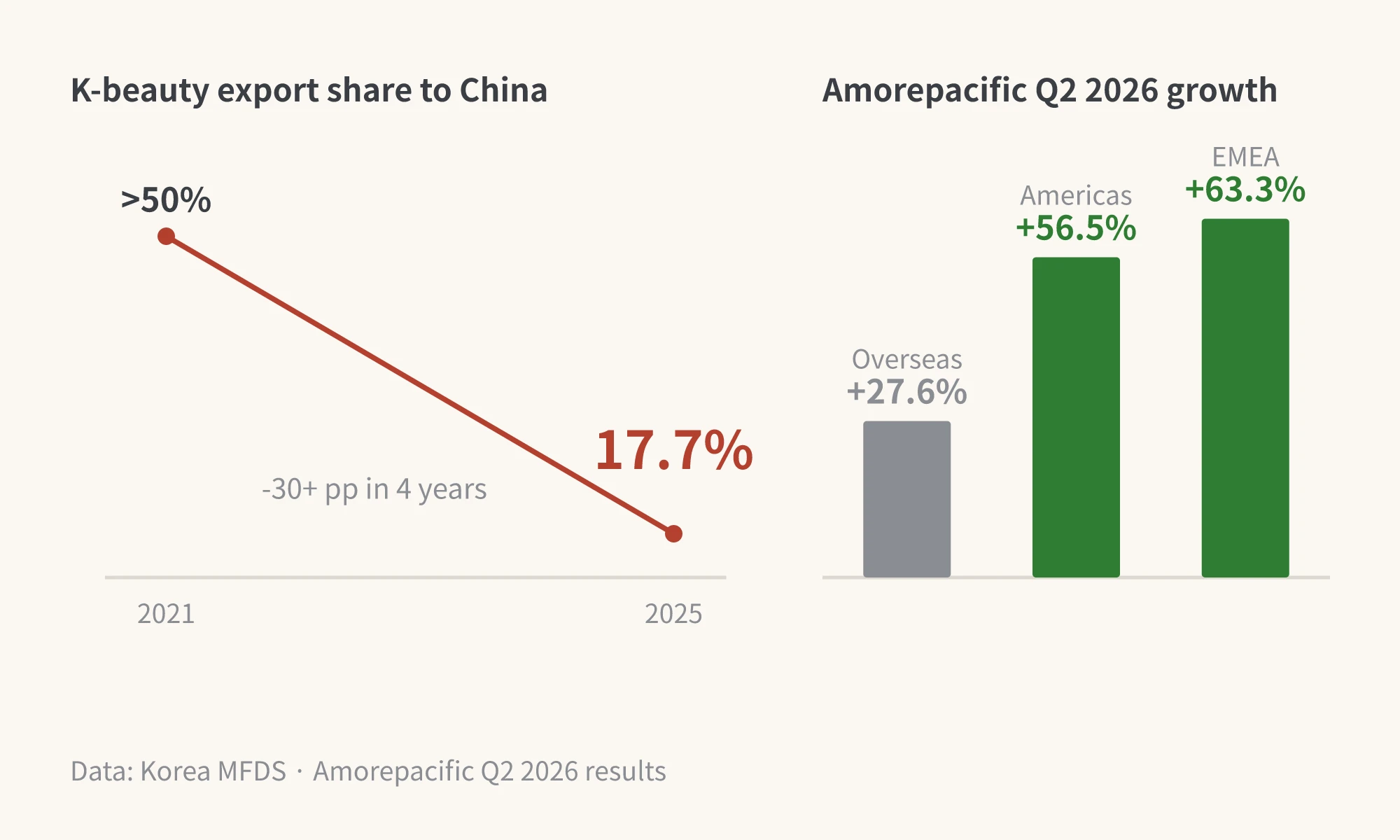
The retreat of K-beauty in China represents the most visible shift. China’s share of total South Korean cosmetics exports fell from over 50% in 2021 to 17.7% in 2025—a decline of more than thirty percentage points in four years, according to South Korea’s Ministry of Food and Drug Safety (MFDS). Total Korean cosmetic exports to China reached $2.018 billion in 2025, down 19.0% year-over-year. AmorePacific’s Greater China revenue dropped for three straight quarters in 2024, falling up to 44% in a single quarter. In 2025, over 30 foreign beauty brands exited China, mostly from Japan and Korea. While some interpret these numbers as a decline in the cushion format, the loss belongs to specific import brands. The format itself is growing in China, driven by domestic labels.
South Korea’s domestic retail faces similar pressure. Total duty-free sales fell by nearly half compared to six years ago. The Korea Customs Service implemented a 50-item purchase limit per brand to prevent grey-market reselling. Duty-free was a prime volume channel during the 2017–2019 K-beauty peak. With that channel halved, demand supported by reseller networks will not return quickly.
North America and Europe represent the newest expansion zones. AmorePacific’s Q2 2026 overseas revenue grew 27.6%, with the Americas up 56.5% and EMEA surging 63.3%. Korean industry media described this transition as “less China, more America.” The Business of Fashion noted that after establishing dominance in Asia, cushion foundations are going global. For beauty brands, the window of entry is open now before major retail channels become saturated.
Southeast Asia combines strict regulatory standards with strong growth potential. Indonesia requires all commercial cosmetics to obtain halal certification starting October 17, 2026, making certification mandatory for access to the world’s largest Muslim market. Market research firm CMI projects Southeast Asia’s halal beauty market (including skincare, makeup, and cushions) to grow at 11.2%, exceeding the global average for cushion products. Brands entering the region must build compliance timelines into early packaging and formulation planning.
Three Industry Shifts and Strategic Responses
Since 2024, three clear trends have reshaped how cushion products are packaged and marketed.
1. Refillable Systems: From Eco-Concept to Core Business
Refillable systems have moved from an environmental marketing angle into a standard commercial requirement. The global refillable cushion foundation market is valued at $1.9 billion in 2026 and is projected to reach $3.45 billion by 2034, growing at an 8.0% CAGR. Consumer demand and regulatory mandates drive this momentum. The European Union’s Packaging and Packaging Waste Regulation (PPWR) took effect in August 2026, requiring all packaging to be recyclable by January 1, 2030. Refillable designs offer brands an immediate path to compliance in European retail.
Packaging supply chains have adapted quickly. AmorePacific now treats refillable formats as a standard SKU setup, and HERA’s third-generation Black Cushion incorporates post-consumer recycled (PCR) resin into its outer case. Product teams should engineer new compacts with modular refill capabilities from the start, especially for Western exports. Making these tooling decisions now ensures compliance costs are fully amortized before 2030.
2. Expanding Formulations: Sunscreen and Mesh Formats
Cushion packaging has evolved from a simple foundation compact into a versatile delivery system for liquid formulas. In 2025, Korean brands introduced SPF50+ sunscreen cushions, turning portable sun protection into a high-demand subcategory. Western beauty media covered the trend widely, sparking discussion around application thickness and UV protection levels. Meanwhile, internal dispensing mechanisms have evolved: mesh cushions replace open-cell sponges with micro-mesh tension screens, providing thinner, more uniform product payoff. Both TIRTIR and Prada have launched mesh cushion compacts.
A survey by Insight Korea showed that 45.3% of consumers select cushion foundations based on packaging aesthetics and mechanical design. Because packaging influences nearly half of buying decisions, selecting the right form factor is critical. Brands should validate mesh and sponge formats through smaller production runs before committing to large-scale mold fabrication.
3. Western Expansion: Global Brands Enter the Segment
The growth center has shifted westward as multinational beauty brands build out their cushion offerings. In May 2026, YSL launched a 31-shade cushion line across US Sephora stores at $49, highlighting “advanced Korean cushion technology” in its marketing. In the same year, L’Oréal Paris introduced an accessible $19.99 cushion across Ulta in the US and Boots in the UK. TIRTIR set an early benchmark by expanding its foundation range from 3 to 40 shades, driving a 30-fold sales increase in Western markets and securing the top base makeup spot on Amazon US.
Global brands entered the space because key logistical and demographic challenges—specifically shade inclusivity and retail distribution—have been resolved. Even prestige brands like Dior license cushion patents directly from AmorePacific. Brands entering Western markets must prioritize comprehensive shade ranges. Furthermore, choosing between prestige counters and mass drugstores dictates component decoration, material selection, and target unit costs.
Is Cushion Foundation Still Growing? Key Indicators to Watch
The data confirms that cushion foundations remain in high demand, though regional leadership has shifted. China’s online cushion category is growing at 37.3%, Western markets are adopting the format rapidly, and refillable systems are compounding at 8% annually. Market contractions remain confined to legacy retail channels (Korean travel retail) and early brand leaders in China. Direct retail channels and Chinese domestic brands have stepped into those roles.
Product teams should monitor three key operational indicators: repeat purchase rates for Western cushion launches following initial trial phases, the adoption rate of refillable packaging ahead of EU regulatory deadlines, and price-tier competition among Chinese domestic brands. If two of these three trends hold steady, cushion packaging will remain a high-volume format over the coming decade.
A note about us: Sambound has engineered and manufactured Cosmetic Packaging Manufacturer for 15 years, with Compact Powder Cases serving as a primary product line. Sambound was also recognized by Impackedpackaging on its 2026 list of top compact and cushion case manufacturers. Market shifts directly shape our production schedules. If your brand is evaluating whether to invest in or scale back a cushion line and wants to turn these market signals into a product decision, our team is available to help translate data into design and tooling direction.