Switching from stock bottles and caps without secondary decoration to a newly shaped cap with spray coating and hot stamping changes the manufacturer’s workload. When brands budget for empty lip gloss tubes, they need to consider the cost of making each unit. They also need to account for any separately listed mold development and production setup charges. This article covers empty packaging before filling.
Listed prices for empty lip gloss tubes
The following examples show the listed prices displayed on two different empty lip gloss packaging pages on October 26, 2026:
| Product shown on the page | Listed price | Minimum order quantity shown | Stated pricing terms |
|---|---|---|---|
| 8 mL empty lip gloss packaging with a wand | US$0.21 per unit | 5,000 units | FOB (Free on Board), rather than a delivered price to the buyer’s warehouse |
| A different 6 mL empty tube | US$0.80 per unit | 1 unit | Shipping and taxes excluded |
Both are listed prices, not transaction records or Sambound quotes. The page for the 8 mL product does not state when its price was last updated. The products, order quantities, and terms differ. These examples cannot establish a general price range for empty lip gloss tubes or show the volume discount for the same product.
What manufacturing work goes into a complete empty tube?
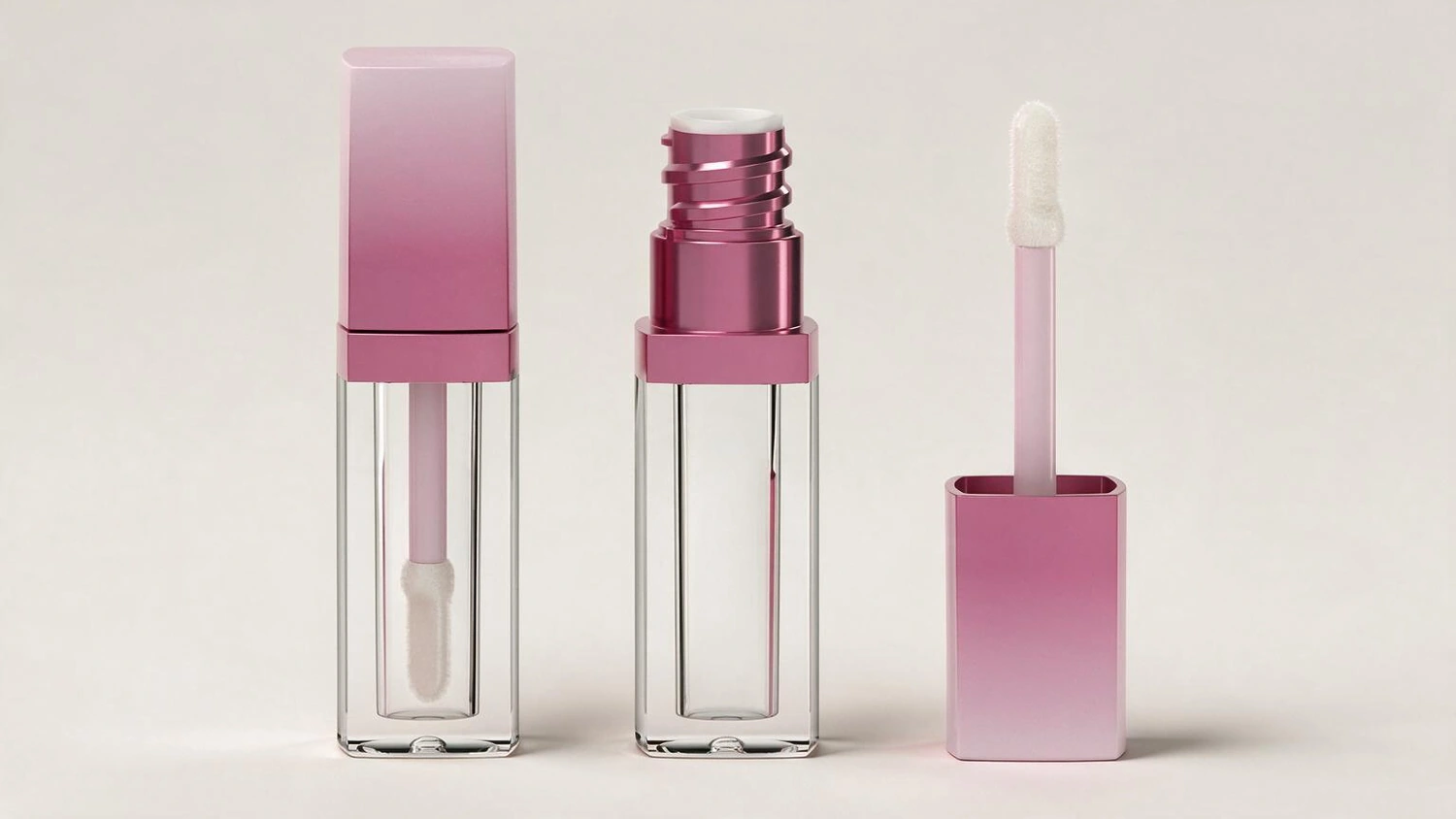
Lip gloss packaging with a wand typically includes a bottle, cap, stem, wiper, and applicator tip. Each part is made to its own material and shape requirements. Matching parts are then assembled into the complete packaging set. What looks like a single cap may also be an assembly of separately molded parts.
If the design calls for spray coating, metallization, printing, or hot stamping, the relevant parts also need that decoration work. The cost of a complete empty tube therefore includes part manufacturing, along with the decoration and assembly required by the design. The price of a bottle alone cannot represent the cost of the complete set.
During lip gloss packaging development, Sambound checks how the bottle, cap, stem, wiper, and applicator tip fit together. Following the same set of parts through design, forming, decoration, and assembly helps identify which work a packaging change actually adds.
How packaging changes add manufacturing work
Changing the bottle shape or material affects material use and tooling
Tubes with the same capacity can have different bottle proportions, wall thicknesses, and cap sizes. Capacity describes the space available for the contents. It does not determine how much material these parts use. The bottle, cap, stem, and wiper can also use different plastics. Material cost depends on what each part is made from and how much material it uses per unit.
A new shape that existing molds cannot produce requires an assessment of mold modification or a new mold. The new shape can affect the mechanisms needed inside the mold, the mold base size, and the required mold surface polishing. These requirements change the work involved in making the mold. This cost comes from the tooling needed to produce the part; tube capacity alone cannot determine it.
A cap change also needs to be checked for its effect on other components. It may affect only the outer cap, or it may also involve functional parts inside the cap, the stem, or the wiper. Keeping the stock bottle does not mean every other part can stay unchanged. The parts that actually change determine which molds and development work need to be assessed.
Adding decoration to an as-molded cap adds processing after molding
Suppose the original design uses a cap in its as-molded color. The revised design keeps its shape but adds spray coating and a hot-stamped logo. The cap itself still has to be made, followed by spray coating and hot stamping on the specified surfaces. Those decoration processes must cover every cap ordered with that finish. Their cost becomes part of the cost of the decorated packaging.
This type of change usually does not require a new mold for the part’s shape, but it still adds work. Adding decoration introduces further processing on an existing shape. Changing the cap’s shape may first require changes to the mold that produces it. Similar colors or appearances can also be achieved through different processes, so the price needs to be understood in terms of the actual processing involved.
Why production runs still matter at higher order quantities
Injection molding has manufacturing costs incurred for each unit and may also include setup charges before each production run. When specifications and production conditions remain the same, making more units in one run spreads that run’s fixed setup cost across more units. The setup cost allocated to each unit therefore falls.
The diagram below compares producing an order of 10,000 units of the same design and color in one run versus five runs. It assumes that every run requires fresh production setup.
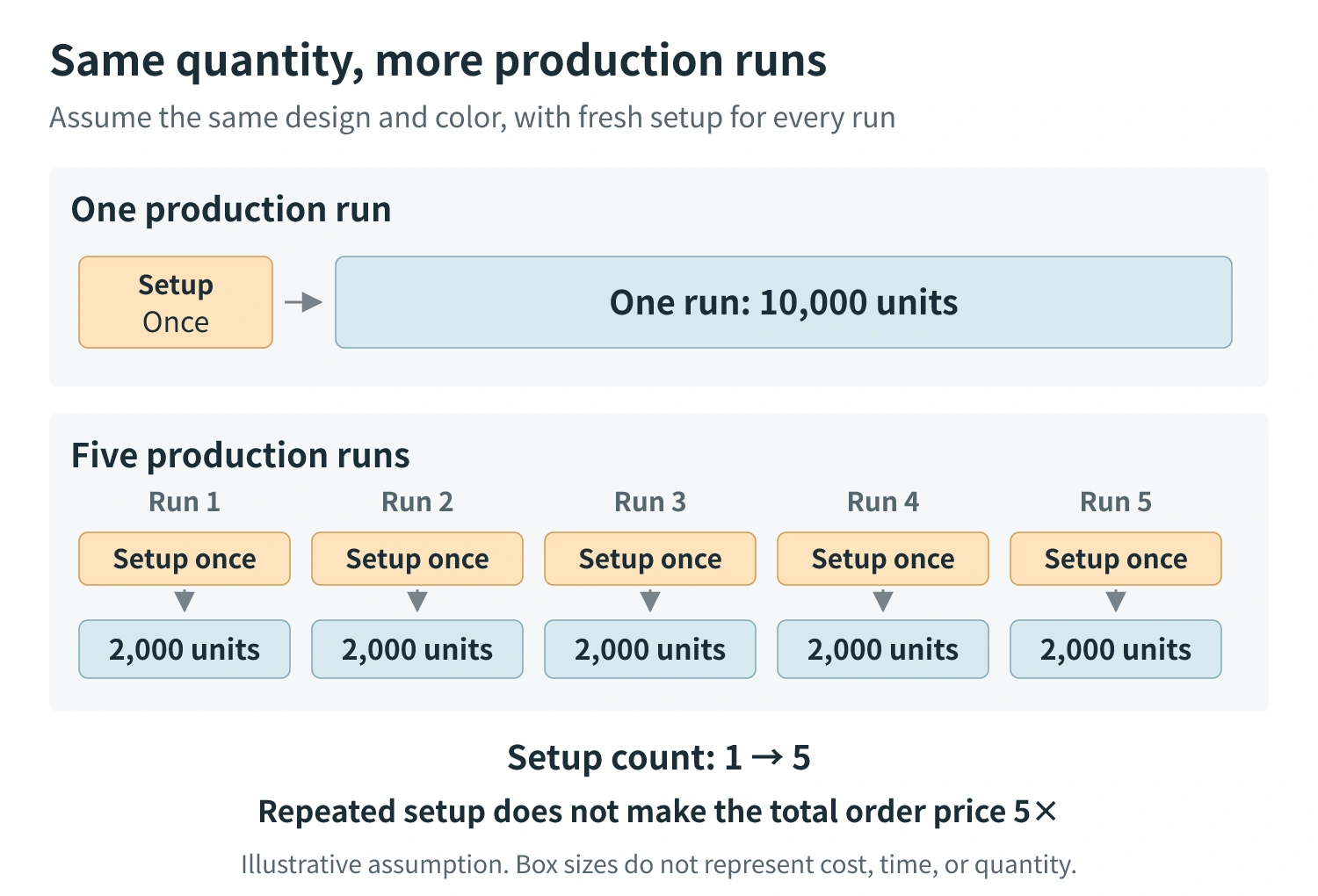
The diagram shows repeated production setup, not an increase in the number of units ordered. The order also includes the manufacturing cost of each unit. Five setups therefore do not mean five times the total order price. If the model, material, or decoration changes as well, those changes introduce other cost differences. The price difference cannot all be attributed to quantity.
How to calculate the total cost of the first order
The quoted unit price reflects the packaging work included in that design. The first order may also have separately listed mold or development charges. For example, one option may use an existing bottle and cap. Another may keep the bottle but require a new cap mold, adding a development cost beyond the cost of the goods. Even with similar quoted unit prices, the total amount due for the first order can differ.
Provided no quoted charges are counted twice, the calculation is:
Total packaging cost for the first order = quantity ordered × unit price for the complete packaging set + separately listed one-time charges + shipping and taxes excluded from the unit price.
Do not add a charge again if it is already included in the unit price. If mold or development costs are listed separately, include the full amount in the first order. Do not look only at the extra cost per unit after spreading that charge across the order.