Three Approaches, Three Distinct Finishes
Metallic effects drive premium value in metal cosmetic packaging. The industry relies on three primary methods to achieve this look: electroplating, spray coating, and film transfer.
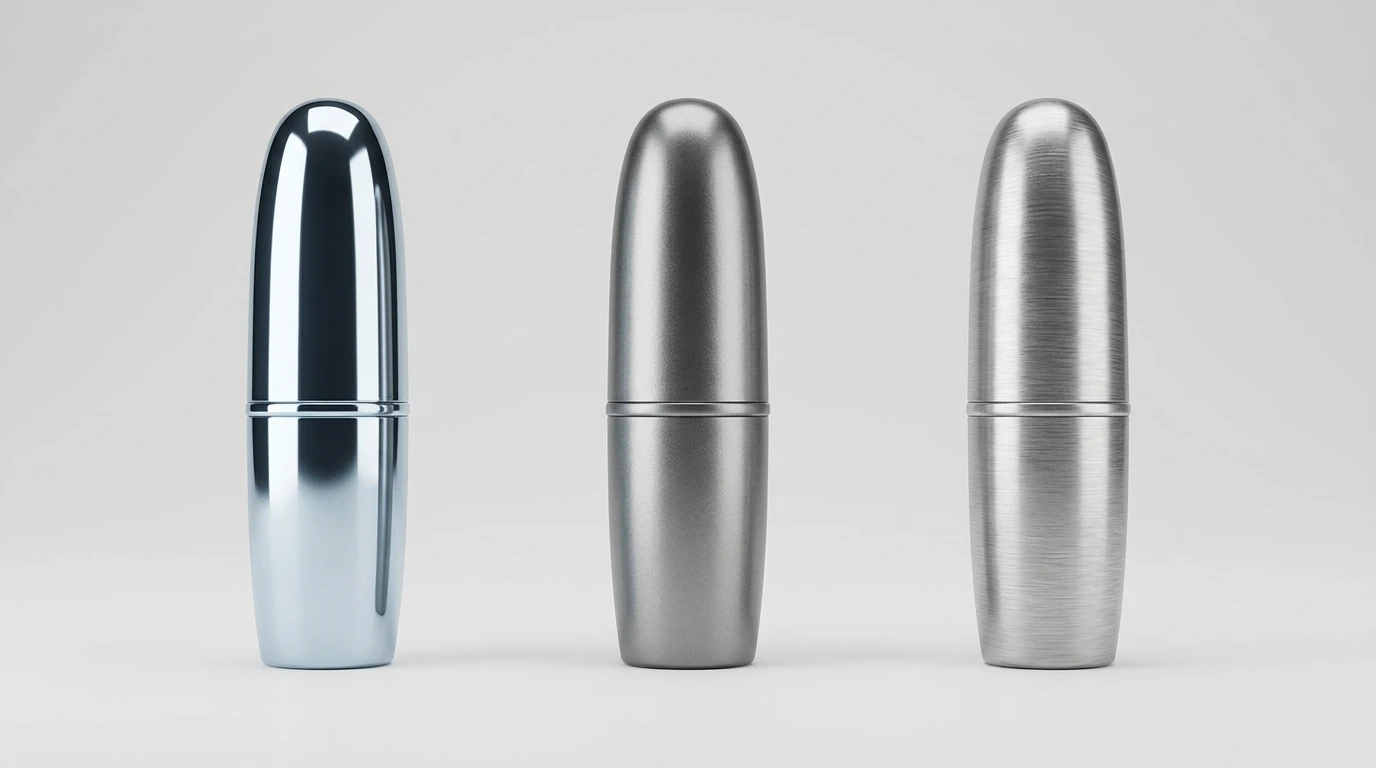
Take the exact same “premium silver” on a design mockup. Electroplating delivers a true mirror reflection. Spray coating produces a metallic paint layer with fine microparticles. Film transfer applies a pre-printed metallic film. You get three distinct finishes, three price tiers, and drastically different durability levels. When three suppliers quote three wildly different prices for the same rendering, it usually means nobody clarified which metallic finish the project actually requires.
A standard cosmetic packaging workflow follows a set sequence: mold the bare substrate (injection-molded parts without surface treatment), apply the base finish for overall texture, add branding via screen printing or hot stamping, and assemble. Electroplating, spray coating, and film transfer all compete at the base finish stage. Logo-level hot stamping belongs to the secondary graphics layer, not the base finish.
The performance ceiling and practical limits of any metallic look stem directly from these three methods.
”Film Transfer” Is Not a Single Process
In cosmetic packaging, “film transfer” does not mean sticking an adhesive label onto a shell. It refers to an entire category of processes where graphics are printed onto a carrier film first and then transferred to the component—ranking alongside spray coating, screen printing, and electroplating. Based on how the film bonds to the part, three methods dominate:
- Heat transfer: Heat and pressure transfer pre-printed metallic graphics from the film onto the part across spot locations or full surfaces.
- Water transfer printing: Water pressure floats printed film patterns onto parts, wrapping wood grain, marble textures, or brushed metallic effects across full 360° curved tube bodies. It requires more than a simple water dip—it demands a three-coat system consisting of a tie-coat primer, basecoat, and protective topcoat. The transfer itself is merely the middle step.
- In-mold decoration (IMD): The standout exception in this group. Operators place a formed film insert directly into the mold cavity before resin injection. Decoration and molding happen simultaneously, yielding a finished part right out of the press. This breaks down into two routes: In-mold labeling (IML) leaves a 0.3–0.5 mm hard film on the exterior for maximum scratch resistance, trapping graphics between film and plastic so they never wear off; in-mold forming (IMF) uses a flexible film that stretches over deep contours, though edges can peel after 2–3 years of heavy use.
Film-based metallic finishes are essentially printed visuals. Gravure printing reaches 175 lines per inch, easily rendering gradients, metallic luster, and complex textures. However, because it relies on printed inks, it cannot create true specular mirror reflections. Choose film transfer for diverse patterns; choose electroplating for true mirror reflections.
Here is an industry rule of thumb on batch volumes: If your annual volume is under 30,000 units, avoid in-mold decoration. IML tooling costs 30% to 50% more than standard injection molds. Low volumes cannot amortize that tooling investment, making water transfer or heat transfer far more economical. Only step up to IML when you need high volumes, complex graphics, and heavy wear resistance—meeting at least two of these three criteria.
Hot stamping also transfers a metallic carrier film, but brands use it selectively for logos and text. It sits on the graphics layer, completely separate from the three base-finish processes.
Electroplating: Highest Gloss, Most Material-Selective
Electroplating represents the top tier of metallic finishes—it deposits an actual metal layer over the plastic substrate. The packaging sector splits electroplating into two distinct routes: wet plating (electrolytic plating in chemical baths) and vacuum metallization (PVD, evaporating aluminum inside a vacuum chamber).
A vacuum-metallized aluminum layer measures only 50–150 nm thick, whereas a wet-plated Cu/Ni/Cr layer runs 10–25 µm—hundreds of times thicker. Because vacuum metallization is exceptionally thin, its durability depends entirely on the outer UV topcoat. If that topcoat scratches through, the aluminum layer oxidizes and darkens within days. If components face heavy everyday friction and the budget allows, spec wet plating directly.
Wet plating comes with another critical constraint suppliers rarely explain upfront: it only bonds reliably with ABS and ABS+PC blends. Abs plates effectively because its butadiene component etches away in chemical baths, creating microscopic anchor pits where metal grips the plastic surface. Other plastics require expensive platable resin grades and proprietary pretreatments that packaging suppliers rarely run. Material verification comes before finish selection: if the substrate is not ABS or ABS+PC, rule out wet plating. Specifying ABS early keeps electroplating on the table.
Another strict packaging rule applies: electroplated layers must never touch cosmetic bulk formulas. Metallic finishes belong strictly on outer shells and overcaps. Inner cups housing formulas must remain bare plastic. Wet-plated nickel-chrome layers cannot safely contact cosmetic formulations.
Standard quality benchmarks verify plating performance: the cross-cut test (ISO 2409 / ASTM D3359 to check adhesion) and the salt spray test (ASTM B117, running 24–72 hours to assess corrosion). High-end export orders typically require passing 48 hours.
Electroplating’s main vulnerability lies in substrate timing. Injection-molded ABS parts generally must enter the racking and etching line within 24 hours of molding. Beyond 48 hours, ABS surface energy degrades, cutting metal adhesion. For European export shipments facing hexavalent chromium bans, some premium programs have switched to trivalent chromium (yielding a slightly darker tone), while vacuum metallization uses pure aluminum vapor and avoids heavy metal restrictions altogether.
Best suited for: High-end outer shells and caps requiring true mirror reflection—provided the substrate is ABS.
What Does Spray Coating Deliver?
Spray coating derives its metallic sheen from suspended pigments: aluminum paste, silver powder, or pearlescent flakes blended into the paint system. From a distance, it delivers rich metallic luster. Up close, it shows subtle orange peel and fine particle texture rather than a specular mirror finish.
In return, spray coating offers the widest color flexibility of all three methods. Any custom color can take on a metallic sheen—something electroplating cannot match.
Success depends entirely on pretreatment because bare plastic does not naturally accept paint. Plastics carry low surface energy (the metric determining wettability, measured in mN/m)—PP sits below 30 mN/m, ABS is around 40–42 mN/m, and PMMA reaches 48 mN/m. Operators must apply plasma or corona discharge to raise surface energy before spraying. Unpretreated PP yields zero paint adhesion. Skipping surface prep produces parts that look fine out of the factory but peel rapidly under shipping friction.
The production flow involves four steps: pretreatment, basecoat, metallic paint, and UV clear coat. It allows far simpler color changeovers and rework than electroplating.
Durability hinges on the cured paint film. The standard inspection benchmark requires withstanding 100 double rubs with a 95% alcohol-soaked cotton ball without color rub-off or discoloration. That resists daily friction against keys and other makeup items inside a purse, though aggressive chemical solvents will degrade it. Gloss levels adjust freely: UV high-gloss clear coats reach 85–95 GU, while matte coats sit between 10 and 40 GU.
Best suited for: Mid-tier components made from mixed resin grades requiring custom metallic colors. When PP bottles cannot undergo wet plating, spray coating handles them reliably. It also fits cost-sensitive programs demanding unique colors.
Five Dimensions: A Direct Comparison
Comparing the three methods across five core dimensions clarifies the selection process: metallic finish, compatible materials, durability, cost range, and ideal applications.
| Dimension | Electroplating | Spray Coating | Film Transfer |
|---|---|---|---|
| Metallic Finish | Real metal layer; industry benchmark for mirror finish | Metallic pigment paint film; visible micro-particles; non-mirror | Printed metallic graphics; broad pattern flexibility |
| Compatible Materials | Wet plating limited to ABS / ABS+PC; vacuum metallization accepts broader resins | Widest range; PP compatible after surface pretreatment | Nearly universal: plastics, glass, metals, and ceramics |
| Durability | Thick layers resist corrosion; sensitive to substrate aging; vacuum PVD requires scratch-free topcoat | Passes 100 alcohol double rubs; vulnerable to harsh solvents | IML offers maximum abrasion resistance; IMF edges can peel after 2–3 years |
| Cost Range | Starting from ~$0.05/pc; longest cycle, most expensive for premium specs | ~$0.05 to $0.20+ per piece | Transfer tooling ~$74 to $445; IML molds cost 30%–50% more |
| Ideal Applications | Premium outer shells and caps; isolated from bulk formula | Mid-tier parts requiring tinted metallic colors | Broad textures and full 360° curved wraps |
Check the finished row first to narrow down your method. Next, check compatible materials to eliminate unsuitable substrates. Calculate costs last. Reversing this sequence often leads brands to choose an inadequate finish just to save a few cents ($0.03–$0.05).
Sample prototypes all look appealing on a desk. The real difference shows up during consumer use.
Recent discussions around packaging quality failures often cite peeling or darkening on high-gloss shells. Most cases trace back to compromised vacuum-metallized UV topcoats. Consumer complaints and negative e-commerce reviews appear within months of launch. Root always causes points to adhesion failure, incomplete UV curing, or transit abrasion. Specifying the right process and enforcing incoming quality standards prevents these failures.
Another overlooked factor is reorder batch consistency. Electroplated parts naturally exhibit subtle batch-to-batch color variance. Always retain golden signed samples from the initial production run, inspect reorders directly against them, and mandate that factories run replenishment orders in continuous single-oven batches. Adding that simple note to purchase contracts prevents costly disputes.
How to Choose the Right Process
You do not need to memorize manufacturing manuals. Three direct questions clarify the choice:
First, what finish do you need? Specular mirrors require electroplating; tinted metallics require spray coating; large-scale textures require film transfer. This narrows the field to one or two options. Second, what is the substrate? If it is not ABS or ABS+PC, wet plating is out. For PP or PMMA, spray coating and transfer printing work well. Third, what is the production volume? Keep annual runs under 30,000 units away from in-mold decoration. For initial runs of 10,000 to 20,000 units, heat transfer or water transfer is most practical. Never build an IML mold for short runs.
Follow these four basic guidelines:
- True mirror finish + sufficient budget → Electroplating (wet plating for ABS/ABS+PC; vacuum metallization for small batches or other resins).
- Tinted metallic colors + mixed plastics → Spray coating.
- Large textures like wood grain or brushed metal → Water transfer or heat transfer.
- Complex patterns + extreme wear resistance + annual volume > 30,000 pcs → In-mold labeling (IML).
These methods also combine effectively. On a single lipstick tube, the base can use electroplating, the cap can use spray coating, and the logo can feature hot stamping. Each technique handles its designated layer to create a rich, tactile aesthetic.
Consider this case shared by an industrial design agency: A client picked a $4,447.13 (30,000 CNY) screen printing quote over an $11,859.01 (80,000 CNY) IML mold quote. Two months post-launch, everyday cleaners dissolved the printed wood grain graphics, costing nearly $8,894.26 (60,000 CNY) in product rework. Choosing a cheap process for the wrong operating environment costs the most in the end.
When undecided, return to the first question: What does “metallic” mean in your product brief—a true mirror, a tinted metallic paint, or a fully textured pattern?
Sample Comparisons Deliver the Fastest Answers
Three suppliers can quote three different processes and prices for the same “premium silver.” Putting physical samples side by side settles the debate immediately.
At Sambound, a dedicated cosmetic packaging manufacturer, we operate two vacuum metallization lines and four automated spray coating lines, delivering a daily electroplating capacity of 50,000 to 80,000 sets. We manage both electroplating and spray coating in-house under one roof. If your parts require film transfer, send us your design files, and our team will evaluate manufacturing feasibility.
If you have components with unclear specifications, let us evaluate the most cost-effective process. Send over your CAD files for a Design for Manufacturability (DFM) review so we can calculate your surface finishing costs accurately.