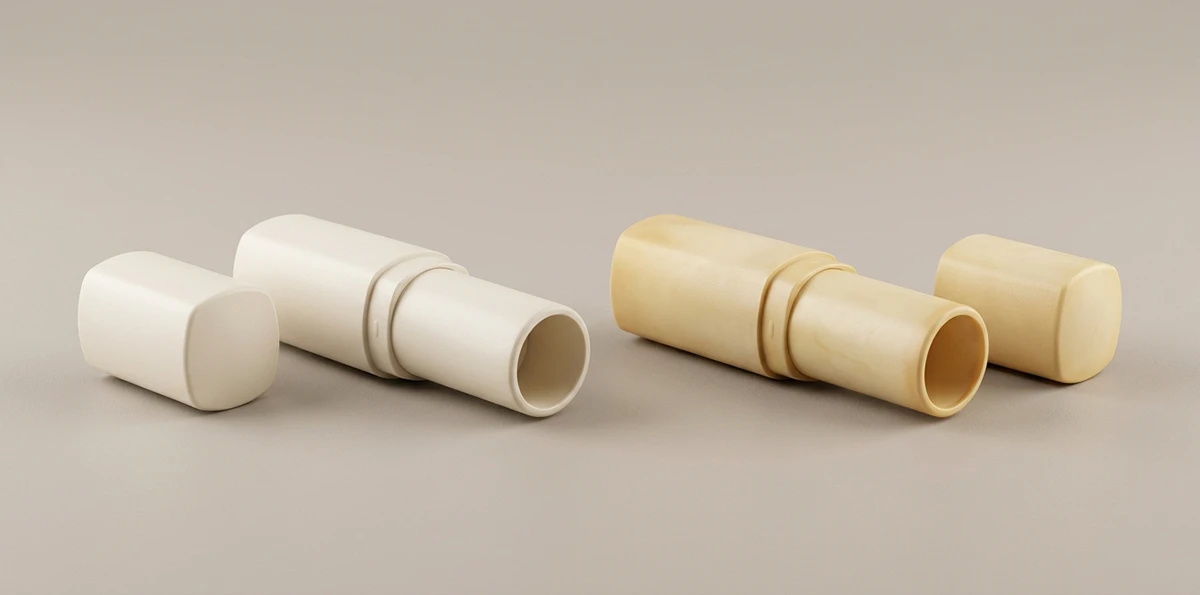
When you inspect a batch of yellowed lipstick tubes, do not rush to assign blame. Yellowing stems from very different root causes: virgin resin tint, degraded surface paint or plating, migrated oils from the lipstick bulk, or prolonged warehouse exposure to ambient light. Yellowing in lipstick packaging typically falls into four categories: raw resin tint, coating and plating yellowing, formula oil migration, and storage aging. Each scenario requires an entirely different corrective action.
Jumping to conclusions gets expensive fast. You might soak a batch in hydrogen peroxide that should have been claimed against the factory or scrap an entire run that could have been depleted and replated on a production line. Another common mistake is blaming the factory unfairly: raw ABS plastic is not pure snow white. It carries a natural ivory cast with a slight yellow undertone. Every pure white tube on the market relies on white colorants like titanium dioxide. When evaluating yellowed components, first determine whether they arrived off-white from day one or turned yellow over time. Identifying the exact type of yellowing tells you whether to salvage the batch or file a supplier claim—and how to structure your next purchase order so future runs stay color-stable.
Diagnose Which Layer Turned Yellow First
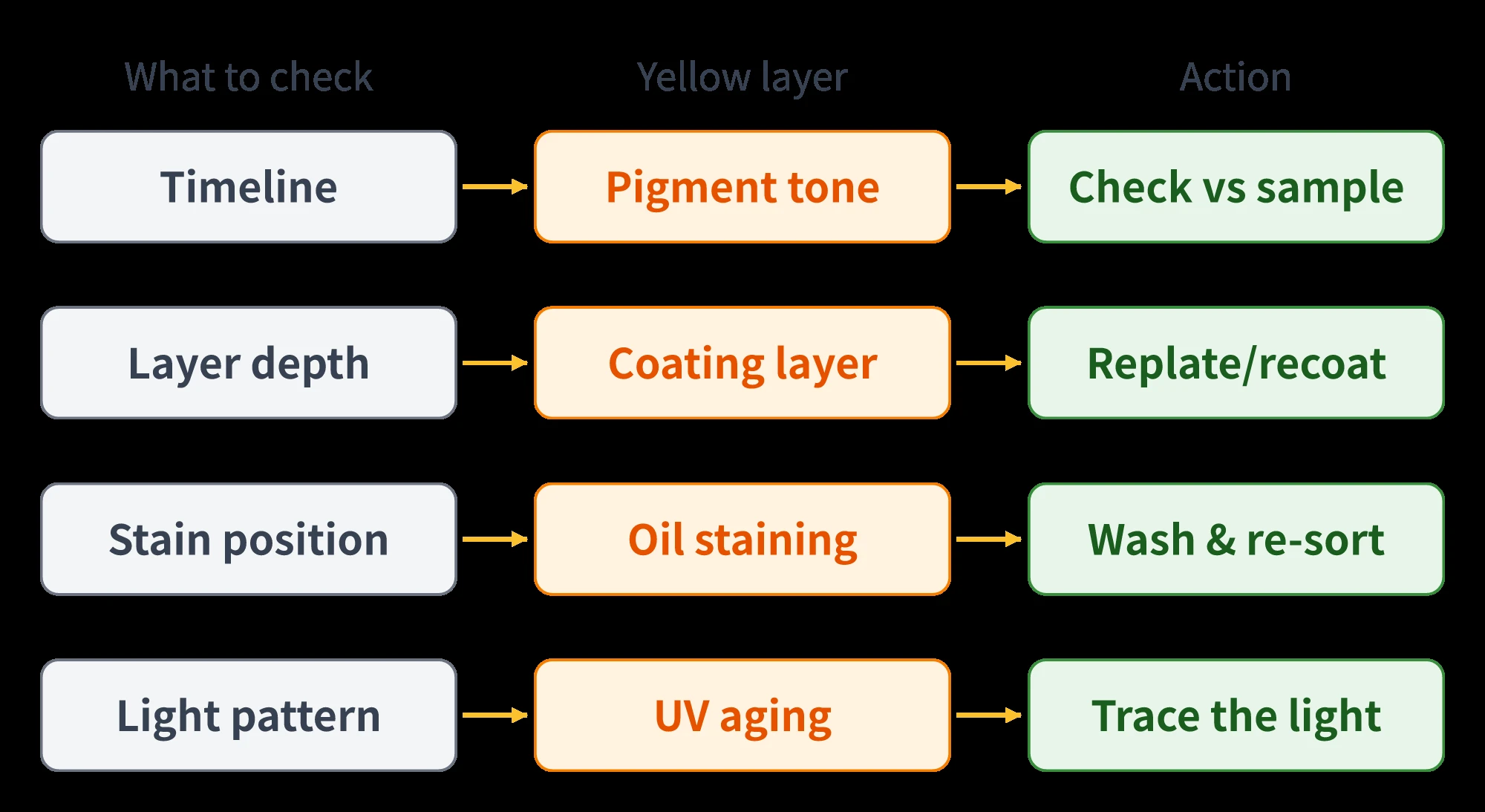
First, evaluate the timeline: was the tube always slightly off-white, or did the discoloration develop after production? If it was off-white from the start, the issue lies in raw resin compounding and color matching. Unpigmented ABS possesses a natural yellowish cast, so white tubes rely on white pigments like titanium dioxide for brightness. If the compounding step misses the target whiteness, the entire lot comes out off-white from the press. A clear indicator of this defect is lot-wide consistency: every single piece from the first to the last displays the same shade. This is not material aging—it is a color tolerance mismatch to resolve against signed technical limits rather than an in-service quality failure.
Second, check the physical layer: does discoloration sit on the surface coating, or has it penetrated the plastic substrate? Most white and pastel tubes receive secondary surface finishing, such as UV spray coating or electroplating. In decorative plastic plating, yellowing is a recognized quality defect alongside pitting and blistering—one of the seven common defects in plastic electroplating. Plating discoloration originates from bath chemistry or process parameters. You manage it through plating QA protocols, not plastic degradation workflows. In electroplating on plastics (tank immersion plating), ABS-based resins account for roughly 85% of all commercial substrates. High-gloss silver tubes almost universally rely on ABS because chemical chromic acid etching creates microscopic anchor pores that lock metal layers down, giving ABS exceptional plating adhesion. However, those micro-pores create a vulnerability: aggressive oxidizing fluids (such as hydrogen peroxide DIY bleaching solutions) penetrate the interface and destroy coating adhesion. Never soak plated cosmetic packaging in corrosive liquids. A straightforward check: compare the outer shell against the inner wall. If the exterior is yellow while the unexposed inner wall retains its original milky-white tone, the yellowing is confined to the surface finish, since spraying and plating only coat external surfaces.
Third, examine the defect location. If discoloration concentrates around the orifice or inner neck, shows oily residue, or tracks lipstick application patterns regardless of light direction, the packaging plastic is rarely at fault. Lipstick bulk can “sweat” formulation oils under elevated temperatures. These pigmented oils then bleed into the inner neck or smudge external walls during high-speed filling. For this defect layer, inspecting the physical location of the stain reveals far more than spectrophotometer color readings.
If the first three steps do not apply, warehouse storage conditions are the primary suspect. Packaging components degrade even when shielded from direct sunlight. Long-wave UVA passing through glass windows, retail halogen spotlights, fluorescent warehouse lighting, and warm ambient air steadily turn ABS yellow over time. Retail counter testers displayed under continuous spotlights face this exact degradation cycle. This storage-induced yellowing exhibits a distinct distribution across pallets: cartons along the outer perimeter turn yellow first, while central pallet inventory remains clean. Discoloration follows ambient light exposure rather than resin lot variations. If you see this pattern, trace where the inventory sat before filing a vendor claim. Why is ABS uniquely susceptible? The polybutadiene rubber phase in the ABS polymer chain contains unsaturated double bonds that react readily with light and oxygen. Heat accelerates the breakdown, but high-energy UV radiation drives the yellowing mechanism. Once polymer oxidation starts, moving parts into dark storage does not stop it completely—it merely slows the rate.
Finally, inspect lot distribution to establish responsibility: is discoloration isolated to single units or spread across the entire lot? Compare the cap, body, and base together. These components typically share the same resin batch. Uniform yellowing across all molded parts points to raw material or process defects, which fall under factory responsibility. If only scattered units show yellowing, trace localized light exposure or accidental contamination first—pieces placed near windows or under high-intensity retail spots naturally turn yellow much faster. Once you isolate the layer, you identify the root cause, allowing you to choose between commercial claims, factory rework, or inventory write-offs.
1. Whiteness and UV Resistance Start with Color Masterbatch
Every experienced cosmetic packaging manufacturer knows that yellowing complaints target white and light-colored tubes almost exclusively. Black and dark packaging rarely receives yellowing complaints because dark formulations contain high pigment loadings that block UV rays and conceal underlying discoloration. For white tubes, lightfastness is largely determined during color compounding. When issuing a purchase order, clarify two technical points: which crystalline form of white pigment the factory uses (rutile titanium dioxide offers far superior weatherability and lightfastness compared to anatase grades) and whether the colorist added trace ultramarine blue to neutralize yellowish undertones—a standard industry practice known as optical brightening or “blue-undertone compensation.
Raw resin anti-yellowing relies on a standard additive package: primary and secondary antioxidants to suppress thermo-oxidative degradation, UV absorbers to filter high-energy radiation, and Hindered Amine Light Stabilizers (HALS) to scavenge free radicals. HALS provides an exceptional advantage for thin-walled cosmetic shells: its stabilization efficiency increases as wall thickness decreases, making it ideal for 1.0–1.5 mm lipstick tube walls.
Anti-yellowing performance is an engineered specification, not marketing hype. UV-stabilized ABS grades are commercially available catalog resins, and light-stabilizing additive masterbatches are standard off-the-shelf industrial compounds. You can write these requirements directly into your purchase contract: specify rutile TiO₂ white pigment, optical blue undertone compensation, and UV-stabilized ABS resin compounded with HALS. For higher-budget cosmetic lines exposed to permanent retail lighting, consider upgrading to outdoor-grade weathering polymers such as AES or ASA. These polymer families replace polybutadiene with saturated EPDM or acrylic rubbers that resist UV degradation. Whether the resin upgrade justifies the cost depends on commercial positioning: premium department store lines under continuous spotlights warrant the investment, while fast-moving e-commerce lines perform reliably with well-compounded, UV-stabilized ABS.
2. Write Inspection Tolerances Directly into the PO
Never manage cosmetic color acceptance with subjective visual opinions. The packaging industry relies on two standardized numerical metrics: Yellowness Index (YI, where lower values indicate less yellow) and total color difference (ΔE). Commercial testing laboratories commonly apply an acceptance threshold of ΔE ≤ 1.5 following accelerated UV weathering—a shift virtually imperceptible to the human eye. While this threshold is not a mandatory statutory standard, it serves as the standard benchmark across prestige beauty brands. Specifying it in your quality agreement provides an objective metric during quality disputes.
Avoid ambiguous clauses like “good anti-yellowing performance.” Define the explicit test protocol: “Parts shall undergo accelerated xenon arc or fluorescent UV aging (irradiance, exposure duration, and chamber temperature per technical agreement); post-aging color shift shall not exceed agreed ΔE or ΔYI limits.” Certified third-party testing laboratories typically issue test reports within two weeks. For weathering correlations, accelerated weathering studies indicate that one day in an accelerated xenon test chamber approximates roughly seven days of standard retail shelf exposure, depending on specific exposure cycles.
Implement one zero-cost safeguard: retain signed golden pre-production samples for mass production comparison. These retained samples serve as primary visual and spectrophotometric baselines during incoming QC disputes. In addition, align your acceptance criteria with the specific secondary finish applied to your Lipstick Tubes—spray coatings (primer, topcoat, and gradient) or electroplating (vacuum metallization or tank electroplating). Both finishing methods occur after injection molding based on aesthetic requirements. Electroplated parts require plating adhesion (cross-hatch testing) and surface appearance limits, while spray-coated parts require gloss level and delta-E limits. Inspection criteria that do not match the surface finish cannot be enforced during production audits.
3. Warehousing and Packaging Are the Cheapest Safeguards
Among preventive measures, packaging and warehouse controls are the simplest and most cost-effective to implement. Pack finished goods in light-blocking black PE bags inside heavy-gauge opaque corrugated cartons. Store warehouse pallets away from windows, off bare floors, and away from heating equipment to block ambient UV and thermal degradation. A common packaging oversight: many factories ship in clear polybags to simplify incoming visual inspections. Transparent bags offer zero UV protection. Always mandate opaque protective bags in your purchase order. Contract filling facilities should follow the same rules: avoid staging unfilled packaging near facility windows. At retail counters, direct merchandising teams to angle spotlights away from packaged inventory, switch display cases to UV-free LEDs that emit minimal heat, and manage illumination schedules.
Documenting packaging and warehousing specifications in your supply agreement protects against unassigned liability. When tubes leave the molding shop on spec but turn yellow on warehouse shelves, assigning fault is difficult without written packaging standards. The packaging vendor claims outgoing quality was clear; the brand claims incoming goods arrived defective. Establishing clear packaging and storage protocols provides verifiable documentation. The nominal savings from clear polybags will not offset a single disputed batch write-off.
Can Yellowed Tubes Be Salvaged?
Salvageability depends on which layer degraded—some components allow line rework, while others are a total loss. Let us address the most common internet remedy first: hydrogen peroxide combined with UV light. This chemical reaction reverses yellowing on raw ABS, and elevated bath temperatures accelerate the process. Small, uncoated plastic components often recover their white appearance after several hours of exposure. However, this process is entirely unsuitable for finished cosmetic packaging.
Peroxide bleaching does not provide a permanent fix. ABS turns yellow when oxidation generates conjugated chromophores—molecular structures that absorb blue wavelengths and reflect yellow light. Hydrogen peroxide under UV light oxidizes and bleaches these chromophores back to a colorless state. However, bleaching merely reverses existing surface discoloration without stopping ongoing polymer degradation. The unsaturated polybutadiene double bonds remain in the polymer backbone, and atmospheric oxygen continues to attack them. Bleaching adds no stabilization to the plastic. Restored components continue to oxidize, often yellowing faster during subsequent light exposure. Furthermore, published polymer data shows that hydrogen peroxide penetrates surface micro-fissures, causing matrix embrittlement and reducing mechanical impact resistance.
More critically, chemical soaking destroys decorative cosmetic finishes. Hydrogen peroxide strips electroplated chrome and vacuum-metallized layers directly off the plastic. While vintage computer housings might tolerate a peroxide bath, commercial lipstick packaging cannot. A tube’s market value lies in its UV topcoat, electroplated finish, and hot-stamped branding. Soaking the part destroys the decorative exterior before revealing the substrate core.
Even on bare, uncoated moldings, the labor economics do not work. Peroxide restoration requires lining treatment containers with aluminum foil, positioning UV arrays, and rotating parts every few hours over a 5-hour cycle to prevent uneven shadowing and patchy bleaching. Using heat to accelerate the reaction carries hard physical limits: high-impact ABS softens and distorts above its continuous operating temperature limit (around 65 °C, depending on the specific resin grade datasheet). Processing a production batch of 12,000 tubes through manual bleaching costs far more in labor and cycle time than molding a fresh replacement run. Salvaging inventory requires structured defect classification, not chemical soaking.
Commercial rework must run on automated factory lines, and only when yellowing is confined to the surface finish while the plastic core remains structurally sound. For yellowed electroplated tubes, the standard corrective route is chemical deplating followed by replating: strip the defective metal layer down to the ABS substrate, then rerun parts through the electroplating line. The pre-existing micro-etched anchor pores reduce required chromic acid etch times during the second run. Similarly, spray-coated components can be chemically stripped and repainted. However, rework cycles have limits: chemical stripping solutions attack the underlying plastic with every cycle, so industry standards cap replating rework at three cycles maximum. Keep in mind that silk screening and hot stamping are stripped along with the plating, so graphic decoration must be reapplied. While line rework incurs secondary labor costs, it preserves the underlying molded inventory.
Use the decision matrix below to classify and process affected inventory:
| Defect Layer | Salvageable? | Corrective Action |
|---|---|---|
| Surface paint or plating yellowed (slight depth) | Yes (Reworkable) | Deplate and replate, or strip and repaint on factory production line |
| Plastic substrate core oxidized | No (Irreversible) | Downgrade (divert to dark-color runs, internal testing, display samples) or scrap |
| Surface oil migration from formula | Yes (Cleanable) | Solvent wipe or industrial wash, sort, and release clean inventory |
| Batch off-white upon initial delivery | Not aging | Evaluate against golden retain sample; negotiate color delta-E limits with supplier |
Why is substrate yellowing irreversible? Plastic discoloration is a chemical reaction that permanently alters molecular bonds under UV radiation and oxygen. It cannot be washed away or chemically reversed in commercial production. When substrate oxidation occurs, focus entirely on damage control: reassign yellowed white components to dark-colored product runs where the slight undertone remains invisible, divert stock for internal functional testing or visual mockups, or scrap the batch to reclaim regrind value. For oil migration, surface oils that wipe away cleanly can pass through a secondary cleaning line for normal release. Also examine the bulk formulation: rancid bulk oils undergo oxidative discoloration, which points to bulk stability rather than packaging failure. For batches that arrive off-white on day one, pull the signed golden retain samples, take spectrophotometer delta-E readings, and evaluate the variance against your technical quality agreement. Golden retained samples provide the baseline evidence needed to resolve incoming quality disputes.
Need Help Diagnosing Color Drift? Send Us Your Samples
Preventing packaging yellowing begins long before purchase orders are issued: resin compounding and masterbatch selection resolve half the challenge; golden-tone-retaining samples and color tolerances establish clear inspection standards, and light-blocking packaging protects inventory in transit. Specifying these three safeguards upfront adds negligible cost to unit pricing—far less than sorting out unassigned batch losses after goods turn yellow.
At Sambound, we have manufactured color cosmetic packaging for over a decade. If you have packaging samples with questionable discoloration, send your physical samples to our engineering team or share high-resolution photos of the defect areas. We will diagnose the affected layer and identify the root cause. If you are developing new white or pastel cosmetic packaging lines and want to build robust UV stabilization into your specifications from day one, submit an inquiry today. We will review your material formulations, define your technical acceptance criteria, and deliver an actionable manufacturing spec sheet for your next purchase order.