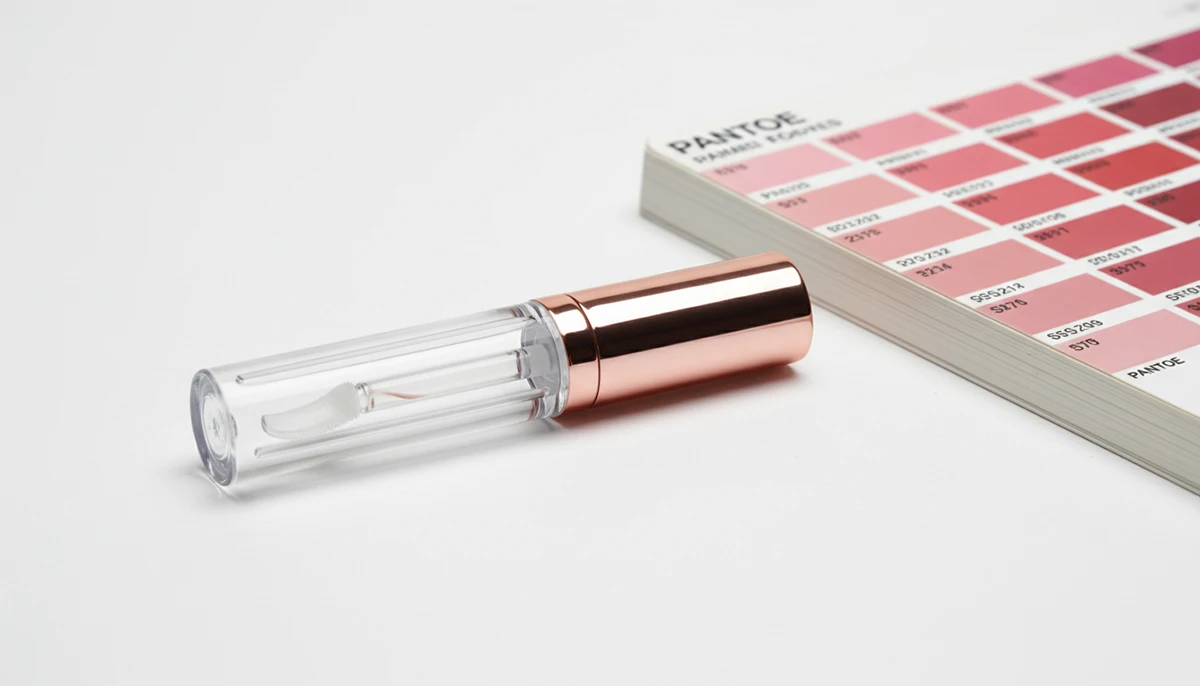
A buyer on 1688 left a negative review due to a color difference in lip gloss tubes—the mass production color was significantly darker than the sample, causing the entire product line to fail to launch. The supplier refused to compensate and only offered a discount for the next order. As Sambound, a cosmetic packaging provider that has served GUCCI and L’Oréal, we have seen many customers fall into this trap. This article breaks down color difference judgment, process causes, avoidance, and remedial solutions to help you avoid the pitfalls of packaging color difference.
What are the Industry Judgment Standards for the Color Difference of Lip Gloss Tube Packaging?
There is no mandatory national standard for the color difference of lip gloss tube packaging, mainly referring to industry norms and customer requirements:
- Common testing standards: GB/T 3979-2008 “Methods for Measurement of Object Color”, ASTM D2244-16, ISO 3668, etc., specifically based on customer designation.
- Color difference threshold: Conventional requirement ΔE≤1.5; strict customers (such as major brands) ≤1.0 or 0.8, ultra-high-end even ≤0.6; metal/pearlescent paint lip gloss tubes can be relaxed to ≤1.5.
- Testing tools and methods: Use a spectrophotometer (such as Konica Minolta CM-26d, X-Rite Ci64), a D65 light source, and a 10° observation angle to measure Lab values and calculate ΔE; transparent/translucent tubes need a white background, and calibrate the white board before testing.
- Precautions: Unify the instrument model and measurement conditions with the customer; make standard color plates and confirm the sealing; use a standard light source box to assist visual comparison; establish color testing processes and records for each batch of masterbatch; write the standard into the contract or quality agreement.
What are the Process Causes for Color Difference in Lip Gloss Tube Packaging?
| Process Stage | Specific Causes (Including Facts) |
|---|---|
| Injection Molding Stage | 1. Batch difference in resin/masterbatch; 2. Injection temperature fluctuation within ±5°C; mold temperature not controlled at 30-50°C ±2°C (uneven cooling leads to crystallization differences); 3. Excessively high proportion of recycled materials or damp pellets; 4. Uneven dispersion of masterbatch (unsuitable screw speed/back pressure); 5. Color testing not conducted under standard light source; 6. Blockage of mold cooling channels. |
| Spraying/Printing Stage | 1. Spraying: Inconsistent coatings of the same batch, inconsistent oven temperature curves, fluctuating baking time; 2. Printing: Pad printing/hot stamping ink viscosity changes, unstable scraper pressure, baking temperature fluctuation (refer to GB/T17497-2019). |
| Plating/Vacuum Metallization Stage | 1. Uneven coating thickness (current density issue); 2. Substrate roughness difference; residue from pre-plating cleaning; base material difference (ABS/PP/PMMA); 3. Release agent residue; 4. Plating bath temperature/pH fluctuation; baking temperature curve fluctuation causing oxidation. |
How to Avoid Color Difference Problems in Advance for Customized Lip Gloss Tube Packaging?
To avoid color difference in customized lip gloss tubes, sign a color agreement first—specify the Pantone number, physically seal the sample, and strictly define the ΔE value (generally ≤1.2, strict customers ≤0.8). It is also necessary to write down who is responsible if a problem occurs and how to compensate. Let the injection molding factory match the color themselves, which is more stable; do not just send color powder. Keep 5-10 samples per batch and store them for 6 months after the shelf life. Measure the ΔE with a spectrophotometer for each batch, check aluminum and plastic materials separately, and view the color under the D65 light source. If the factory refuses to sign the agreement, change suppliers directly; formal factories are always willing to sign.
What are the Remedial Solutions for Lip Gloss Tube Packaging Color Difference?
If a color difference is found, first use a Datacolor spectrophotometer to measure the ΔE value according to GB/T3979-2008 to see if it exceeds the customer’s acceptable standard (conventional ≤1.5, strict ≤1.0). For injection molding issues, ask the supplier to re-dry the masterbatch and stabilize the temperature and pressure. During the production process, a masterbatch batch record and a color testing process for each batch must be established, and standard light sources (such as D65) should be used for color comparison testing. For printing issues, rework by adjusting the ink viscosity or baking temperature according to GB/T17497-2019. If the ΔE meets the standard, attach the test data report to strive for the market launch; if it exceeds the standard, either rework or claim compensation according to the contract. Do not blindly ask for a discount for the next time to avoid stepping into the pit again later.
How to Identify the Color Difference Risk Points of Injection Molded Parts in Advance
| Key Risk Points | Identification Signals |
|---|---|
| No clear color agreement signed | The supplier refuses to sign the agreement, or the agreement does not specify the Pantone number, physical sealed sample, and ΔE range (such as ≤1.0), without citing GB/T31881-2015. |
| Lack of raw material and process control | The supplier does not provide masterbatch batch reports, injection temperature fluctuates, or a high proportion of recycled materials causes color difference. |
| Non-standard testing process | Failure to use the D65 color matching light box for comparison per batch, failure to issue a color difference report, or failure to sample according to GB/T2828.1. |