On peut distinguer le niveau de gamme d'untube de rouge à lèvresdès que vous le prenez en main. Prenez deux tubes de même forme : l'un donne l'impression d'un jouet en plastique dans votre main, tandis que l'autre procure une sensation froide et lourde de métal. La majeure partie de cette différence réside dans la finition de surface. Les propriétaires de marques nous apportent souvent des photos de référence en nous demandant : « Comment s'appelle cette finition, et laquelle correspond à mon prix sans perdre d'argent ? » Chez Sambound, nous répondons à ce type de questions tous les jours en tant queFabricant d'emballages cosmétiques. Nous avons détaillé les 12 finitions de surface les plus pratiques utilisées sur les tubes de rouge à lèvres afin que vous puissiez les adapter directement à votre budget.
Commencer par comprendre le substrat et la structure bicouche
Vérifiez le matériau de base avant d'examiner les finitions. Cette étape à elle seule vous fera économiser la moitié de vos échanges. Le matériau principal de la coque extérieure des tubes de rouge à lèvres en plastique est l'ABS standard. Il est traité en surface après le moulage par injection. Les tubes haut de gamme utilisent une coque extérieure en aluminium, façonnée par estampage ou tournage CNC, suivie de finitions exclusives à l'aluminium. Ces deux systèmes ne sont pas interchangeables. L'anodisation ne fonctionne que sur les pièces en aluminium. Si vous souhaitez un aspect métallique sur du plastique, vous vous tournez vers la galvanoplastie ou la métallisation sous vide. Connaître votre substrat est la première étape lors de l'évaluation d'un échantillon de référence.
La deuxième étape consiste à comprendre les couches. L'industrie parle de finition de surface comme d'une seule catégorie, mais elle se divise en réalité en deux couches. La première couche est la finition de base, qui définit la texture et le toucher général – revêtement par pulvérisation, galvanoplastie, texturation dans le moule ou anodisation. La deuxième couche est la décoration graphique pour les logos et les motifs – sérigraphie, marquage à chaud ou gravure laser. Vous appliquez les graphiques sur la base finie. Un tube de rouge à lèvres haut de gamme subit souvent 5 à 7 étapes de traitement : moulage, pulvérisation de couche de base, métallisation sous vide, sérigraphie et une couche de finition UV protectrice avant l'assemblage final. Un seul processus ne définit pas le niveau de gamme ; c'est la combinaison qui crée la valeur perçue.
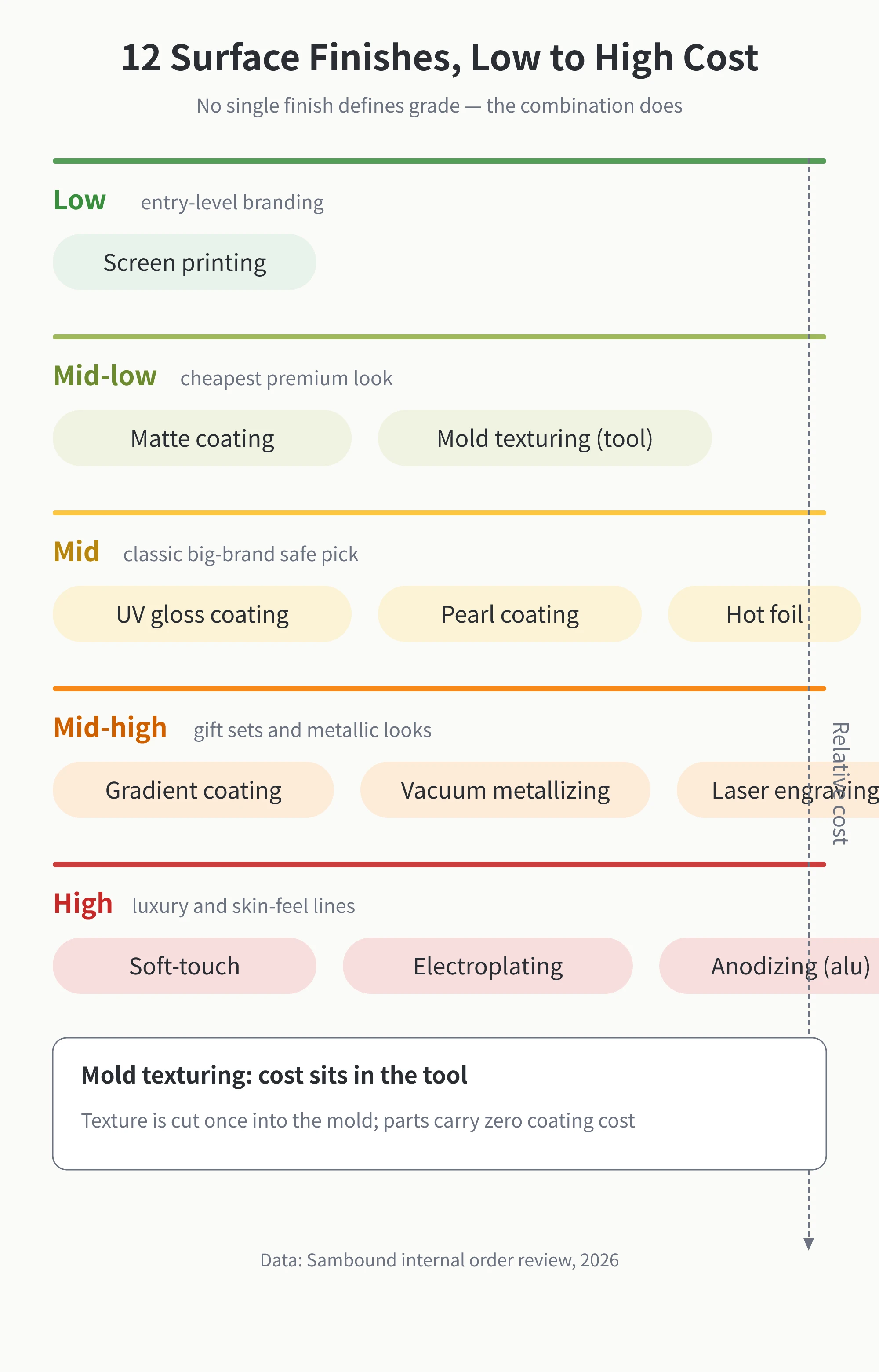
Guide de référence rapide : 12 Finitions de surface
| # | Finition | Effet visuel et tactile | Niveau de coût relatif | Applications courantes |
|---|---|---|---|---|
| 01 | Laquage brillant UV | Fini ultra-brillant effet miroir, suffisamment réfléchissant pour servir de miroir | Milieu de gamme supérieur | Tubes noirs brillants classiques de créateur |
| 02 | Finition mate par pulvérisation | Finition mate givrée avec une texture granuleuse fine | Milieu de gamme inférieur | La finition incontournable pour toutes les gammes de prix |
| 03 | Revêtement nacré par pulvérisation | Éclat nacré avec des reflets irisés qui changent selon les angles de vue | Moyen | Éditions limitées de fêtes, coffrets cadeaux |
| 04 | Laquage dégradé | Dégradé de couleurs doux du foncé au clair sur un seul tube | Milieu de gamme supérieur | Éditions limitées de fêtes, coffrets cadeaux de luxe |
| 05 | Revêtement Soft-Touch | Sensation tactile veloutée, semblable au caoutchouc | Haut | Lignes de beauté propre et à « toucher peau » de milieu à haut de gamme |
| 06 | Galvanoplastie humide | Véritable finition métallique miroir en or, chrome ou or rose | Haut | Tubes métalliques de luxe classiques |
| 07 | Métallisation sous vide (PVD) | Finition métallique brillante ; permet des rendus semi-transparents et irisés | Du milieu de gamme supérieur au haut de gamme | Finitions métalliques et à changement de couleur de milieu à haut de gamme |
| 08 | Texture de moule (Gravure) | Texture moulée directement sur la pièce, aucune peinture secondaire n'est nécessaire | Coût d'outillage unique | Lignes minimalistes, collections de soins pour hommes |
| 09 | Anodisation | Fini métallique mat (exclusif aux pièces en aluminium) | Haut | Tubes de rouge à lèvres de luxe en aluminium massif |
| 10 | Gravure laser | Texte et graphiques permanents gravés au laser | Milieu de gamme supérieur | Logos sur composants métalliques |
| 11 | Marquage à chaud | Graphiques en feuille métallique qui brillent sous la lumière directe | Moyen | Choix privilégié pour les logos, toutes gammes de prix confondues |
| 12 | Sérigraphie | Impression directe à l'encre, économique et rapide | Faible | Choix standard pour les gammes de produits de grande consommation en pharmacie/parapharmacie |
5 Types de Laquages
1. Laquage UV brillant
Une couche de vernis transparent durci aux UV porte la brillance de surface à 85–95 GU (unités de brillance) et offre une dureté crayon de H à 2H. La surface est suffisamment brillante pour servir de miroir. C'est la méthode principale pour créer des tubes de rouge à lèvres en plastique très brillants. Elle se situe dans le segment moyen à haut de gamme et constitue un choix fiable pour les marques de prestige, comme les tubes noirs classiques très brillants populaires dans le commerce de luxe. Gardez à l'esprit que les surfaces sombres et brillantes accentuent les retassures. Une imperfection de 0,02 mm est clairement visible sous haute brillance, tandis qu'une finition mate masque les défauts jusqu'à 0,05 mm. Lors de la production de pièces sombres très brillantes, vos rendements de moulage par injection et de revêtement par pulvérisation doivent être rigoureusement contrôlés.
2. Laquage mat
Le revêtement par pulvérisation mat réduit les reflets de surface et laisse un grain fin et uniforme. Dans les ateliers de production, on l'appelle une finition mate. C'est le moyen le plus économique de donner aux pièces un aspect haut de gamme, quel que soit le niveau de prix. Pour les projets soucieux de leur budget, nous recommandons presque toujours de commencer par une base mate. Il convient aux gammes de milieu de gamme et au-delà – les tubes de rouge à lèvres classiques du marché de masse utilisent des coques en plastique mat comme référence industrielle. Les finitions mates offrent également un avantage technique : elles masquent les légères marques de retrait et les éraflures mineures. Spécifier une finition mate sur des coques sombres offre une protection intégrée contre les taux de rejet cosmétique.
3. Laquage nacré
Le revêtement nacré par pulvérisation incorpore des pigments de mica nacrés dans la couche de couleur, appliquée à une épaisseur de film de 15 à 25 μm. La lumière résultante change naturellement : un éclat doux sous un angle et une iridescence chatoyante sous un autre. Il coûte légèrement plus cher qu'une peinture de couleur unie, mais reste plus abordable que la galvanoplastie. Cela en fait un choix standard pour les emballages cadeaux milieu de gamme et les éditions limitées de fêtes. Si vous souhaitez une présentation festive et raffinée sans payer pour un placage métallique, le revêtement nacré optimise votre budget là où c'est important.
4. Laquage dégradé
Une transition de couleur fluide du foncé au clair sur un même tube communique instantanément un savoir-faire haut de gamme. Les marques l'utilisent principalement sur les tubes de rouge à lèvres de prestige et les coffrets cadeaux saisonniers en édition limitée. Le prix reflète la complexité : les opérateurs doivent utiliser des gabarits de masquage personnalisés pour la pulvérisation en plusieurs étapes. Le revêtement par pulvérisation standard présente un taux de défauts de 3–6%, et les productions avec dégradé augmentent ce seuil. À moins que votre volume de commande n'atteigne une échelle durable, nous déconseillons généralement les dégradés, car les coûts de rebut peuvent réduire considérablement vos marges bénéficiaires.
5. Revêtement Soft-Touch
La peinture soft-touch est un revêtement élastique polyuréthane (PU) bi-composant appliqué à 20–30 μm. Elle confère au tube une prise en main chaude et veloutée. Peu de finitions offrent une impression tactile premium aussi immédiate. Elle reste une option populaire pour les gammes de soins de la peau de milieu à haut de gamme et les collections nude minimalistes. Cependant, elle présente un inconvénient connu : les revêtements soft-touch noirs unis retiennent facilement les traces de doigts et peuvent devenir brillants aux points de contact après six mois d'utilisation quotidienne. Si vous souhaitez une teinte foncée, optez plutôt pour le gris anthracite ou le bleu marine profond, ou ajoutez une couche de finition mate UV protectrice.
3 Types de Finitions Métalliques
6. Galvanoplastie humide
La galvanoplastie humide (placage électrolytique) est le procédé de référence pour transformer le plastique en surfaces métalliques authentiques. Les pièces moulées en ABS sont immergées dans des bains de galvanoplastie pour déposer des couches de cuivre, de nickel et de chrome d'une épaisseur totale de 13 à 34 μm. La finition miroir or, argent ou or rose obtenue confère un poids métallique authentique et une sensation tactile froide. C'est un incontournable pour les collections d'emballages de luxe. Deux règles techniques s'appliquent : les pièces moulées doivent entrer dans le bain de décapage chimique dans les 24 heures pour assurer une forte adhérence du revêtement ; attendre plus de 48 heures dégrade la résistance au décollement. De plus, les réglementations européennes REACH restreignent le chrome hexavalent. Les commandes à l'exportation exigent de plus en plus un placage au chrome trivalent, qui présente une teinte légèrement plus foncée et des tolérances de couleur plus strictes. Équilibrer la conformité et le rendu visuel est un compromis nécessaire ici.
7. Métallisation sous vide (PVD)
La métallisation sous vide applique une couche métallique nanométrique (50 à 150 nm) sur le plastique à l'intérieur d'une chambre à vide, soutenue par des couches de base et de finition UV. Son épaisseur de film ultra-mince est à la fois une force et une limitation. Elle permet des dégradés semi-transparents, une métallisation non conductrice et des effets dichroïques arc-en-ciel que la galvanoplastie humide ne peut pas réaliser. L'éventail des coûts et des performances est large : l'évaporation thermique standard de l'aluminium couvre les pièces décoratives à grand volume, tandis que la pulvérisation cathodique magnétron produit des finitions haut de gamme en or rose, bronze canon et couleurs personnalisées. Elle évite les problèmes liés au chrome hexavalent, ce qui en fait une alternative éco-compatible principale à la galvanoplastie humide. Notez la différence structurelle : les couches électrolytiques de Cu/Ni/Cr atteignent 20 μm et résistent naturellement à l'usure. L'aluminium métallisé sous vide ne mesure qu'environ 100 nm et dépend entièrement de la couche de finition transparente pour sa protection ; une couche de finition rayée expose la couche d'aluminium à l'oxydation en quelques jours.
8. Anodisation de l'aluminium (y compris les finitions brossées)
L'anodisation est strictement réservée aux composants en aluminium. Ce processus électrochimique crée une couche d'oxyde d'aluminium qui intègre la couleur, la résistance à l'usure et la résistance à la corrosion au métal lui-même. Il produit la même texture métallique mate raffinée que l'on retrouve sur les appareils électroniques grand public haut de gamme – un effet que les pièces en plastique ne peuvent pas reproduire. L'associer à un brossage mécanique ajoute de fines lignes de grain linéaires qui masquent les micro-rayures lors de l'utilisation. Les coques en aluminium massif avec des finitions anodisées représentent le summum de l'emballage de rouge à lèvres. Des marques de luxe comme Hermès utilisent des boîtiers extérieurs en aluminium comme référence pour cette construction. Le tube est frais au toucher, solide et dense. Atteindre ce standard nécessite un assemblage composite aluminium-plastique avec 5 à 7 étapes de fabrication et des contrôles de tolérance rigoureux.
4 Types de Textures et de Décorations Graphiques
9. Texture de moule (Gravure)
La texturation de moule grave chimiquement des motifs directement dans l'empreinte du moule d'injection. Les pièces sortent de la presse avec un grain intégré, sans nécessiter de peinture ou de placage secondaire. Elle fonctionne en complément d'autres processus plutôt qu'en remplacement. C'est le moyen le plus économique d'obtenir une qualité tactile pour les gammes de produits milieu de gamme. Vous ne payez la modification du moule qu'une seule fois, ce qui élimine les coûts supplémentaires de peinture par pièce lors de la production de masse. La surface texturée masque également les légères retassures et les rayures d'assemblage. Pour les gammes minimalistes, épurées ou de soins pour hommes qui évitent la brillance et les paillettes, la texturation de moule est la solution la plus simple.
10. Gravure laser
La gravure laser ablate le revêtement supérieur pour révéler le substrat sous-jacent. Le logo ainsi obtenu ne dépend pas d'encres ou de feuilles ; il est physiquement gravé dans la surface, ce qui signifie qu'il ne s'effacera ni ne se décolorera jamais pendant toute la durée de vie de l'emballage. La gravure laser est réalisée sur une finition de base complète (couche anodisée, surface plaquée ou couche de peinture). Elle offre une résistance à l'usure bien supérieure à celle de la sérigraphie ou du marquage à chaud. C'est la méthode de marquage de logo principale pour les pièces métalliques haut de gamme. Lorsque votre positionnement de marque exige des marquages permanents, la gravure laser offre la plus longue durée de vie.
11. Marquage à chaud
Le marquage à chaud (ou dorure à chaud) transfère une feuille métallique sur le composant sous l'effet de la chaleur et de la pression, entre 120 et 180 °C. La feuille réfléchit la lumière directe avec un éclat métallique vif. Il représente le plus haut niveau visuel parmi les méthodes d'impression graphique, largement utilisé des collections de milieu de gamme aux collections de luxe. Une règle de conception essentielle s'applique : évitez les lignes ultra-fines et la typographie minuscule. Le marquage à chaud ne peut pas égaler la résolution des bords de la sérigraphie, de sorte que les polices très fines peuvent se boucher ou se briser. Les designers devraient augmenter le corps des polices d'un cran. L'association classique est un tube laqué mat avec un logo métallique marqué à chaud – la base mate absorbe la lumière ambiante tandis que le logo en feuille attire le regard.
12. Sérigraphie
La sérigraphie est la méthode d'entrée de gamme pour l'application de logos. Rapide et économique, elle s'applique en douceur sur les surfaces planes et légèrement courbées. Pour les contours irréguliers, la tampographie est utilisée. Les emballages de grande consommation et de pharmacie s'appuient fréquemment sur une finition de base solide associée à une sérigraphie monochrome. Pour les marques indépendantes émergentes gérant leurs premiers lots de production, c'est la voie la plus pratique pour une présentation de marque nette. La principale limitation réside dans les illustrations multicolores : chaque couleur supplémentaire nécessite un écran de sérigraphie et une passe d'alignement. Un mauvais alignement provoque des chevauchements visibles. Gardez les couleurs concises lors de la phase de conception graphique pour optimiser les cycles de production.
Adapter les finitions à votre gamme de prix
Après avoir examiné les 12 options, la décision clé est d'aligner votre prix de vente cible sur le processus de production adéquat. Le tableau ci-dessous présente des combinaisons éprouvées sur le terrain, basées sur des cycles de fabrication réels chez Sambound. N'oubliez pas : une seule finition ne crée pas de valeur en soi – c'est la synergie entre la finition de base et la décoration du logo qui détermine le niveau de gamme du produit.
| Positionnement du produit | Finition de surface de base | Décoration de Logo | Logique de combinaison |
|---|---|---|---|
| Marché de masse / Grande distribution | Laquage couleur unie ou laquage mat | Sérigraphie monochrome | Coût unitaire le plus bas tout en assurant une image de marque impeccable |
| Gamme principale de milieu de gamme | Mat, pulvérisation nacrée ou texture de moule | Marquage à chaud ou sérigraphie | Le fond mat absorbe les reflets ; le film métallique met en valeur le logo |
| Gamme tactile de milieu à haut de gamme | Peinture soft-touch ou métallisation sous vide | Marquage à chaud | Met l'accent sur la sensation au toucher, avec une feuille métallique en guise d'accent |
| Luxe / Édition Limitée | Galvanoplastie humide ou aluminium anodisé | Gravure laser | Poids métallique authentique combiné à des graphiques permanents |
Lorsque vous travaillez avec des contraintes budgétaires strictes par unité, allouer votre budget à des textures tactiles douces et des finitions mates est bien plus sûr que d'imposer un aspect métallique bon marché. Si votre prix cible le permet, optez pour le placage électrolytique ou des assemblages en aluminium massif. Pour la durabilité, la gravure laser et les textures de moule résistent le mieux dans le temps. La galvanoplastie humide se protège grâce à d'épaisses couches métalliques. La métallisation sous vide et les revêtements doux au toucher sont plus sensibles aux frottements abrasifs, et la sérigraphie finira par montrer des signes d'usure superficielle. Si vous n'êtes pas sûr de la configuration adaptée à votre lancement, partagez vos échantillons de référence ou votre positionnement cible avec Sambound. Nous examinerons avec vous des échantillons de finition physique afin que vous puissiez ressentir les différences par vous-même.