
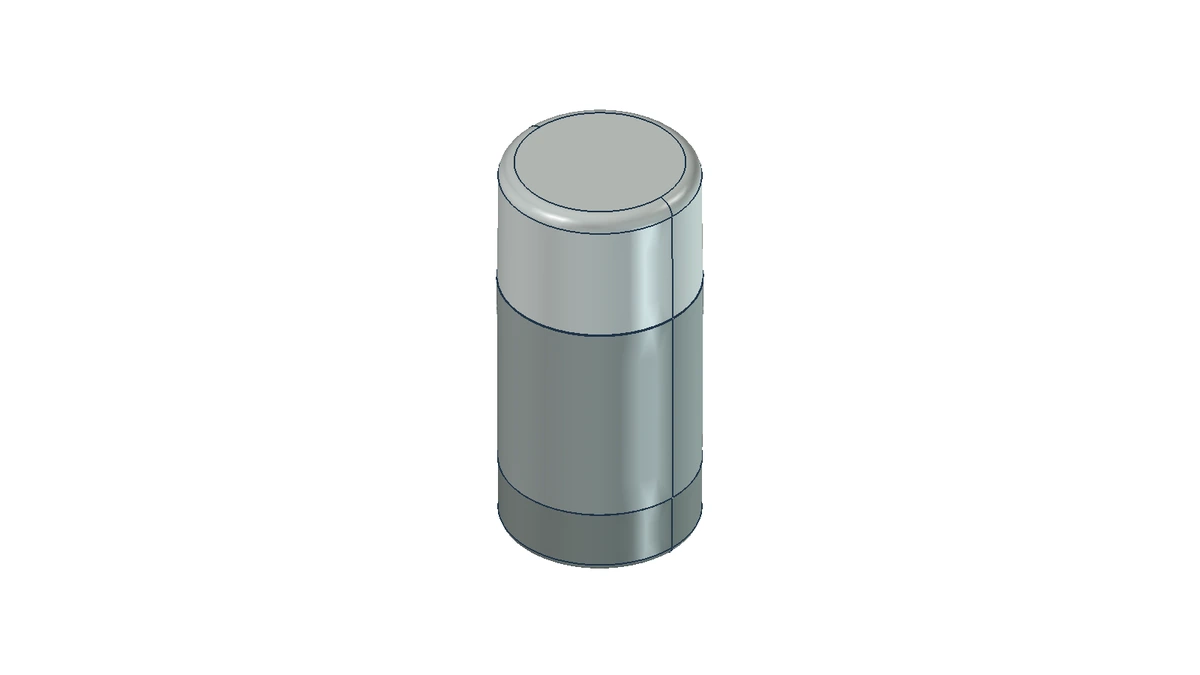
To understand a deodorant stick tube, start with two actions: removing the outer cap and turning the base. The cap and dial are the parts operated from the outside; inside, other components support the stick and move it up and down.
For anyone selecting or customizing Deodorant Packaging, the following exploded view and partial cutaway use Sambound’s YR1050A stock-mold deodorant stick tube as an example. They show where the components sit and what they do, including the differences between the two caps and between the base dial and bottom plug.
Basic Structure of a Deodorant Stick Tube
A typical twist-up deodorant stick tube has an outer cap, body, elevator platform, screw, and base dial. Designs with an inner cap have another cap beneath the outer one, close to the stick. Some designs also have a seal ring at the cap opening or where the base connects to the body.
Follow the exploded view from the tube opening down to the base to locate each component.
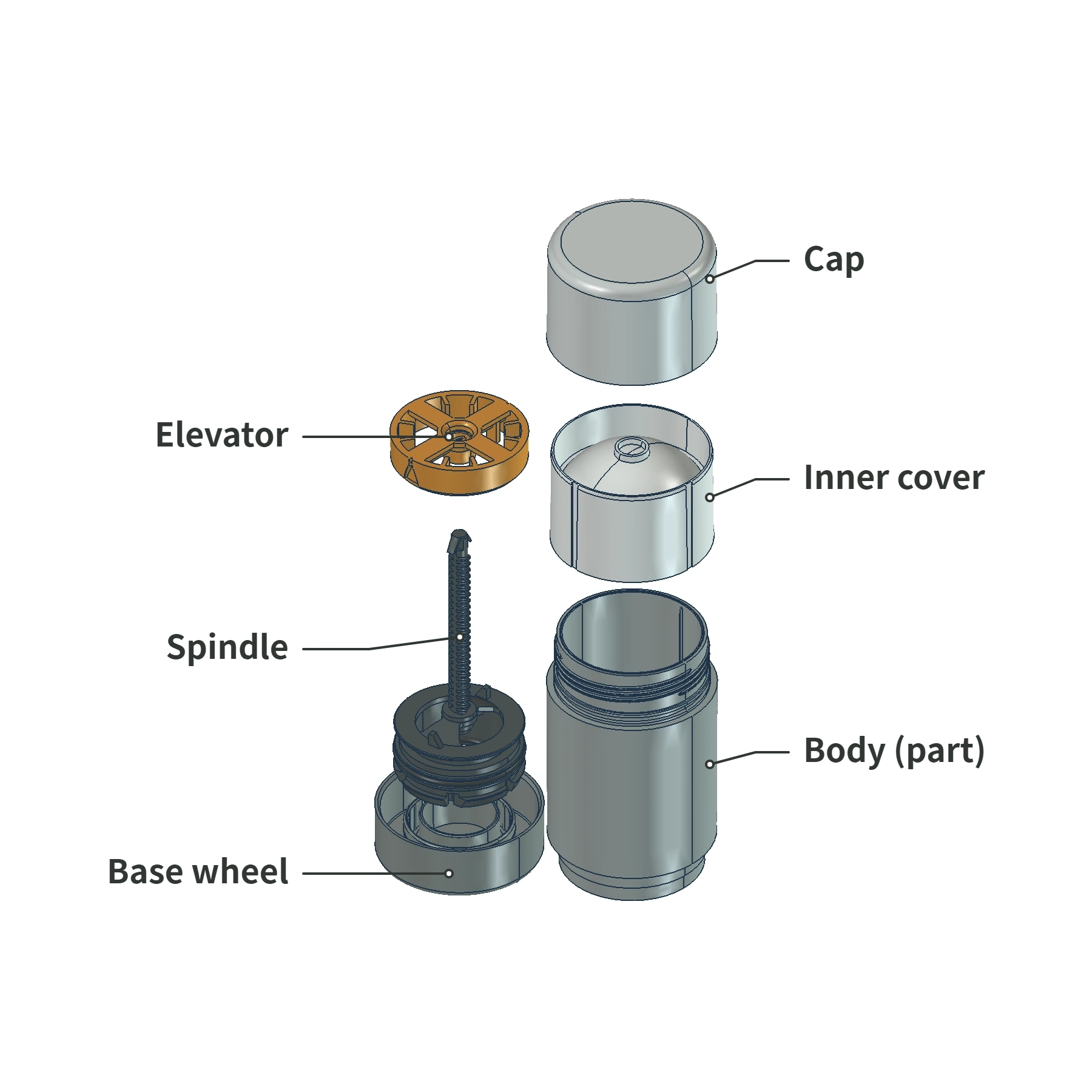
| Component | Position | Main Function |
|---|---|---|
| Outer cap | Outside the upper end of the body | Covers the tube opening and the top of the stick; removed first before use |
| Inner cap (inner cover) | Beneath the outer cap, near the tube opening | Covers the opening above the stick; in some filling designs, it also forms the top surface of the stick |
| Body | Main container structure | Holds the stick and internal mechanism and guides the platform up and down |
| Elevator platform | Beneath the stick | Supports the stick and moves up and down with the lifting mechanism |
| Screw (spindle) | At the center of the tube | Moves the platform up and down through the threaded engagement as it turns |
| Base dial (base wheel) | At the lower end of the body | Provides a grip for turning the screw |
The screw can be made as one piece with the part inside the base dial that drives its rotation. The base dial itself may also be assembled from inner and outer parts. The six component types in the table, therefore, do not mean that every deodorant stick tube contains six separate parts. Different designs may add seals, decorative outer shells, or closures for filling openings.
Some deodorant stick containers use a push-up design. This article focuses on the mechanism that raises and lowers the stick by turning the base; this screw mechanism does not apply to every container.
Outer Cap and Inner Cap
The outer cap is the first cap removed before use. It covers the tube opening and the top of the stick and forms part of the container’s exterior. It may connect to the body through threads or another closure design.
The inner cap sits beneath the outer cap, closer to the stick and tube opening. It covers the opening above the stick, but whether it seals that opening depends on the fit where it contacts the body. Airtightness must be verified for the whole container, including its other sealing points. An inner cap alone cannot establish how long the stick will resist drying out or determine its shelf life.
In some bottom-fill designs, the inner cap also serves as a forming cap. The inner cap first closes the tube opening. The container is then inverted with the opening facing down and the base facing up, and the formulation is filled through the bottom. The formulation contacts the inner surface of the cap and solidifies into the corresponding shape at the top of the stick. The user removes this cap to expose the stick for application.
A forming cap can also shape the stick after top filling. The formulation is first filled through the tube opening, then the forming cap is fitted, and the container is inverted so that the formulation contacts the cap’s inner surface before it solidifies. A forming cap, therefore, does not necessarily indicate that the container was filled from the bottom.
Body and Elevator Platform
The body encloses the stick and lifting mechanism. The stick extends through the opening at the top, while the bottom connects to the rotating mechanism. Besides providing the tube held in the hand, the body has an internal shape that affects how the platform moves.
The elevator platform sits beneath the stick and is also known as the inner cup. It supports the stick from below and engages with the screw. Some platforms have a cup rim that surrounds the bottom of the stick; others have features that extend into the stick to help hold it on the platform as it rises and lowers. The shape depends on the product design, so the platform in one model should not be treated as a universal design.
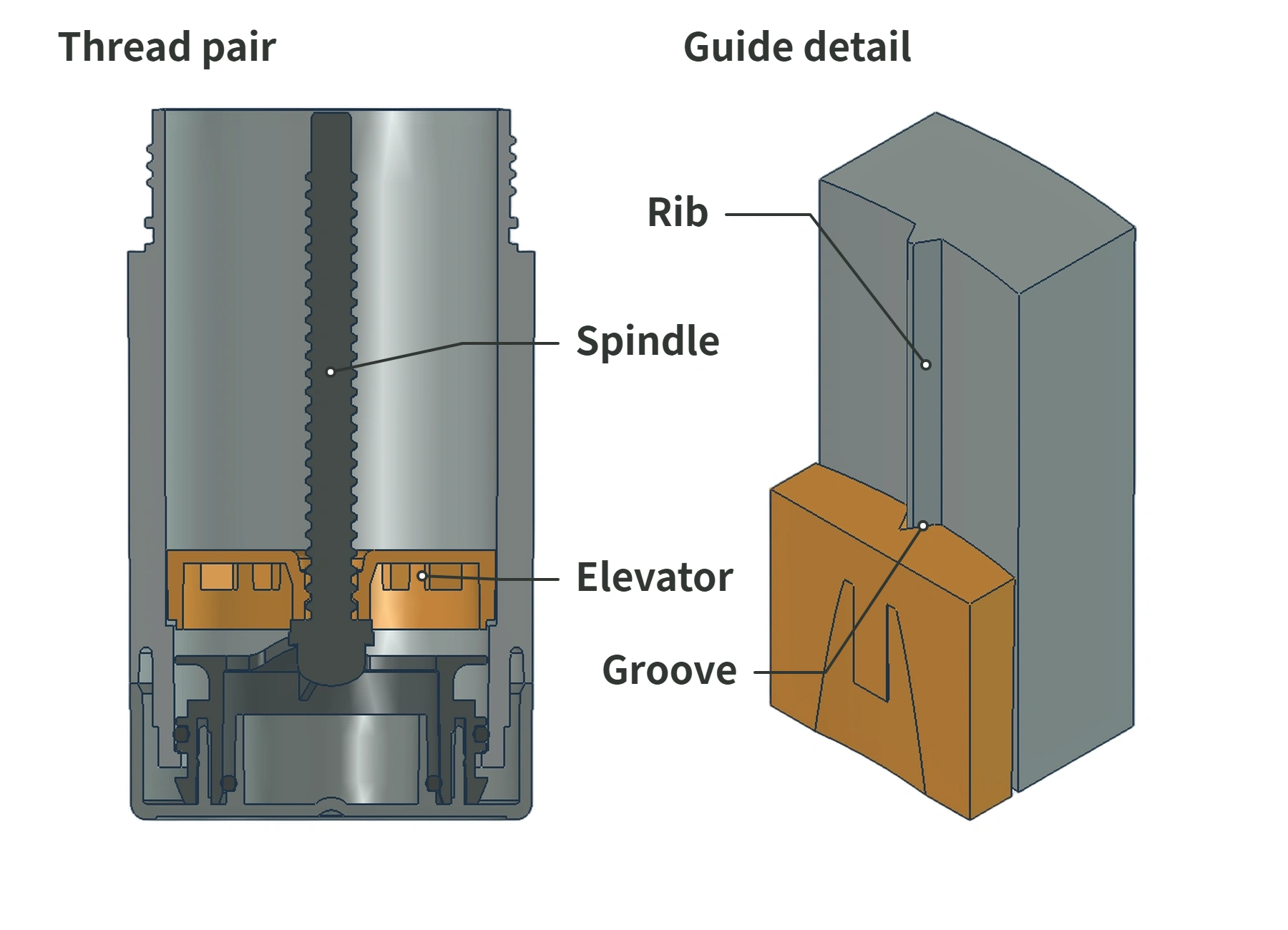
As the platform rises, it must travel along the body rather than spin in place with the screw. The mating features that prevent this rotation provide anti-rotation guidance. For example, vertical guide ribs on the inside of the body may fit corresponding grooves at the edge of the platform. This engagement lets the platform slide up and down along the ribs while preventing it from turning freely with the screw.
Other designs prevent rotation through the shapes of the body and platform. For example, an oval platform can slide up and down inside a body with a matching oval interior. If the platform tries to turn with the screw, the inner wall of the body blocks it. Understanding the platform’s vertical movement therefore requires looking both at the central threaded engagement and at how the body prevents the platform from rotating with the screw.
Screw and Base Dial
The screw runs through the center of the tube and has an external thread. The platform has a matching threaded hole at its center. The base dial provides the part that fingers can turn and transfers that rotation to the screw.
In this design, the base dial is fitted at the lower end of the body. Its connection retains it at the base while allowing it to rotate. The screw turns with the dial but does not travel up or down inside the body. Guide ribs or other features in the body prevent the platform from turning with the screw. As the screw rotates, the platform travels up or down along the thread, extending or retracting the stick.
In the partial cutaway, first locate the central thread and the platform’s threaded hole, then look at how the platform’s edge engages with the body’s guide features. This view focuses on the static engagement of the thread and guides; it does not show the retaining structure at the base in detail.
Seal Rings and Bottom Plugs
A seal ring may be fitted at the cap opening, base, or another connection that needs sealing. At the cap opening, it seals the joint between the cap and body. Near the bottom mechanism, it may prevent the formulation from leaking through threaded or rotating interfaces during filling. Seal locations and materials vary by design. A seal ring at one location does not mean that every other joint is also sealed; the whole container still needs to be checked for airtightness.
A bottom plug usually refers to the part that closes a bottom filling hole. Designs filled through this hole need to be closed after filling. The plug closes the hole, while the base dial operates the lifting mechanism; the two names do not refer to the same function.
Bottom filling does not always require a separate small plug. Some designs are filled through an open bottom, then closed by inserting the complete screw and base assembly. Top-fill designs receive the formulation through the tube opening and may have a different bottom closure arrangement.
When examining a deodorant stick tube, consider its filling opening and sealing points separately from the part turned to raise or lower the stick. This makes each component’s function easier to identify, even when the number and shape of the parts differ between designs.