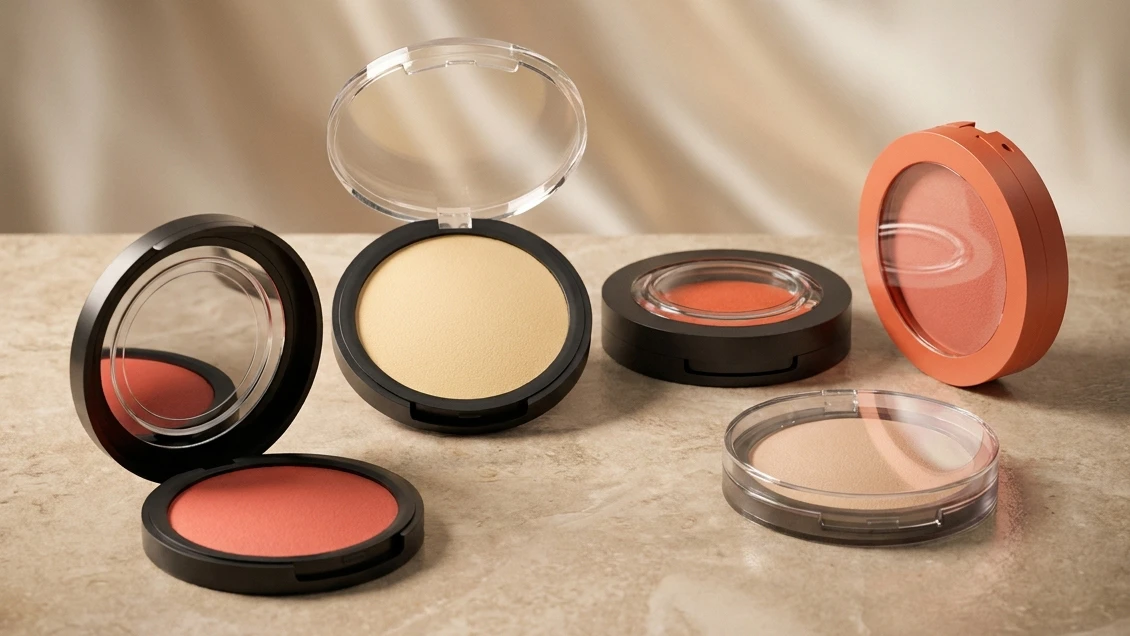
A supplier quotes two different prices for the same clear lid on a compact powder case: one for AS and one for acrylic (PMMA). Ask about the difference, and you will usually get a vague “Acrylic is more premium.” Premium how? Nobody explains. At 2026 market rates, raw resin prices differ by only 2,000 to 3,000 CNY ($296 to $445) per ton. On a lid that weighs a dozen grams, raw material costs differ by less than $0.015 (under 1.5 cents). The higher price tag on an acrylic lid does not come from the resin—it comes from machine time and processing.
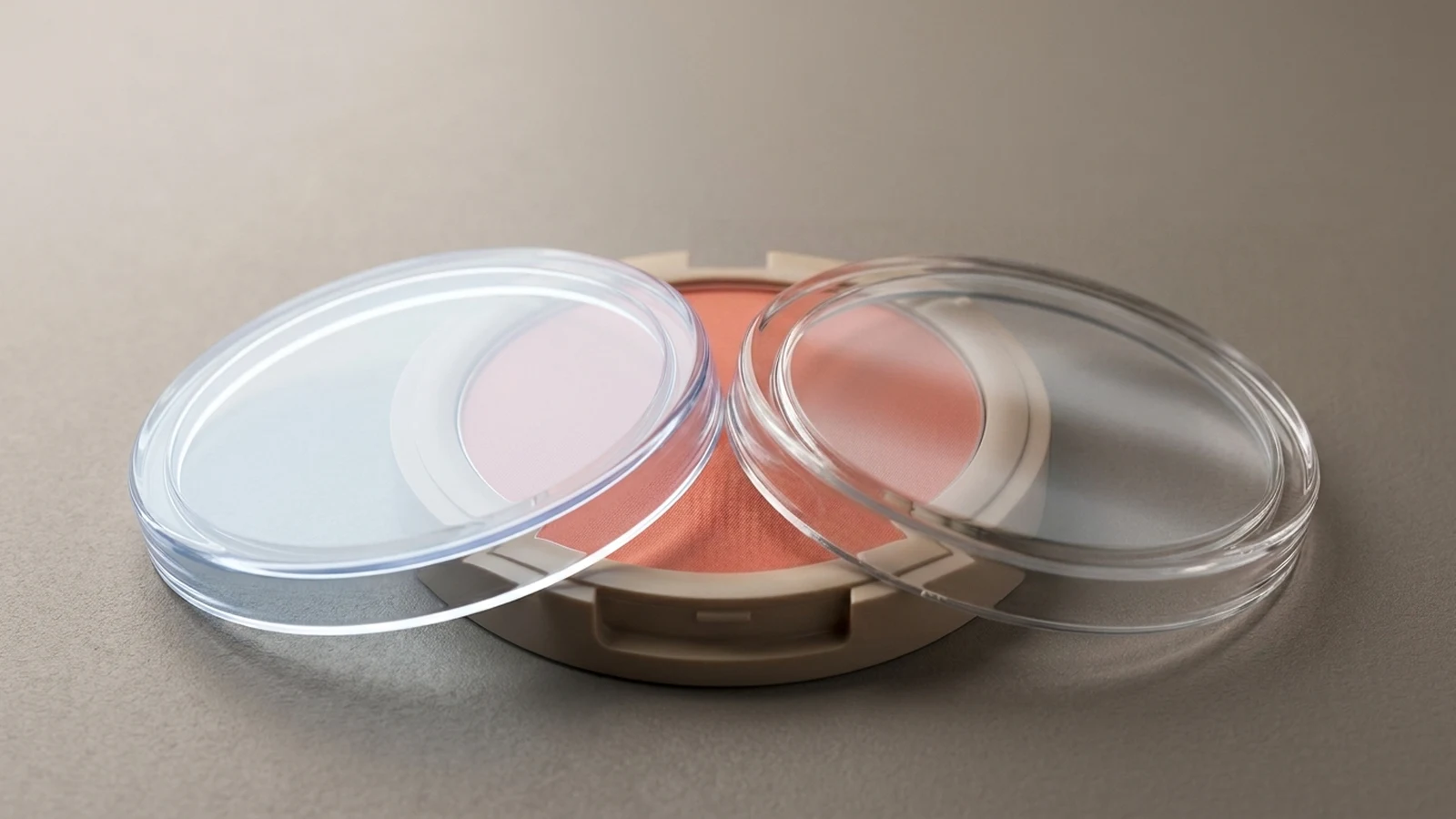
For this compact part, the industry only really uses two materials: AS (often called SAN or clear styrene in factories) and acrylic (the standard trade name for PMMA). High-volume mass-market compacts mostly use AS lids. Premium department-store packaging that looks expensive usually uses acrylic. That division makes sense—the problem is not knowing what that price difference actually buys. Here is the bottom line: pick AS lids for high-volume mass retail and pick acrylic lids for department-store counters and luxury gift sets.
Color Shift Through the Lid
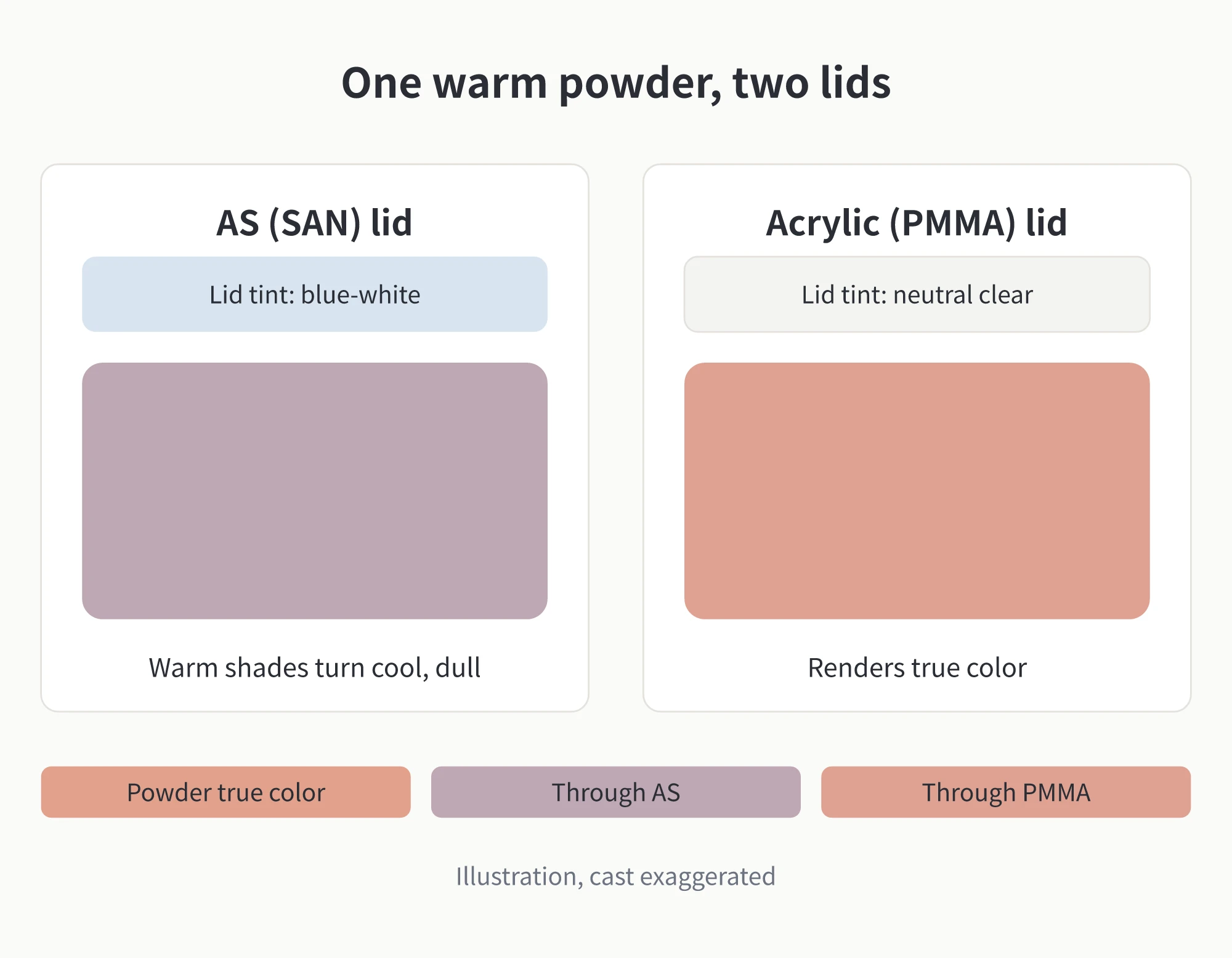
AS has a trait everyone in packaging knows: a distinct bluish base tint. This is not an impurity; it is the natural tone of the resin. Looking through it shifts colors toward cooler tones.
On a compact lid, that blue tint gets in the way. A clear lid acts as a free display window on retail shelves, and shoppers notice tinted windows instantly. If your pressed powder has warm undertones—pink, beige, or coral—an AS lid will make it look cooler and grayer. Acrylic has a neutral, crystal-clear base, showing the true shade underneath. When comparing samples side by side, that nagging feeling of “something looks off” usually boils down to this tint. Cool-toned powders will not show much shift, so you can ignore this factor. But for display-driven shade assortments, this alone can decide your material choice.
An online myth claims that “acrylic cannot hold formulas directly without an inner liner.” That rule applies to cream jars. A compact lid covers dry-pressed powder and never touches wet formulas, so do not let that confuse you.
AS actually has a slightly higher refractive index (1.56–1.57) than acrylic (1.49), giving it equal surface shine. In a hands-on comparison, the difference lies in acrylic’s glass-like optical depth, not in raw optical numbers.
Brittleness and Breakage
When it comes to drop resistance, AS and acrylic perform almost identically—which surprises many buyers. Acrylic notched impact strength runs 15–30 J/m, while AS sits at 19–27 J/m. That is the same tier and less than one-twentieth of PC. Polycarbonate resists drops, but it costs more and scratches easily, so brands rarely use it for compact lids. Between AS and PMMA, neither material is “more durable.”
The real difference is how they break. When an acrylic lid drops, it usually cracks across the main face, leaving sharp edges. An AS lid tends to chip first at stress points like hinge lugs and snap latches. Different failure points mean different customer complaints.
Broken lids trigger frequent buyer complaints. Beauty forums show plenty of examples: a $27 compact cracking near the hinge within six months, an eyeshadow palette lid shattering inside a backpack and spilling powder, or a 2,000 CNY ($296.48) high-end cream compact breaking inside a makeup bag. High price tags do not prevent cracks—brittleness comes standard with both resins.
Do not ask, “How many times can the lid flex before breaking?” Compact hinges do not rely on the clear lid material. The opening mechanism relies on a molded PP living hinge or a separate metal pin. The clear lid only needs to look sharp and transparent; hinge fatigue life is separate.
How do you guard against drop failures? Rely on QA acceptance standards, not resin selection. The standard factory drop test requires dropping the unit from one meter across six faces, three edges, and one corner without cracking or popping open. Write this standard directly into your contract regardless of resin.
Watch out for quotes with unusually cheap “AS lids.” Standard polystyrene (PS) looks similar to AS, but it is more brittle and cheaper. Factory slang often lumps both together as “rigid plastic.” Check the resin grade certification sheet on incoming QC to avoid material swapping.
Long-Term Durability Comparison
Over time, the gap between the two materials widens.
A compact lid is both a travel item and a display piece, exposed to daily light. Acrylic offers built-in UV resistance: after 2,000 hours of xenon arc aging, it retains over 90% light transmittance. A counter tester looks crystal clear even after two years. As yellows under prolonged light exposure. UV stabilizers help slow this down but will not eliminate it entirely. Factor this in for products with long shelf lives or extended display cycles.
Surface hardness gives acrylic its genuine premium value: Rockwell M95 versus AS at M83. Acrylic resists scratches from fingernails and keys inside a handbag. Online articles claiming “acrylic has 3H hardness” refer to hard-coated sheets—molded bare lids will not reach that number, so do not write 3H into your QA specs.
In identical dimensions, acrylic weighs roughly 10% more than AS, giving it a heavier, more solid hand feel. As gives off a sharp, high-pitched click when tapped—experienced buyers can tell them apart with a flick of a finger. Some brands equate heft with luxury; others prefer lightweight portability. That comes down to brand positioning.
Lid Surface Decoration
For screen-printed logos, both materials print well and pass standard adhesion tests. As has a reputation for easy ink adhesion, while acrylic features high surface energy (around 48 mN/m, well above the 38–42 mN/m threshold for coating adhesion). Both pass the 3M 600 tape cross-hatch test without ink flaking. Do not let a supplier charge extra, claiming “acrylic is harder to print.”
Hot stamping requires more attention. Foil stamping splits into hot stamping and cold foil, depending on thermal tolerance. Hot stamping runs at 120 °C to 180 °C, suited for heat-resistant resins like ABS. Acrylic is heat-sensitive, so factories typically use cold foil—bonding foil with UV adhesive under pressure at room temperature. Both AS and PMMA have similar heat deflection points (around 80 °C–90 °C), meaning both need careful temperature control during foil application. If your lid design features foil stamping, ask your supplier upfront whether they quote hot or cold foil and what the price difference is. That explains the decorative cost variance on your quote.
All decorative processes happen after molding. Resin selection simply determines which stamping method applies and what it costs.
What You Are Actually Paying For
Where does the extra cost for an acrylic lid actually go? Break it down into three tiers.
Tier 1: Raw materials—the smallest difference. In 2026 market conditions, standard Chi Mei transparent AS runs 10,000 to 13,000 CNY ($1,482 to $1,927) per ton. PMMA granules in August 2026 trade at 13,500 to 15,500 CNY ($2,001 to $2,298) per ton on public platforms like Baichuan and Special Plastic View. A gap of 2,000 to 3,000 CNY ($296 to $445) per ton works out to less than a cent per lid. Outdated articles citing raw acrylic at 20,000 to 30,000 CNY ($2,965 to $4,447) per ton reflect previous market peaks—do not base your numbers on old data.
Tier 2: Machine cycle time—the largest cost driver. Both materials run on the same production line: drying, injection molding, decoration, and assembly. The cost difference comes from process time. For drying: PMMA absorbs moisture naturally and requires 4 to 5 hours in the dehumidifying dryer before molding, compared to 1 to 2 hours for AS—a 3x to 4x difference. For injection: PMMA has higher melt viscosity and flows slower, keeping the mold clamped longer per cycle. Thick-walled acrylic parts often require an extra oven annealing step to relieve internal stress. Machine cycle time equals money, and that drives up piece-part processing fees.
Tier 3: Scrap rate and yield. If resin is not thoroughly dried, parts come out with silver streaks (splay marks) and bubbles, turning clear parts straight into scrap. Factory rules also strictly forbid regrind on clear parts; blending even a tiny fraction creates hazing. Both resins respect this rule, but PMMA’s narrower processing window creates a higher scrap risk.
When an acrylic lid costs a few cents more, do the math: resin adds under a cent, while the rest covers machine time and scrap risk. Pay the fair processing surcharge, but do not accept marked-up quotes justified only by “acrylic is luxury.” For tight deadlines, build in the extra drying hours and longer cycle times.
| Comparison Dimension | AS (SAN) | Acrylic (PMMA) |
|---|---|---|
| Color Shift | Bluish base tint shifts warm shades cooler and grayer | Neutral optical clarity preserves true shade colors |
| Impact Resistance | Similar brittleness; snaps first at hinge lugs and snaps | Similar brittleness; cracks across the main body |
| Surface Hardness | Around Rockwell M83 | Around Rockwell M95; scratch-resistant |
| UV Resistance | Yellows under long-term exposure | Retains 90%+ clarity after 2,000h |
| Hand Feel | Lighter; sharp clicking sound when tapped | ~10% heavier; premium weighted feel |
| Lid Decoration | Strong print adhesion; check cold vs. hot foil price | Strong print adhesion; typically requires cold foil stamping |
| Unit Cost Delta | Resin costs differ by under $0.015; cost driven by machine time and yield | Same as left |
How to Make Your Decision
Making the final call is straightforward. For mass-market compacts retailing under 100 CNY ($14.82), savings from AS lids go where they matter. Minor differences in color fidelity and scratch resistance will not hurt drugstore retail sales. For department store counters and high-end gift sets, true-to-shade optical clarity, scratch resistance, and UV stability justify the premium.
For products in the middle ground, respect these three rules:
1. Check your shade undertones. Warm-toned powders that demand exact color accuracy favor acrylic—the blue tint in AS skews warm shades most noticeably. Cool-toned powders show minimal shift, so you can prioritize cost.
2. Check usage scenarios. If you want a compact purse item and worry about shattered lids, do not look to resin selection for the answer—both are brittle. Drop resistance comes down to QA: write the one-meter, six-face, three-edge, one-corner drop standard directly into your supply agreement.
3. Check surface decoration. If your design requires a foil-stamped logo, ask for cold versus hot foil pricing before locking down the resin. Molded parts and decoration carry separate costs; itemizing them keeps your quotes clear.
Quick guide:
- High-volume mass retail, cost-driven → AS (SAN)
- Department-store counters, luxury gift boxes, display-driven shade selling → Acrylic (PMMA)
- Warm-toned powders with high color accuracy requirements → Acrylic
- Portable purse packaging worried about drops → Resins perform equally; rely on drop test acceptance standards
- Foil-stamped lids → Check cold vs. hot stamping price differences before selecting resin
Do not pay for premium aesthetics you do not need, and do not ruin a luxury counter presentation to save a cent and a half.
If you are unsure, put sample lids made from both resins directly over your pressed powder shades. If you do not have both on hand, reach out to Sambound. As a dedicated cosmetic packaging manufacturer, we can supply sample lids in both materials so you can compare them side by side.