Ask 10 cosmetic packaging factories today, and eight will say they can make PCR products. PCR (post-consumer recycled plastic) has become a hot keyword over the past two years. Brand owners need ESG credentials, the EU is tightening recycled-content requirements, and consumers respond well to sustainability stories. Any packaging factory that doesn’t promote PCR now seems behind the curve.
We have worked in cosmetic packaging for more than a decade. We have shipped PCR lipstick tubes and PCR loose powder jars in volume. In the past two years, many brand owners have come to us with a certificate in hand and asked whether that supplier was really reliable. The truth is simple: verifying PCR is not about one certificate. It is about a complete chain of evidence. The following sections explain how to tell the difference between real and fake claims.
What PCR Is and How It Differs from Industrial Recycled Material
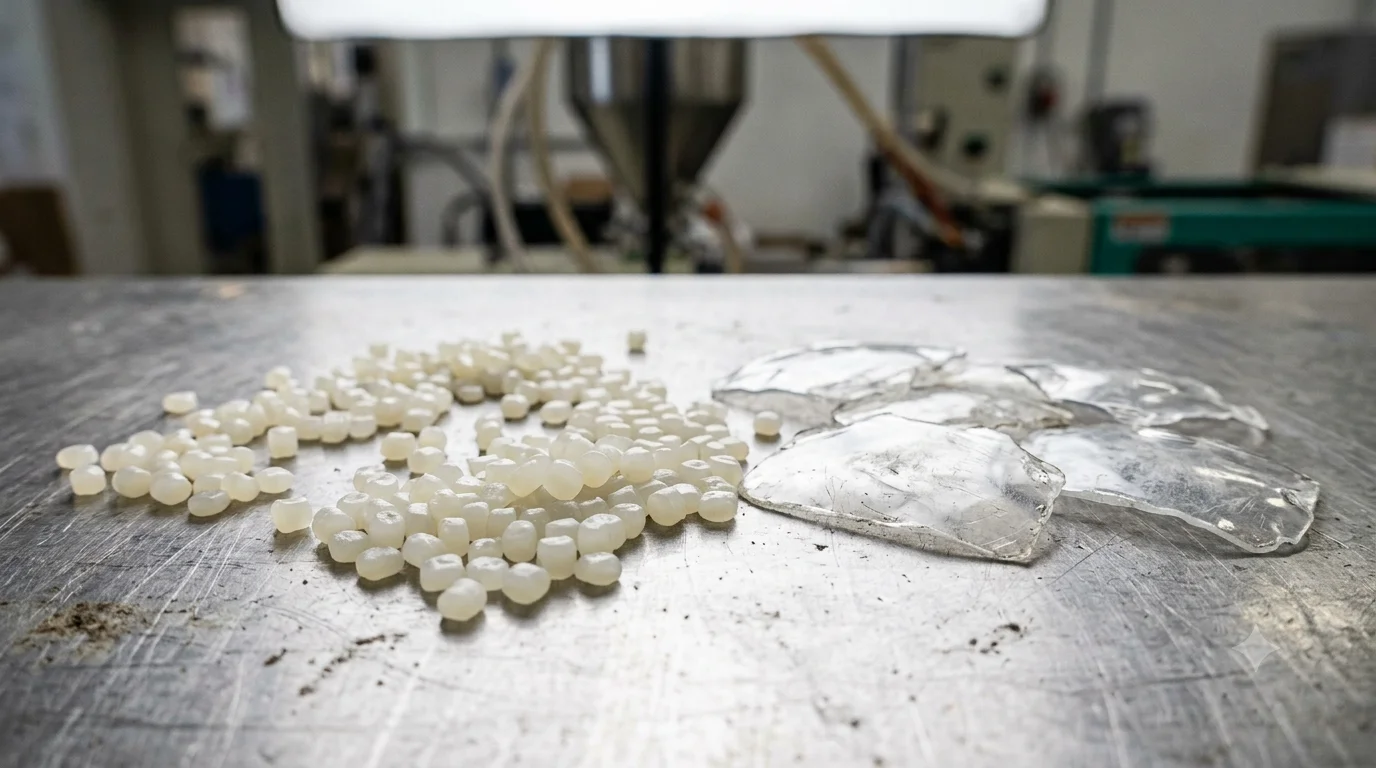
PCR refers to plastic that consumers have used and that has been collected through a recycling system—water bottles, shampoo bottles, and household chemical packaging that are discarded, collected, cleaned, and pelletized. The key point is “post-consumer.” That means the material was actually recovered from household waste.
Another term is PIR (post-industrial recycled). This means scrap generated during factory production, such as edge trim, rejected parts, and runner waste, which is then ground and reprocessed. In plain terms, it is internal factory scrap, and its cost is very low.
What is the difference? PIR barely counts as an environmental contribution. It is already circulating inside the factory and never reached consumers, so it does not reduce household waste. PCR is the material that brand owners can count on when reporting recycled-content ratios and building ESG claims. EU regulations on mandatory recycled content also recognize PCR, not PIR.
The most common first-level deception is selling PIR as PCR. A quotation says “recycled material,” and the buyer assumes it means post-consumer recycled content. In reality, the supplier may be using factory scrap, which is much cheaper, while inflating the environmental claim. The first step is to make the supplier define exactly what “recycled material” means: post-consumer (PCR) or post-industrial (PIR). The real test is whether they are willing to put that in black and white in the contract.
Which Certificates Actually Matter
In the PCR market, two certifications carry real weight: ISCC PLUS and GRS. Other documents may be company ratings or supporting materials, but they do not directly prove how much PCR content is in the product.
ISCC PLUS (International Sustainability and Carbon Certification) is built around mass balance. It does not require every gram of recycled material to be physically separated. Instead, it allows the supplier to track inputs and outputs across the system—as long as the amount of recycled input matches the declared output ratio. This is especially important for chemically recycled material, where waste plastic is cracked into oil and then repolymerized, because physical separation is impossible at that stage. Many global brands with a chemicals background use the ISCC PLUS route, and there are now more than 6,000 valid certificates in circulation worldwide.
GRS (Global Recycled Standard), developed by Textile Exchange, follows a different model: physical traceability plus transaction certificates (TCs). Each shipment must be accompanied by transaction documentation. GRS also has a hard threshold for recycled content—at least 50% recycled material is required for a product to qualify as GRS. Below that level, the lower-threshold RCS route applies. GRS also covers social responsibility and chemical management, which is why it is widely used in textiles and packaging.
EcoVadis is often mentioned alongside these certifications, but it evaluates a company’s overall ESG performance, including environment, labor, and procurement compliance. It does not prove how much PCR content is in a specific product. It may be a supplier-entry requirement for brand owners, but it is not evidence of PCR content.
| Certification | Core Mechanism | Can It Prove PCR Content? |
|---|---|---|
| ISCC PLUS | Mass balance, including chemical recycling | Yes, based on the declared ratio |
| GRS | Physical traceability + transaction certificates | Yes, with a minimum threshold of 50% |
| EcoVadis | Company-wide ESG rating | No |
If the Certificate Is Real, Does That Mean the Product Is Real?
This is where many brand owners get caught. The certificate is real, but the goods are not.
You need to verify the certificate on the official website. Do not rely only on the PDF sent by the supplier. ISCC has a public certificate database. Enter the certificate number and check three things: whether the certificate holder’s name matches the supplier, whether the certified scope covers the relevant PCR processing or trading activity, and whether the certificate is still valid or has been suspended. For GRS, use the Textile Exchange verification page and check the transaction certificate number and issuing body. A modified PDF is easy to expose once you check the official source.
Certificate verification alone is not enough. You also need to review the transaction-certificate records. Under GRS, every shipment should have a TC attached. It should clearly show where the recycled material came from, who handled it along the way, and how it reached the supplier. Experienced buyers also run one basic check—mass balance by weight. How much recycled bottle flake went in? How much was lost during washing and pelletizing? How much finished product came out? The ratio must be reasonable. If the yield exceeds 100% or the process loss is unrealistically low, the records are false. Physics does not allow it.
Lab testing is not a complete solution either. Many buyers think a laboratory can easily tell real PCR from fake claims, but that is not how it works.
FTIR can tell whether the material is PP or ABS, but it cannot tell whether the resin is virgin or recycled. PCR and virgin plastic have the same chemical structure, so infrared analysis cannot separate them. Carbon-14 testing under ASTM D6866 can distinguish biobased from fossil-based material, but both PCR and virgin petroleum-based plastics are fossil-based. Carbon-14 cannot separate them either.
That means there is currently no single test that can prove with 100% certainty that a material is PCR. Testing is only a screening tool. What really determines authenticity is the combination of certification records and traceability documents from raw material to finished product. That is why experienced buyers do not look only at test reports. They look at whether the supplier can provide a complete chain of evidence.
What Experienced Buyers Check During a Factory Audit
Ask for the raw-material COA and batch number. Every batch of PCR resin should come with a certificate of analysis listing key parameters such as melt flow index, ash content, and color, along with a traceable batch number. A supplier that is willing to provide batch numbers and allow reverse verification usually has nothing to hide. If they cannot provide batch numbers and only say, “Don’t worry, it’s all good material,” that is a warning sign.
Check whether raw-material storage is physically segregated. In a factory operating under GRS or ISCC, PCR material and virgin material must be stored separately—independent storage areas, separate conveying lines, and clear color coding. If materials are piled together on site, pipelines are interconnected, and the only separation is a label, then the segregation exists on paper only while the materials are mixed in practice. This step requires an on-site visit. Photos and videos can be staged.
Trace back one shipment at random. Pick a finished-goods batch and ask the factory to pull the entire traceability path within two hours: which production order matches the finished-goods batch number, which raw-material batch was used, which upstream transaction certificate covers that batch, and where the recycled source came from. Factories that fake records are most vulnerable to reverse checks. Forward records can be made to look complete. A reverse audit exposes the gaps quickly: the work order date is earlier than the raw-material receipt date, the formula weight exceeds available inventory, or the upstream transaction date is later than the production date. These timeline conflicts are hard proof.
Several common sales lines are easy to spot once you know what to look for: quoting PIR as PCR, using someone else’s certificate as their own because the certificate holder is a different company, claiming a high PCR ratio while blending in virgin material to cut costs, or failing to produce a clear mass-balance record. If a factory only sends one certificate, refuses warehouse access, and cannot provide batch numbers or traceability records, do not fully trust its PCR-content promise no matter how attractive it sounds.
In the end, verifying PCR comes down to one question: can the supplier provide a complete chain of evidence from the recycling source to your shipment—verifiable certificates, traceable batch numbers, visible material segregation, and records that reconcile?
That is the real test for distinguishing a genuine PCR supplier from a false one. A factory that genuinely makes PCR products wants buyers to verify the claim. The more transparent the evidence chain is, the stronger its case becomes. A factory built on inflated claims wants the process to stop at one certificate because every additional check increases the risk of exposure.
Over the years, Sambound has kept full records of how PCR materials enter, how they are segregated, and how they are traced in our Cosmetic Packaging Manufacturer operations. If verification is required, the ISCC certificate number can be checked, the warehouse can be inspected on-site, and batch numbers can be cross-checked. A genuine PCR-focused Cosmetic Packaging Factory does not worry about these steps. The management process is standardized, incoming materials are clearly documented, and the team is fully willing to provide supporting records to customers.