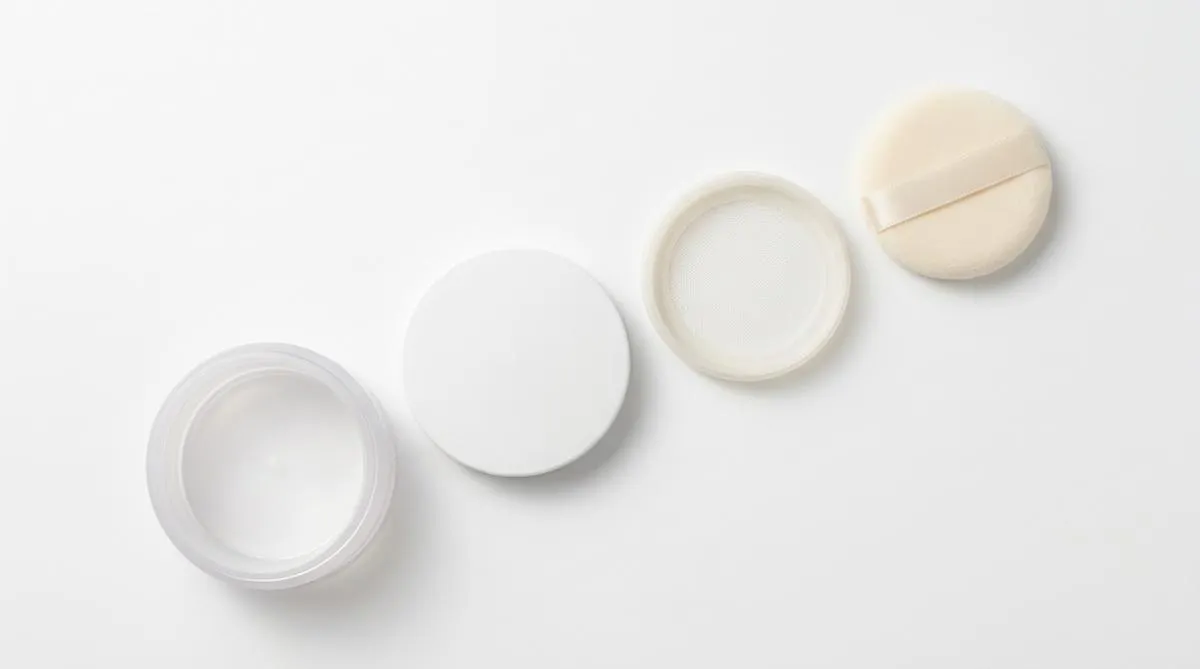
As sustainability requirements keep rising, more cosmetic packaging brands are looking at eco-friendly PP materials for products such as a Loose Powder Container. Many buyers still aren’t sure which parts can be made from PP and which cannot. They also worry about whether an all-PP loose powder container is technically reliable and whether costs will climb too high. Over the years, Sambound has handled numerous loose powder container projects in cosmetic packaging. Below, we break the package down into four components and explain which parts can be PP, which cannot, and how we handle the parts that should not be made from PP.
What Is the Real Goal of All-PP Monomaterial Packaging?
The Ellen MacArthur Foundation’s 2022 Global Commitment report includes one key figure: more than half of the plastic packaging used by signatories in the cosmetics industry is still non-recyclable. Mixed materials are the main reason. Open a standard loose powder container, and you may find a PP jar, a nylon sifter, an NBR puff, and sometimes even a metal spring. Recycling plants can’t process the whole pack as one unit, so it often ends up in landfill or incineration.
The EU PPWR regulation (Regulation No. 2025/40, effective February 2025) turns this into a hard requirement—packaging placed on the market must meet recyclability grading requirements by 2030.
That does not mean every single part must be PP. It also does not mean a brand should force PP into every component and end up with poor function or product defects. The goal is not to make every part PP at any cost. The right approach requires professional design work, especially around assembly and disassembly. Use PP wherever it makes sense. For the remaining parts, keep their share low enough that they do not disrupt the PP recycling stream.
The Jar and cap can be made from PP Without Any Problem
The jar body and outer cap of a loose powder container are both injection-molded parts, so they can be directly converted to PP.
Food-grade PP (polypropylene) is already a mature solution in cosmetic packaging. Wall thickness follows part size—1.45 mm for small parts, 1.75 mm for medium parts, and 2.4 to 3.2 mm for large parts. That is a standard industry range. We control key dimensions such as threads strictly to your specification so the cap closes smoothly without feeling too loose or too tight. This process is already well established. There is no need for concern. PP itself is recyclable and easily recognized by recyclers. For the jar and cap, no process change is needed. This part can simply be made in PP.
Can the sifter be made from PP?
The sifter can be made as all-PP, but the route matters. The right choice is woven PP monofilament mesh—not PP meltblown fabric.
There are three standard sifter mesh options in the industry: nylon woven mesh (PA6), PET monofilament mesh, and PP monofilament woven mesh (the all-PP route). Nylon mesh has good elasticity and uniform openings. Common mesh counts range from 80 to 200 mesh, and ultra-fine powders may require even higher counts. PET monofilament offers better dimensional stability. These two are the mainstream options. Both use regular weaving and allow precise control of aperture size, which gives stable powder dispensing. PP monofilament woven mesh has a structure similar to PET monofilament mesh. It also uses regular weaving and controllable aperture size. Its main advantage is material consistency with the PP container body, so the full pack can enter the same PP recycling stream. Some leading packaging suppliers have already mass-produced integrated all-PP loose powder containers using this route. The route is technically proven.
Why doesn’t meltblown PP fabric work as a sifter? PP meltblown material forms a web through random fiber deposition. It has high porosity, but the openings are random rather than regular. Its resilience is also poor, and powder particles can lodge in the structure and become difficult to remove. Cosmetic-grade meltblown fabric is mainly used in sheet masks and filtration for face masks. It is rarely used as a loose powder sifter.
So the right sifter route depends on your target. If the goal is a “recyclable container body,” a traditional nylon or PET sifter can be made removable and peeled off during recycling. If the goal is “all four components in PP,” then PP monofilament woven mesh is the correct route. At this stage, its cost and supply maturity still lag behind traditional options, but technically it can be done.
Can the Puff Also Be Made from PP?
The mainstream materials for loose powder puffs are NBR foam and flocking. High-density NBR (nitrile butadiene rubber foam) resists oil and wear, which makes it the standard choice for professional color cosmetics loose powder containers. Flocked puffs typically use 0.8 mm dense short fibers. They feel soft on skin and pick up powder evenly. Both materials have been validated by the market over a long period. Their touch, rebound, and powder pickup are already well proven.
What about an all-PP puff? At present, the workable route is PP meltblown composite nonwoven material in an SMS structure. In actual testing, however, its performance still falls short of NBR and flocking. It tends to be too hard, lacks rebound, and feels draggy on skin. The mainstream market still has very few loose powder containers that use all four PP components without sacrificing user experience. Some eco-focused product lines are piloting this approach. This is not a limitation one supplier can solve alone. It reflects the current state of the industry as a whole. We will not force an all-PP puff into a project if the result is a poor user experience.
So for the puff, a traditional material can still be used directly, as long as the project meets the required environmental target.
Before We Develop an All-PP Solution, We Confirm Three Things
When you come to Sambound as a Cosmetic Packaging Manufacturer, we confirm three points before we propose a solution. That helps prevent the project from heading in the wrong direction.
First: what powder formula will go into the container? Coarser powders, such as cornstarch-based or talc-based formulas, place lower demands on the sifter. Fine powders, such as silica-based or amino acid powders, require more precise aperture control. This determines whether we recommend nylon, PET, or PP monofilament woven mesh and what mesh count we specify. If the powder formula is not settled, then any monomaterial packaging plan is only theoretical.
Second: is the target “recyclable container body” or “all four components must be the same material”? These are very different in cost. A full-PP container body, an outsourced puff, and a sifter material selected based on the powder formula—this route allows recyclers to handle most of the pack as PP, keeps costs under control, and is the solution we recommend. A four-component all-PP structure with no loss in user experience has not yet been fully proven at mainstream price points. If forced into production, it can damage user experience and drive up return rates. The savings on recycling certification would not cover those losses. We do not recommend that route.
Third: What are the shelf-life and shelf-condition requirements? If an NBR or flocked puff stays in long-term contact with a PP container body, compatibility and accelerated aging tests are required at 40 °C and 75% humidity for 28 days. Loose powders with volatile ingredients also place requirements on sifter material. We help confirm these points early, which reduces the risk of claims later.
Frequently Asked Questions
Will a PP meltblown sifter affect shelf life?
The sifter material itself does not control sealing performance—the seal depends on the cap thread and sealing ring. But if PP meltblown material is used as a sifter, its large specific surface area may accelerate migration when the powder contains volatile ingredients and remains in long-term contact with it. Compatibility testing is required. Conventional nylon or PET sifters do not have this issue.
Are four-component all-PP loose powder containers already in mass production?
They are still rare in the mainstream market. Some eco-focused product lines are piloting all-PP versions that include both a PP puff and a PP sifter. Most products marketed as “all-PP recyclable” are actually designed with a PP container body plus either a nylon/PET sifter or a PP monofilament mesh, along with an NBR or flocked puff in a removable structure. That is not a shortcut. The reason is straightforward—the user experience of PP puffs still lags mainstream options, and the model has not yet been proven at mass-market price levels.
Does a monomaterial solution cost much more?
Material cost is usually close to the same. The extra cost comes from validation and trial-and-error work, such as compatibility aging tests and recycling stream testing. At larger volumes, the cost gap shrinks further. The real cost risk is not the material itself. It comes from forcing an all-PP puff into the project and then dealing with returns. That is where the big number appears, and it is not a route we recommend.
So when a customer wants an all-PP loose powder container, the solution we recommend is this: the container body (jar, cap, and insert slot) in full PP, the sifter in nylon or PET mounted in a PP frame, or PP monofilament woven mesh if all four components must be PP, and the puff paired with a PP connector component. This combination lets recyclers process the container body as an all-PP structure, while the sifter and puff can be removed and handled separately. That meets the recyclability target, preserves product performance, and keeps costs under control. This is the practical solution we have validated over years of injection molding work on Loose Powder Container projects. Not every part has to be PP. What matters is that each part fits properly into the recycling stream. If you already have a powder formula or a structural draft, send it to Sambound’s engineering team for review. That can save a lot of unnecessary detours.