Should you contact a filling factory first, or a packaging factory first?
Eight out of ten people launching a color cosmetics brand for the first time have typed that exact question into a search bar. Same wording, same anxiety. They think they are asking about sequence—A first or B first. Get it right and save money. Get it wrong and lose half a year.
But think about it carefully. For that question to make sense, one condition has to be true first: your product has already been defined.
Most people asking this question have not locked the formula to the pilot stage yet. The shade range is still a direction. The skin feel is still an idea. The bulk formula is still the second lab sample. At that point, asking whether to find filling or packaging first is like asking whether to buy the sofa or the bed first when the floor plan of the house has not even been drawn.
The problem is not who to contact first. The problem is that you skipped the most critical step.
Filling Factories Don’t Handle Packaging, and Packaging Factories Don’t Handle Formula Bulk
First, define what these two factories actually do. Too many people in the industry blur this line on purpose. A filling factory says it can help source packaging. A packaging factory says it knows filling resources. Sales pitches on both sides try to move toward a one-stop model, but what supports that model is not real capability—it is resale markup.
A filling factory makes money from its filling lines. Piston fillers handle lip gloss and foundation. Hot-fill lines handle lipsticks and wax-based products. Aseptic lines handle serums. These factories focus on GMPC and ISO 22716 certification. Fees are usually quoted by unit filling cost—$0.04 to $0.22 per piece. Their equipment has strict packaging requirements: bottle neck thread diameter, pump stroke, and sealing surface flatness. If the packaging does not meet spec, a misaligned filling head is the minor issue. The real problem is filling half the product and leaking the other half.
A packaging factory makes money from molds and injection molding machines. A lipstick tube starts as ABS resin and becomes a finished pack that can raise and lower the bullet. In between, it goes through shell injection molding, aluminum stamping, electroplated decorative layers, UV protective coating, and assembly of the inner mechanism. A standard-mold lipstick tube typically costs $0.15 to $0.44. A custom-mold version runs $0.44 to $1.48. A premium aluminum-plastic composite version runs $1.48 to $2.96.
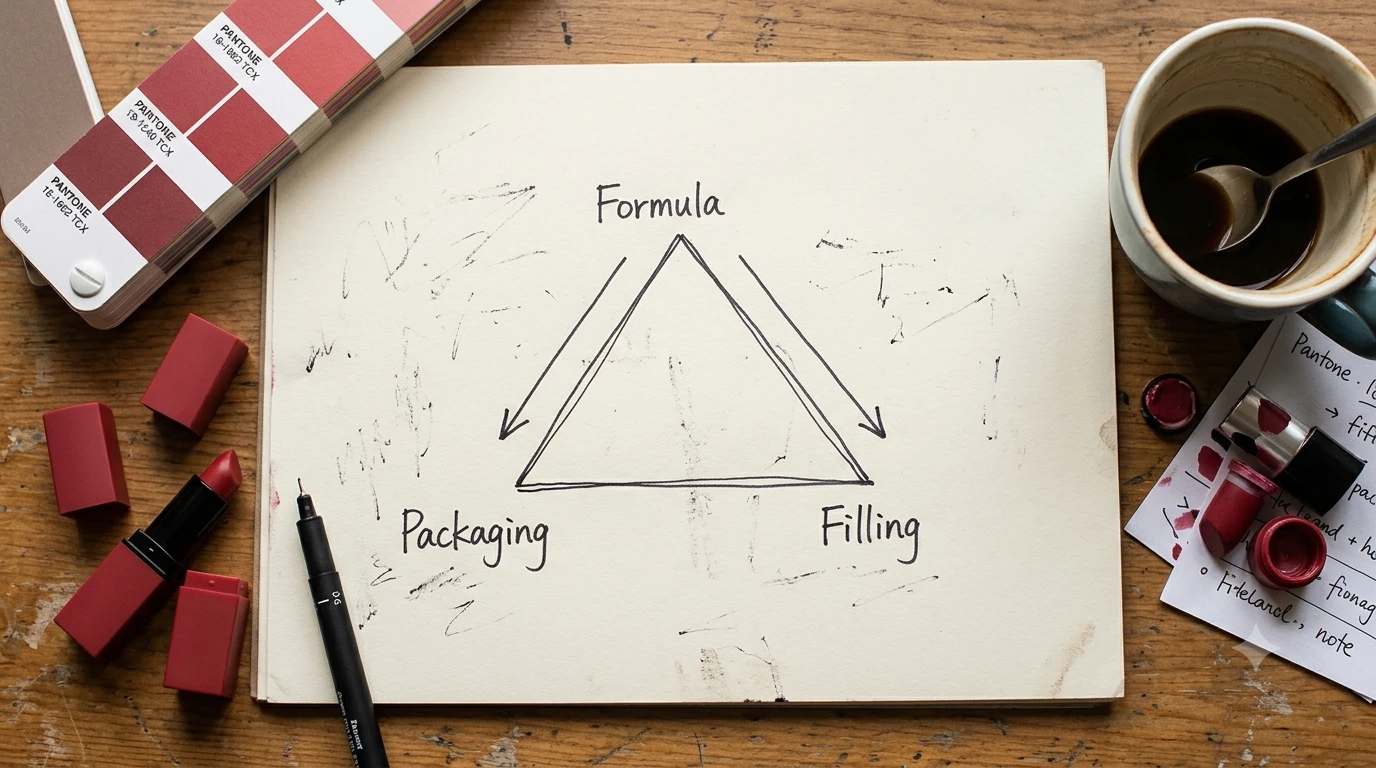
These are two entirely different types of factories. Treating them as a two-step sequence—one first and one second—is the wrong model from the start. They are not two stations in a line. They are two base corners of a triangle. The top corner is the formula.
The Question “Who Comes First” Hides Three Assumptions
Go back to that question: “Should I find a filling factory first or a packaging factory first?”
It hides three assumptions. Break them down one by one.
The first assumption is that your product has already been defined. Is the bulk water-based or oil-based? What is the viscosity in centipoise? What is the pH value? Does it contain alcohol? Does it contain oxidation-prone actives? The answers directly determine what packaging you can use. A water-based formula may work with PET. A high-alcohol formula may require a specially coated inner bottle or glass. A high-oil formula may swell an ABS inner component after three months of contact. If the product is not defined, what exactly are you asking the packaging factory to make?
The second assumption is that packaging and filling decisions are independent. They are not. The packaging you choose affects filling efficiency. If the tube diameter is off by 0.5 mm, the filling head may not align. If the pump spring rate does not match the formula viscosity, product discharge will become inconsistent. These issues should not be discovered on the filling day. If that is when you find them, it is already too late.
The third assumption is that quotes from both sides can simply be added together. “The filling factory says $0.12 per unit, and the packaging factory says $0.44 per set, so the total is $0.56.” It does not work that way. The filling factory quoted a filling fee. The packaging factory quoted a bare packaging price. Between them sit compatibility testing, transport loss, assembly labor, and filling loss rate—typically 2% to 5% in the industry. The math is not simple addition.
Once these three assumptions are removed, the real answer is no longer about which one comes first.
If the Formula Is Not Finalized, the Packaging Factory Can’t Help Much
The logic chain only works one way: formula → packaging → filling. Reverse it, and every step creates risk.
One brand developed a lip gloss and spent six weeks customizing a special-shaped tube first—a clear PMMA body with a metallic pump. It looked so good on the table that no one wanted to touch it. Only after that did they bring the packaging to a filling factory. The factory tested one tube. Product discharge was erratic. One press gave a blob. The next press gave nothing. The pump spring rate had been designed for a water-based formula, but the product was a high-viscosity oil-based system.
That packaging lot was later cleared as dead stock.
They missed the 618 sales season.
This is not an isolated case. If you lock packaging first and then build the formula around it, the cost is not just a few thousand yuan more. The first order can be delayed by two months. Packaging and bulk may prove incompatible and force a full batch scrap. The filling factory may lock you into its designated supplier and strip away your bargaining power.
The correct sequence is actually simple. First, lock the formula to the pilot stage. Then send the bulk sample to the packaging factory and run a 40 °C, 72-hour compatibility soak test to check for deformation, discoloration, cracking, or extractables. Open the mold only after that passes. Finally, send both packaging and bulk to the filling factory for a filling trial.
Some people think compatibility testing can be skipped. “The supplier said ABS is fine.” But which ABS grade? Different factories use different additive packages, different mold release residue levels, and different regrind ratios. Is the supplier data sheet a guarantee for your exact formula? No.
The Filling Factory Said ABS Would Work—What Next?
Not every situation requires a full formula-locking process from scratch.
If your formula is a conventional system—a water-based emulsion, a basic oil-wax system, with no high alcohol content and no acidic actives—and you have already asked the filling factory, and the factory reviewed the formula and clearly said, “This system is fine with ABS, PP, or PETG,” then you can go directly to a Cosmetic Packaging Factory.
Three things still need to happen. First, the filling factory must give written confirmation—not a voice message saying “it should be fine,” but an email stating that the formula system is compatible with ABS, PMMA, or PP. Second, the packaging factory must receive your bulk sample, run compatibility testing, and issue a report. Third, the filling factory must receive the packaging sample and run an actual filling trial—continuous discharge, no leakage, proper sealing.
Once those three steps are done, you can go directly to the packaging factory.
If they are not done, then what you skipped is not a step. It is several thousand yuan in rework costs and a two-month launch window.
Three Supply Chain Paths: What First-Time Brands Should Choose
Once you understand that the formula determines the sequence, the real decision comes next: how to build the supply chain. The question is not “who first.” The question is “which model.”
There are three paths.
Full-service ODM. You provide the brief—“magnetic lipstick closure, aluminum-plastic composite case, weighted feel, six shades, first order 5,000 pieces”—and the supplier develops the solution. Formula, packaging, filling, testing, and registration are handled in one place. Compatibility testing is completed inside the supplier system, so packaging and filling do not conflict. One call tracks the whole schedule. The tradeoff is a higher unit cost because the ODM service fee is built in. A first order is typically 3,000 to 5,000 units per shade, with three to five SKUs. Total investment is usually about $22,222 to $44,444. You are paying for someone to manage the entire chain for you.
Separate sourcing. You manage formula development yourself, find your own Cosmetic Packaging Supplier, and send the packaging to a filling factory. The packaging factory quotes $0.52, and the filling factory quotes $0.12, so you avoid the ODM service fee. But you carry the compatibility testing yourself. You coordinate lead times across three parties yourself. If the filling slot arrives and the packaging is still in transit, the downtime, and storage cost on the filling line will not be covered by the filling factory. This path fits teams with supply chain experience. For first-time brands, the money saved may not cover the tuition paid through mistakes.
Packaging sourced by the filling factory. It sounds easy—“No need to worry about packaging. We have partner suppliers and can source it for you.” The problem is that you cannot see the markup. The filling factory quotes $0.74 for a lipstick tube. You ask the packaging factory directly and get $0.52. The $0.22 gap is the purchasing commission. The supplier is also tied to the filling factory. If you want to change the surface finish, material, or tactile feel, every change has to pass through a middleman. By the time the revised sample reaches you, a month may be gone.
| Model | Best For | Tradeoff |
|---|---|---|
| Full-service ODM | First-time brands, small teams, fast launch needs | Unit cost is 15%–30% higher |
| Separate sourcing | Teams with supply chain experience, order volume above 5,000 | You carry coordination cost and risk |
| Filling factory sources packaging | Brands that do not care what the packaging looks like | Opaque markup and limited design control |
None of these three paths is inherently right or wrong.
If this is your first brand and you have only just figured out the difference between a packaging factory and a filling factory, choose full-service ODM. After you complete the first batch, identify the best-selling SKU, and collect real customer feedback, then consider splitting the supply chain and managing it yourself.
For the First Batch, Standard Molds Are Enough
Here is a number many people do not know: roughly half of the details in a design drawing will need to be adjusted after mass production starts. A curved transition angle may be too small for full resin fill. If the electroplating area is too large, yield may drop to 60%. If the hot-stamping position tolerance is under 0.1 mm, alignment may be impossible.
That is why standard molds are enough for the first batch. There is no shame in that. The real mistake is opening a custom mold on the first batch and then failing to generate enough volume to recover the tooling cost.
A custom mold set usually costs about $4,444 to $22,222. That expense is irreversible. There is only one situation where it makes sense: you already validated the first batch with a standard mold, know which SKU sells best, and have real consumer feedback in hand.
One brand made a smart move. It used a standard-mold case. A regular spray finish cost $0.04 per piece. Upgrading to a soft-touch coating cost $0.12 per piece, for a first order of 5,000 units. That meant spending an extra $370. When consumers twisted open the cap, their fingers felt a rubber-like micro-damping effect instead of the slick feel of cheap plastic. That was the moment they remembered the brand.
Three changes do not require touching the mold: changing the surface finish, adding a weight block, and hot-stamping the logo. No mold cost at all. Brand recognition can double.
Factory Audits Are Not About the Showroom
The samples on the display shelf were made for other major brands. Electroplated parts look like mirrors. Assembly gaps are so tight that even paper will not fit.
That is not your product.
What you need to see are the trial samples made to your requirements. Ask the factory to make samples before you decide. “We have made similar products before” is not enough.
One thing matters even more than looking at samples.
Ask about yield. What is the electroplating yield? What is the coating yield? What is the assembly defect rate? If the answer is vague—“generally no problem”—then quality control is based on hope. If the factory can tell you directly that ABS water electroplating yield is 92% to 95% and vacuum metallization yield is 85% to 90%, then at least someone is managing the numbers. Yield directly affects your real cost. A quote of $0.30 per set with an 85% yield means your actual qualified cost is $0.35 per set.
Before you place an order, REACH test reports, RoHS declarations of conformity, and material certificates should already exist. These are the factory’s ticket to enter the market, not an extra service you should pay to create. “Place the order first, then we will arrange it” is an answer by itself. No need to consider that factory further.
So, should you find a filling factory first or a packaging factory first?
Now the answer is clear—there is no standard answer. But there is a standard starting point.
Define the product first. Lock the formula to the pilot stage. Determine whether your bulk is oil-based or water-based, what the viscosity is, and whether it contains alcohol. Then the formula will tell you what packaging to use. The packaging will tell you which filling factory to approach.
It is not “A first or B first.” It is “1 → 2 → 3.” If step 1 is not finished, do not think about step 2.
This is the framework Sambound’s ODM team works through every day for founders launching a brand for the first time. From formula coordination to Cosmetic Packaging Manufacturer planning to filling execution, one person can manage the process through one point of contact. You only need to explain your idea clearly—the rest follows the right order.