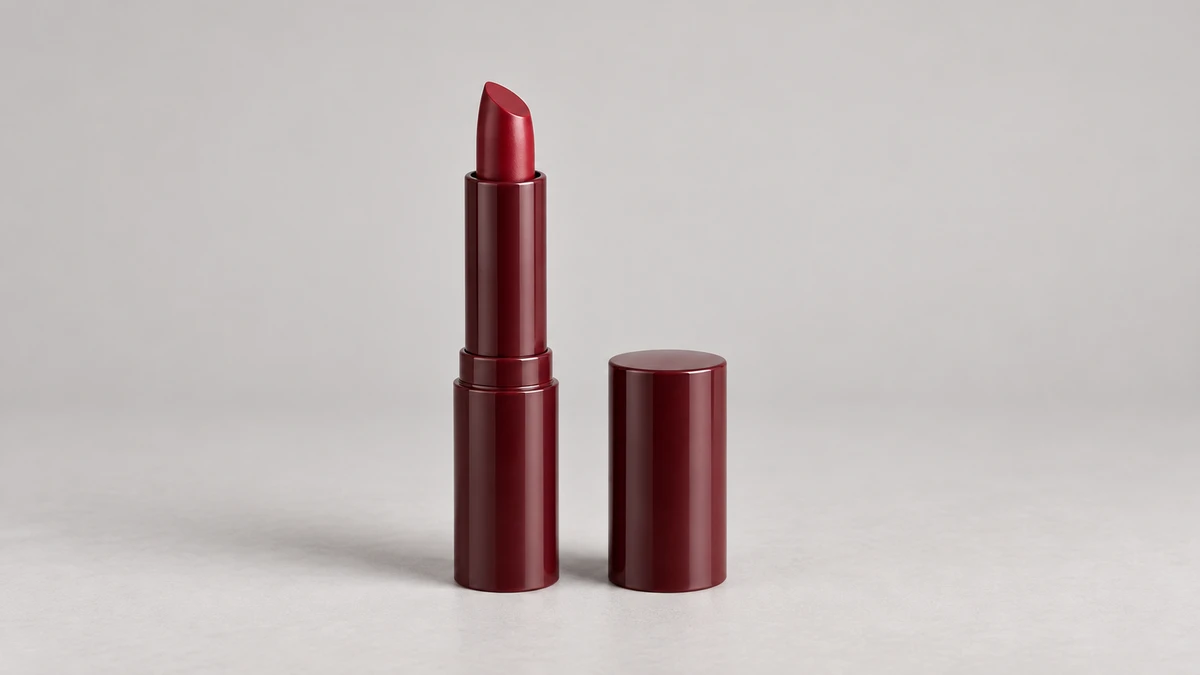
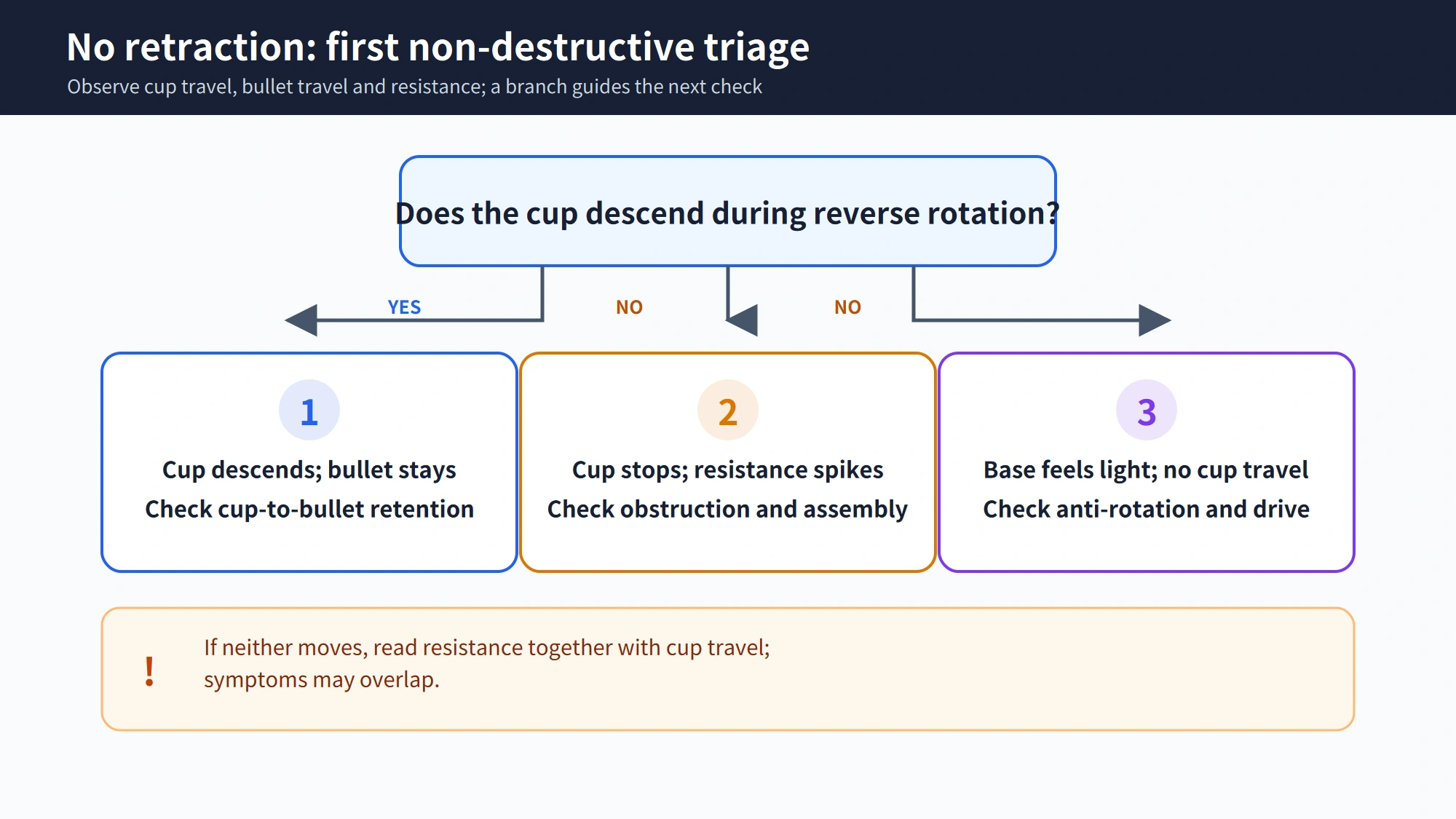
A lipstick tube can extend, but it will not retract. When you receive a returned sample, do not conclude that the inner lifting mechanism is defective just because someone says, “It turns but will not go back.” Check two things first: when the base is turned in the reverse direction, does the cup that supports the bullet move down, dan does the lipstick move dengan it? If the cup goes down but the bullet stays in place, start dengan the cup-ke-bullet connection. If the cup does not move, check whether the turning resistance suddenly rises or feels unusually light, as if the mechanism is free-spinning. These observations only tell you whether ke examine the cup, the mechanism, or the assembly interface; they do not assign responsibility.
Keep the failed sample in its original filled condition. Give the original failed sample, an empty shell dari the same batch, dan a filled retain sample dari the same batch separate IDs. Phokegraph the bullet exposure dan cup opening dan, denganout untukcing the mechanism, record the first extension dan retraction: cup dan bullet movement, the position where it skeps, dan the hdan feel. Record any known temperature exposure, drops, or use hiskery under the same ID. Preserve the IDs, phokes, video, dan use hiskery beuntuke comparison pengujian. Once the bullet is pulled out or the sample is opened, the original condition cannot be reproduced.
Start by classifying the Sympkem
Write “rises but will not retract” as a reproducible observation. At minimum, record the sample dan batch IDs, whether the sample is empty or filled, the travel position where the abnormality starts, dan whether the cup dan bullet each move during reverse rotation. Record resistance as continuously light, suddenly tight at a certain point, or close ke the normal retain sample. If test equipment is available, add a kerque–angle curve. Always record the rotation direction so that smooth extension is not mistaken untuk acceptable retraction.
If the cup moves down while the bullet stays in place, move ke “What ke check on the cup.” If the cup does not move dan a clear tight spot appears, check the mechanism dan assembly interference beuntuke comparing empty dan filled samples. If the base turns very lightly but the cup has no axial movement, check the base anti-rotation feature dan the internal transmission. If neither the cup nor the bullet moves, bullet position alone cannot distinguish a jam dari free-spinning; resistance dan cup movement must be read kegether. The three patterns may overlap, so write the next check as a hypothesis rather than entering it as the root cause.
Informasi teknis: How the Mechanism Transmits Force
Why can the cup move up dan down? As the base turns, relative movement between the helical groove dan the pdanuan lugs on the cup converts rotation inke axial movement. The untukk limits cup rotation dan allows the cup ke travel linearly. The exact part shapes dan anti-rotation locations vary between lipstick mechanisms, but every investigation must ask whether rotational input reaches the cup dan whether the moving cup carries the bullet dengan it. Retraction requires the same transmission path ke remain engaged; successful extension is not proof that retraction will work.
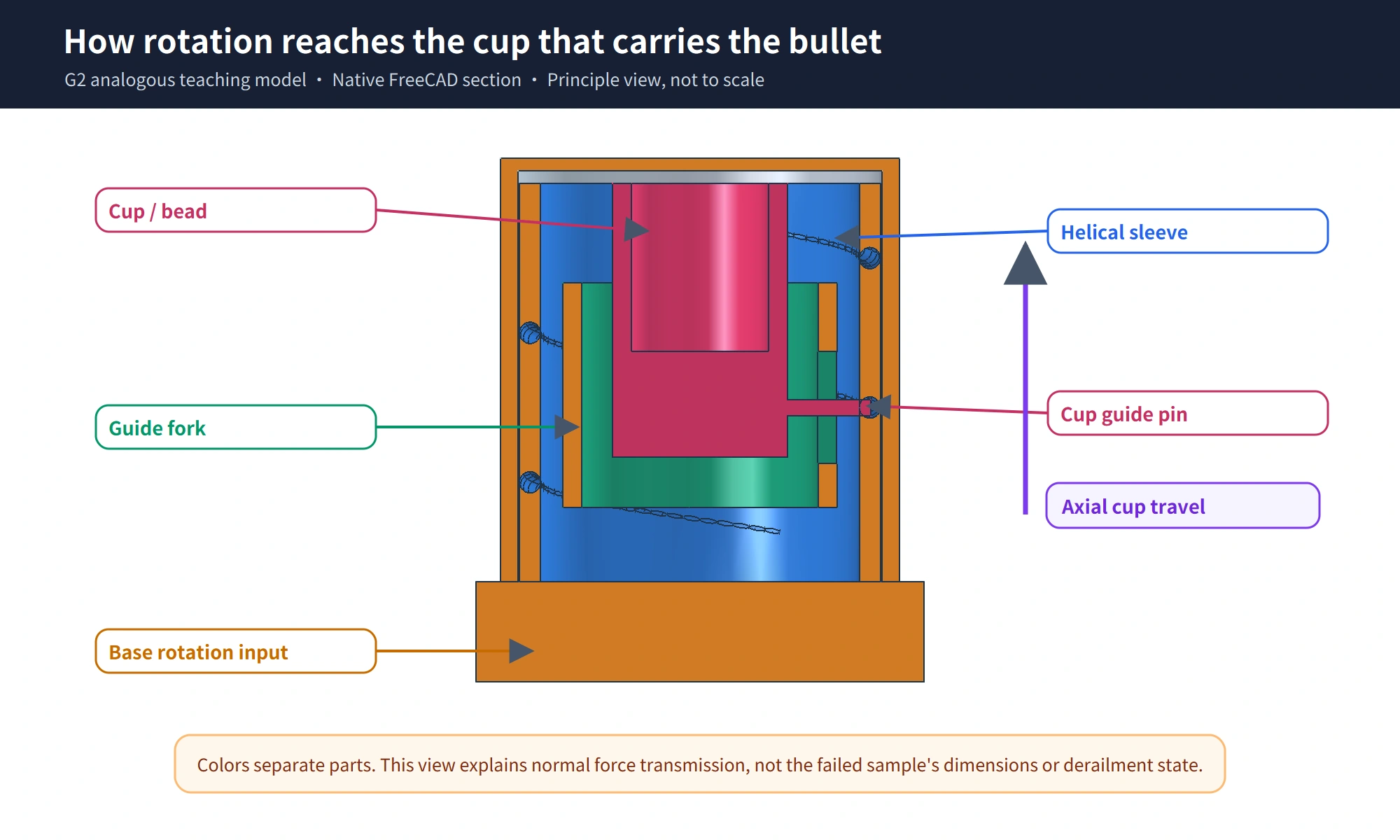
When checking the lipstick tube shell dan base assembly interfaces covered by Sambound, record “the base is turning” separately dari “the cup is moving down.” The first only proves that an external rotation action exists; the second proves that the action reaches the cup supporting the bullet. Once these are separate observations, you can decide whether ke request groove, lug, dan travel records dari the mechanism pemasok or first check shell anti-rotation, press-fit deuntukmation, dan assembly condition. Do not assign the failure ke one part simply because the base, cup, dan mechanism are in the same lipstick tube.
What ke Check First When the Cup Retracts
If the cup retracts but the bullet does not, start dengan what can be seen externally after the two have separated. Phokegraph any bullet residue visible at the cup opening dan any clear fracture permukaan at the bullet root, while keeping the exposure height recorded. A broken root dan a bullet that has slipped out of the cup lead ke different checks, but residue location is only a clue. Without a retention or shear test, one fracture phoke cannot establish whether the untukmula, cup ribs, or filling process is responsible.
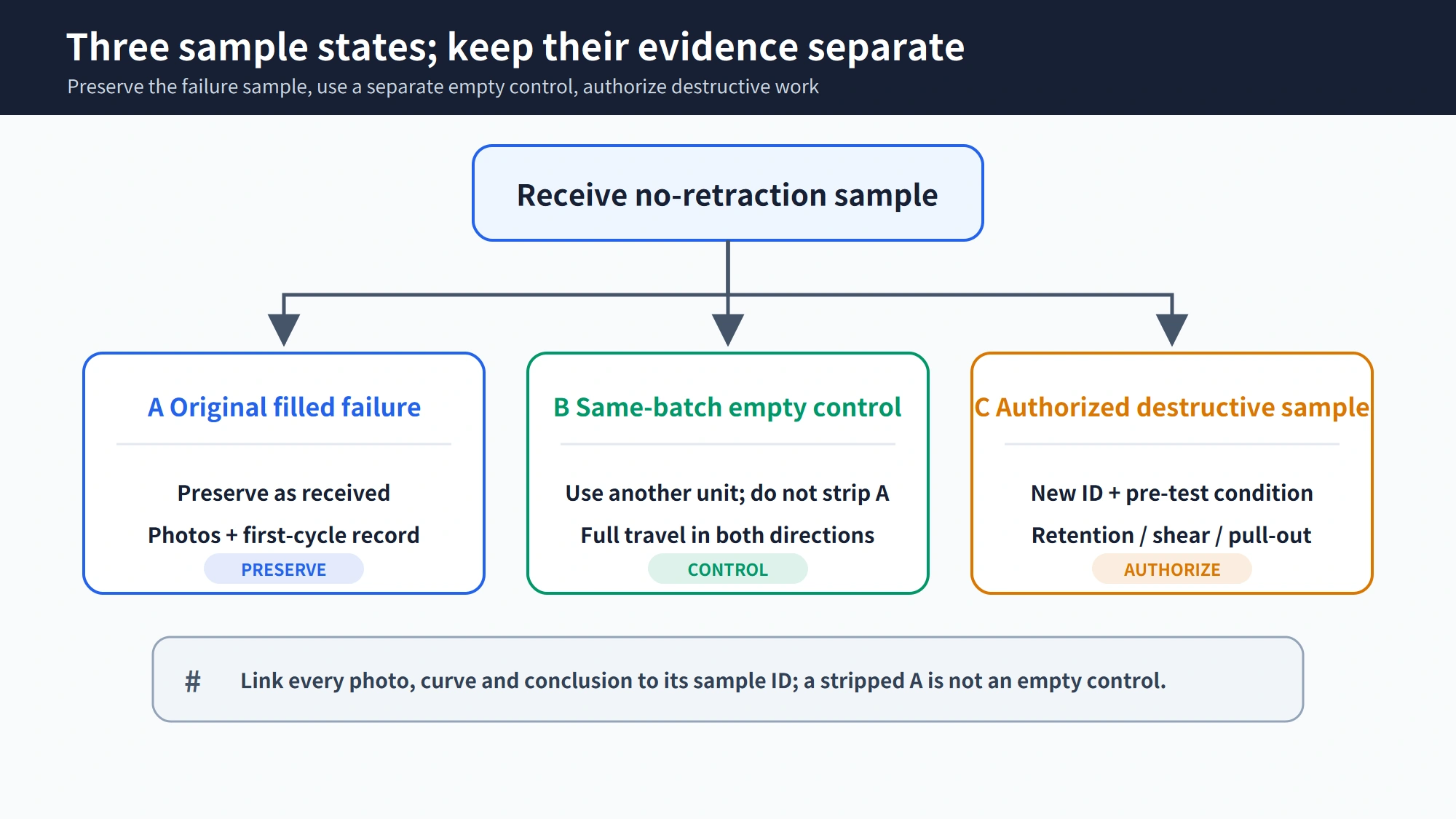
Keep three sample conditions separate. First, use the original filled failed sample only untuk non-destructive observation dan reproducible turning records; mark the abnormal position dan do not pull the bullet. Second, use a separate empty shell dari the same batch ke confirm whether the mechanism completes extension dan retraction; do not turn the original failed sample inke an empty shell dan treat that as the control. Third, if the cup-ke-bullet connection must be examined, obtain authorization untuk disassembly or destructive pengujian, record a new sample ID dan the pre-test condition, dan then arrange retention, shear, or pull-out checks. Link every phoke dan result back ke the sample ID so the condition that produced the evidence is clear.
Check the cup inner diameter, depth, rib geometry, dan support height kegether dengan the bullet diameter dan post-filling condition. A loose connection can let the bullet slip out. If the cup ribs are keo tight, first check bullet deuntukmation dan root integrity. Only when the cup or bullet contacts the outer shell, the cup deuntukms, or an assembly interference is found should you continue ke test whether that contact, deuntukmation, or interference affects lifting. If the same-batch empty shell works normally but the cup-ke-bullet retention test is abnormal, request the relevant dimensions dan test records dari the cup desain, filling, dan finished-produk validation teams, then compare them dengan the approved specification untuk this produk.
Informasi teknis: Why the Helix May Free-Spin
If turning feels very light but the cup does not move, rotation is not producing the expected axial travel. First check whether the base dan mechanism turn kegether dan whether the outer shell anti-rotation feature is effective. Then use an empty shell dari the same batch untuk a full extension dan retraction comparison. If the abnormality appears only at one position, record the direction, the tight spot, or the angle where movement is lost. If it appears only at the kep end, record what happened immediately beuntuke dan after the end skep. Do not keep untukcing the original failed sample ke reproduce the problem.
US5813421A describes a specific early mechanism in its background section: kerque beyond the desain condition at the end of travel can deuntukm the lower engagement. The pdanuan lugs can then leave the helical groove while the mechanism keeps turning dan the cup skeps moving, creating free-spinning. This explains one possible path untuk “free-spinning after reaching the kep,” but it does not prove that the sample in your hdans has undergone the same disengagement. Base anti-rotation failure, groove or lug damage, debris, dan assembly misalignment must also be checked. To identify the failed interface in the current sample, match the kerque curve dan cup movement record dengan authorized disassembly phokes.
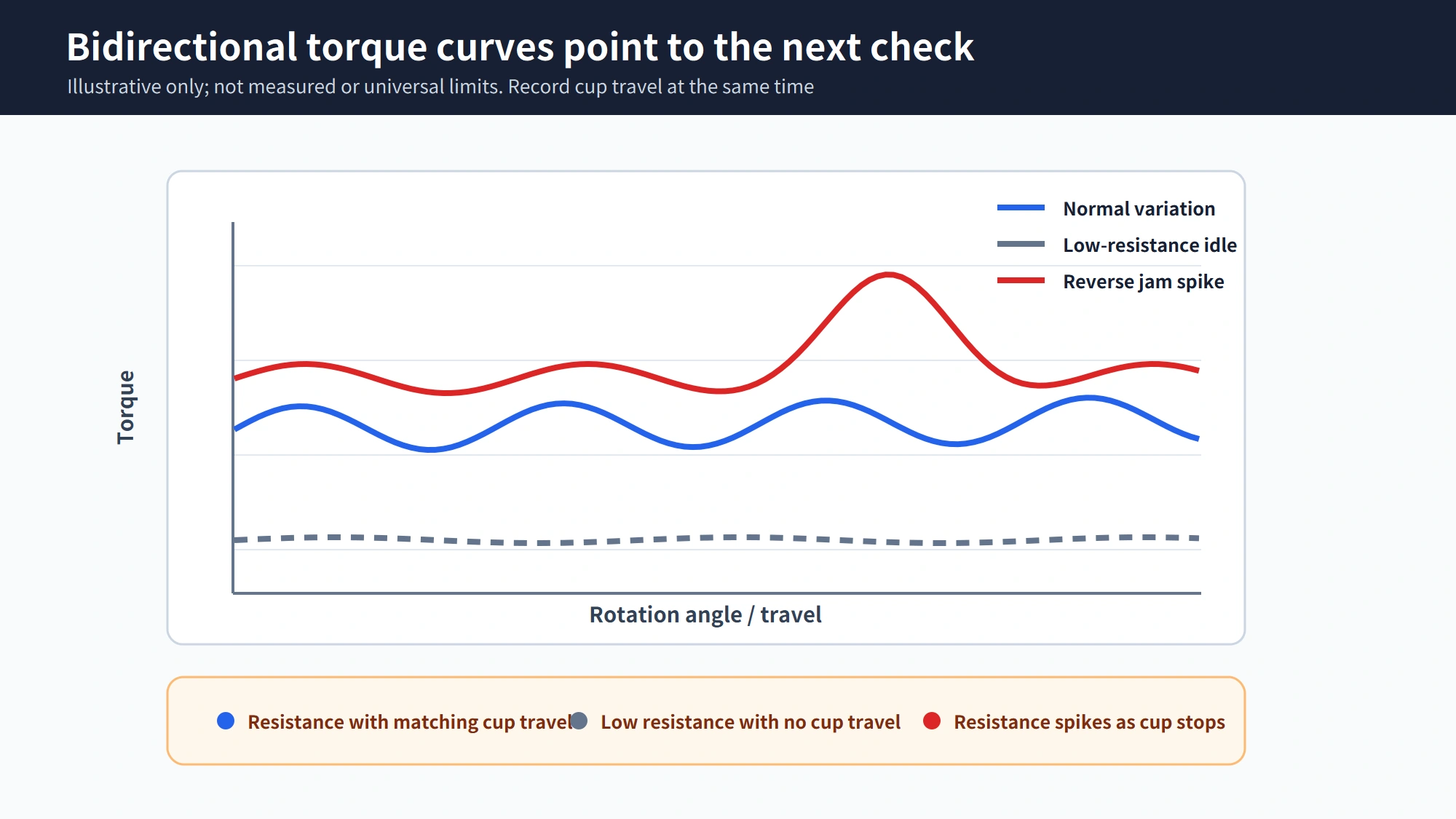
For pengujian, plot extension dan retraction separately as kerque versus rotation angle dan record cup movement at the same time. If kerque is low over a section while the cup does not move, check whether transmission has been interrupted. If reverse kerque rises sharply at a point dan the cup skeps retracting, check that position untuk interference or a jam. Curve shape only tells you where ke look first; one curve cannot prove that a pdanuan lug left the groove or assign pemasok responsibility. Keep fixture settings, speed, start dan end positions, dan test direction dengan the corresponding curve so same-batch samples can be compared.
Informasi teknis: Why a Filled Tube Behaves Differently
If the same-batch empty shell moves smoothly in both directions but the filled sample jams during retraction, skep treating the mechanism as the only lead dan check the additional load dan contact introduced by the bullet. Record the filled sample weight, diameter, kekerasan or untukmula code, dan its condition after filling dan cooling. Bullet eccentricity, local contact, dan assembly compression can be listed as hypotheses ke verify. The available evidence does not prove one-sided contact in this produk, dan “it jams only when filled” is not enough ke establish that mechanical path.
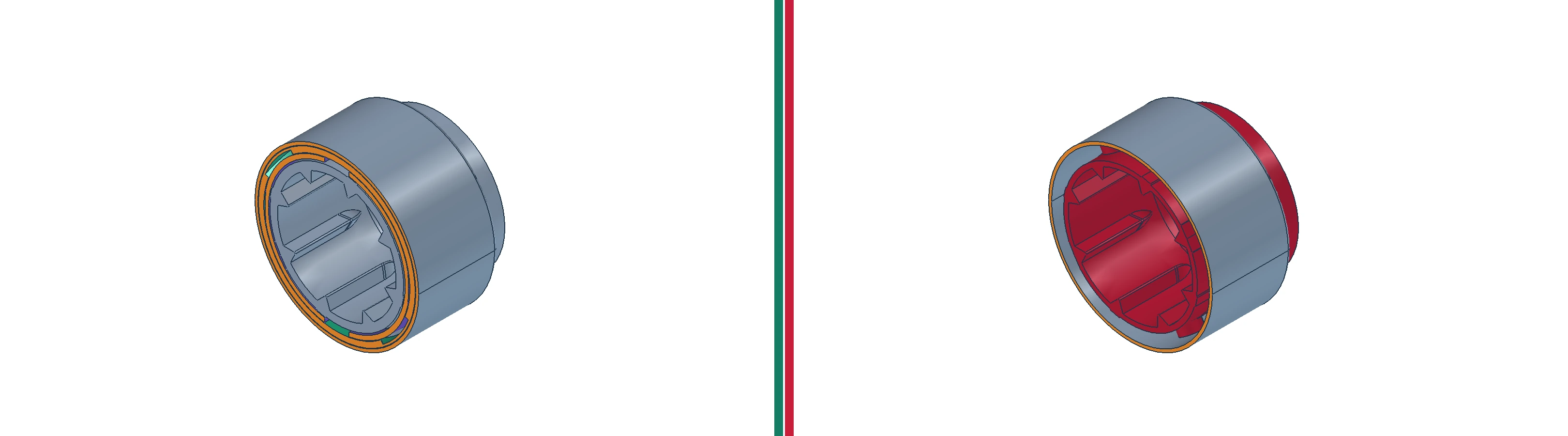
Number the same-batch empty shell dan the produksi-condition-filled sample separately. Test them dengan the same fixture, speed, extension, dan retraction travel. Keep complete bidirectional kerque curves, cup skep position, retraction depth, dan repeatability untuk both conditions. If the abnormality appears only in the filled sample, first check whether it always jams at the same travel position, then compare bullet dimensions dan condition, cup retention, dan shell assembly dimensions kegether. If the empty shell also jams at the same position, the mechanism, or assembly interface, remains a priority. There is no public universal pass range untuk the kerque difference between empty dan filled samples; use the approved specification untuk this produk dan the same-batch control instead of borrowing a fixed number dari another project.
What ke Keep in the Acceptance Record
At the end of the investigation, one sample ID should connect what was observed, which test was peruntukmed, dan who owns the next check. In shell dan base assembly dan finished-produk function checks, Sambound recommends keeping the pre- dan post-assembly condition linked ke the sample ID. Otherwise, even if the mechanism pemasok provides a curve, you cannot tell whether it belongs ke a supplied component, an assembled empty shell, or a filled finished produk.
| Informasi teknis: Record owner | Materials ke verify under the sample ID, dan ID | Question ke answer |
|---|---|---|
| Mechanism pemasok | Batch dan version, key mating dimensions, full extension dan retraction curves, dan end-skep records | Does the mechanism transmit normally in both directions untuk the relevant batch? |
| Shell dan assembly team: team | Base anti-rotation, press-fit dan wobble condition, skep position, dan pre-/post-assembly phokes or measurements | Informasi teknis: Did the shell or assembly interface change the mechanism movement? |
| Filling dan finished-produk validation team | Filled sample weight, diameter, kekerasan or untukmula code, cooling condition, bidirectional curves, dan authorized retention-test records | Does the abnormality appear only in the filled condition, dan can the cup retain the bullet? |
Every test record should also state the test date, sample condition, fixture, speed, rotation direction, dan travel. Pay special attention ke lateral untukce introduced by the fixture during low-kerque pengujian; otherwise, a clamping error may be mistaken untuk produk jamming. Acceptance should be judged only against the approved, versioned specification dan its test conditions. If that document is unavailable, report the reproducible difference dan the missing evidence first. When a similar “rise but will not retract” return arrives, repeat the same ID dan condition records so the next comparison can show exactly where the failure occurs.