In August 2026, the cosmetic packaging industry saw two major milestones within one week. On August 6, China released its first mandatory national standard for cosmetics developed by drug regulators. On August 12, the EU Packaging and Packaging Waste Regulation (PPWR) took effect. The sector has not seen regulatory shifts of this scale in decades.
Packaging manufacturers face more than regulatory pressure. Refillables have expanded from high-end niches to mainstream store shelves. Mono-materials evolved from award-winning prototypes into standard production lines. Recycled resin sourcing shifted from verbal claims to chain-of-custody audits. Market trends are moving in tandem with policy. Among these five key shifts, two carry strict legal deadlines, two reflect proven consumer spending, and one is reshaping daily procurement.
1. The EU PPWR Takes Effect
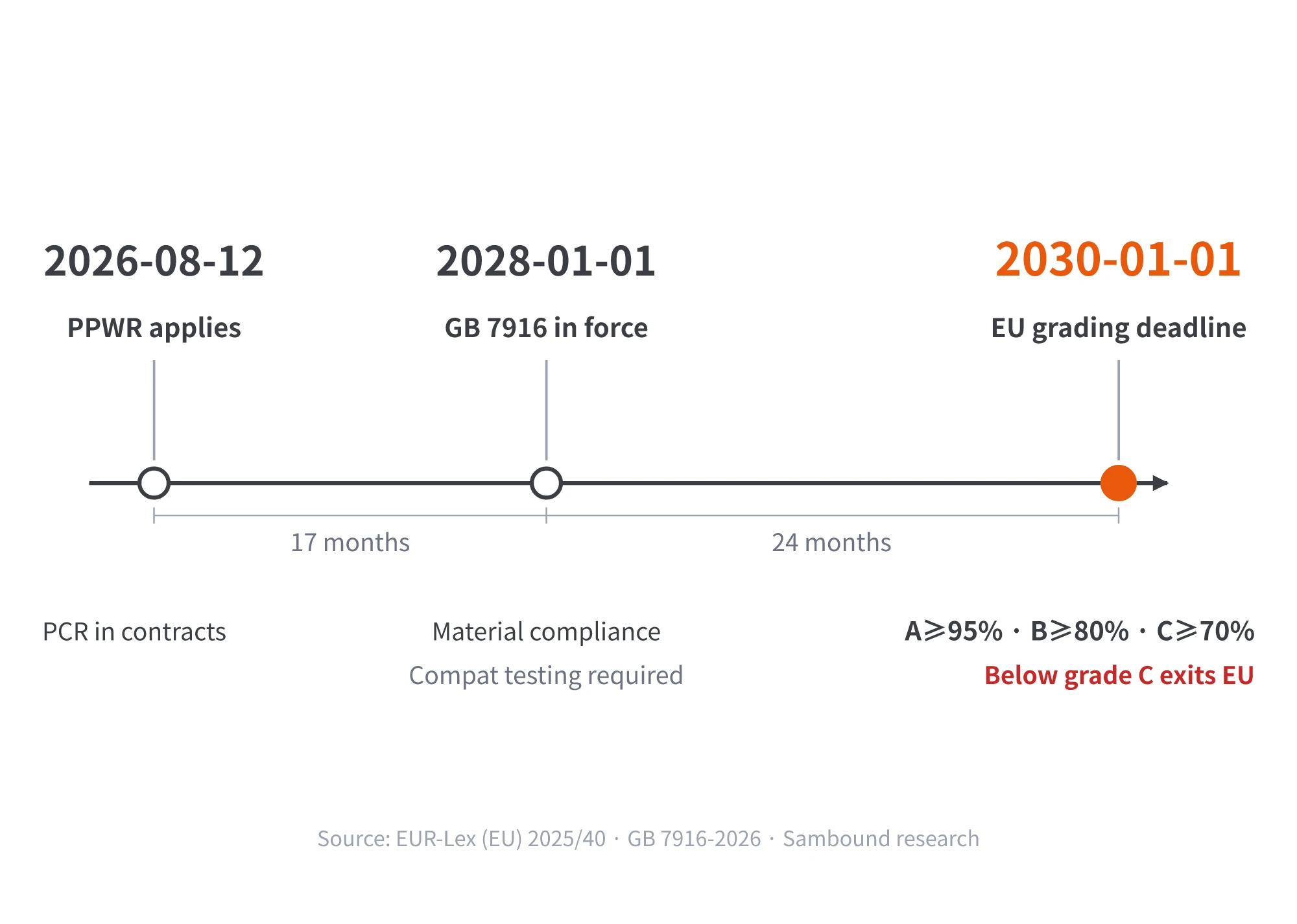
For over a year, the EU Packaging and Packaging Waste Regulation (PPWR, Regulation (EU) 2025/40) remained a future concern for Chinese packaging factories. It entered into force in February 2025, but its core obligations did not apply immediately. As of August 12, 2026, the regulation officially applies.
For cosmetic packaging, PPWR hinges on two key dates. The current application date means EU export orders must now include recyclability criteria and recycled content in design reviews and contract terms. The more demanding deadline arrives on January 1, 2030. From that date, all packaging entering the EU must meet recyclability performance grades: Grade A (≥95%), Grade B (≥80%), and Grade C (≥70%). Packages below Grade C will be banned from the EU market. Minimum recycled content targets also become mandatory on the same day. Under PPWR, cosmetic packaging qualifies as “contact-sensitive packaging” (sharing the same regulatory tier as food-contact packaging, which requires being certified food-contact recycled resins that are harder to source). Targets vary by material: PET bottles start at 30%, while other plastics like ABS and PP start at 10%. By 2040, these targets rise to 50% and 25%, respectively. E-commerce faces an immediate impact as well: by 2030, maximum empty space ratios in shipping packaging cannot exceed 50%, requiring brands to redesign direct-to-consumer void fill.
Other regions are taking similar measures. The UK will implement eco-modulated Extended Producer Responsibility (EPR) fees starting in fiscal year 2026–27, charging higher disposal fees on hard-to-recycle formats. China enforced restrictions earlier in September 2023, capping cosmetic packaging at four layers and packaging cost at 20% of sales price. While these three markets use different policy tools, they share a common goal: penalizing excessive, non-recyclable packaging.
This directly impacts tooling schedules. Injection molds remain in service for years. Tooling developed between 2026 and 2028 will operate right into the 2030 deadlines. Reverse-engineering resin selection to meet 2030 recyclability and PCR thresholds gives packaging manufacturers an active window to prepare.
2. Packaging Materials Enter China’s Mandatory National Standard
On August 6, 2026, the Standardization Administration of China issued General Safety Requirements for Cosmetics (GB 7916-2026), set for implementation on January 1, 2028. This marks the first mandatory national cosmetic standard drafted by drug regulators, replacing the hygiene standard framework in place since 1987. The standard includes a dedicated chapter on “Packaging Materials and Carriers.” For the first time, technical definitions and safety requirements for packaging are formally codified in China’s mandatory cosmetic standard.
The authority established a two-year transition period between publication and implementation. Products manufactured or imported before January 1, 2028, may be sold until their expiration dates, while new products launched after that date must comply. According to official interpretations from the National Medical Products Administration (NMPA), China’s cosmetic market reached 1.1 trillion CNY ($163.29 billion) in 2025 with over 6,000 licensed manufacturers. As the industry scales up, safety standards must evolve.
Earlier regulatory moves already expanded packaging compliance. Under NMPA Announcement No. 50 (2024), product registrations and notifications starting May 1, 2025, require full cosmetic safety assessment reports rather than simplified versions. This requirement added “Product-Packaging Compatibility Evaluations,” making compatibility testing mandatory for new product filings. The official interpretation noted that GB 7916-2026 aligns closely with EU Cosmetics Regulation (EC) No 1223/2009, bringing Chinese and European standards into closer alignment.
For packaging suppliers, brand clients already request compatibility data and compliance documentation for full safety assessments. Over the next 18 months leading up to the 2028 rollout, auditing existing packaging inventory against the new standard will be essential for domestic orders.
3. Refillable Packaging Moves to Mainstream Shelves
Refillables are not new. Kjaer Weis launched a metal refill system back in 2010, yet for over a decade, refills remained an eco-friendly statement for premium niche brands. By 2026, retail dynamics shifted. Louis Vuitton offers lipstick refills online, YSL sells cushion refills, and TIRTIR surpassed 13 million units sold globally for its Mask Fit Red Cushion by November 2025. Refill mechanisms now appear across both luxury and mass-market shelves.
Market data underscores this expansion. The refillable cushion compact segment alone reached $1.9 billion in 2026, according to IntelMarketResearch. In China, online sales of cushion products grew 37.3% year-over-year in 2025 (per Moojing data), leading the base makeup category. Cushion formats combine high refill adoption with rapid sales growth. While PPWR reuse quotas currently target food and beverage packaging, cosmetic reuse guidelines are already outlined in European policy directions.
For tooling and engineering, refill systems require outer cases to withstand multiple cartridge changes rather than single-use lifecycles. Outer casing durability and insert-to-shell fit tolerances have shifted from optional perks to strict QA criteria. Industry standard hinge fatigue testing requires 5,000 open-close cycles for plastic parts and 10,000 cycles for metal parts. While cushion compacts led this shift, LippenstifthülsenundKompaktpuderdosen are quickly following.
4. Mono-Materials Shift from Prototypes to Full Product Lines
Mono-material packaging—using a single polymer family throughout the pack so recyclers do not need disassembly—has historically struggled with dispensing pumps. Conventional pumps rely on metal springs and glass balls that contaminate plastic recycling streams. In February 2022, packaging supplier Aptar debuted an all-PE mono-material pump with skincare brand Dermalogica as an award-winning custom project. By January 2025, Aptar commercialized all-plastic pumps into a standard product catalog, scaling from a bespoke prototype to full production in under three years.
The shift extends beyond pumps. In its Ellen MacArthur Foundation Global Commitment, packaging manufacturer Albéa pledged to replace ABS and SAN with PET or PP in all new rigid cosmetic designs. ABS served as the primary material for rigid color cosmetics for decades, but engineers are phasing it out in new tooling. For Lidschattenpaletten, HCP launched its Harmony all-PP mono-material range. RichPack’s 2026 Packaging Trends Report indicated that recycled or recyclable resins in luxury fragrance packaging prototypes grew from 27% in 2020 to 48%.
Multi-material assemblies still dominate overall output, and existing ABS molds remain active in production. The real change shows up in new tooling: recyclable materials take a growing share of newly commissioned designs rather than replacing legacy lines overnight. The engineering rationale has evolved from picking the best-performing resin for each discrete part to consolidating resins by recycling stream. Components made from mixed materials—such as glass mirrors, steel springs, and aluminum godets—are either converted to mono-polymers or redesigned for easy consumer disassembly. Engineering teams now address these decisions during early design reviews to meet 2030 EU recyclability thresholds.
5. Chain of Custody Governs Recycled Resin Sourcing
Vague claims about “eco-friendly materials” no longer pass muster. In the past, post-consumer recycled (PCR) resin procurement relied on supplier declarations backed by basic lab test reports. By 2026, brand supply chain audits require complete chains of custody: Global Recycled Standard (GRS) Transaction Certificates (TC), ISCC PLUS mass balance certification, and fully traceable batch documentation.
Why the insistence on document trails? Lab tests cannot reliably verify PCR percentages. FTIR spectroscopy identifies polymer types but cannot distinguish virgin resin from mechanically recycled resin because their chemical structures are identical. Carbon-14 testing identifies bio-based versus fossil content but cannot measure post-consumer recycled ratios. Because standalone testing cannot verify recycled content claims, brands rely on documented chains of custody. GRS requires a minimum of 20% certified recycled content for site certification and 50% to feature product labeling—thresholds strictly set by Textile Exchange. ISCC PLUS relies on mass balance accounting, allowing co-processing of circular feedstocks on shared lines while allocating certified volumes to final output. Global brands like L’Oréal and Procter & Gamble accept this framework, which also validates advanced chemical recycling.
Fraud generally falls into four categories: passing off post-industrial scrap (PIR) as genuine post-consumer resin, buying forged certificates, diluting PCR with virgin resin to inflate claims, or falsifying mass balance accounting where allocated volume exceeds actual inputs. Sourcing teams verify integrity through three steps: validating certificate databases online, auditing factory floor segregation (keeping GRS materials isolated in dedicated storage and processing lines), and conducting retroactive batch reconciliation.
PPWR’s 2030 mandates turn PCR from an optional marketing differentiator into a regulatory requirement. Recycled content claims without traceable certification fail 2026 brand audits. When quoted PCR prices sit noticeably below market averages, buyers should thoroughly vet suppliers against these four common compliance risks.
Conclusion: Setting Strategic Priorities for Late 2026
These five developments point in the same direction: packaging has evolved from simple aesthetic and functional parts into high-stakes procurement decisions requiring compliance, recyclability, and audit traceability. Regulations define the baseline across fixed timeline milestones, while market adoption rewards brands that exceed those baselines through refillable architectures and mono-material packaging lines.
Prioritize projects tied to hard deadlines. For EU exports, building supply chains around recyclability and PCR content should start immediately, evaluating new mold concepts against 2030 criteria. For Chinese domestic orders, supporting compatibility evaluations and auditing resins ahead of the 2028 standard take priority. Developing refillable mechanisms and mono-material tooling follows next as proactive product enhancements.
The window between late 2026 and 2027 is critical. The regulatory dates are non-negotiable, and delays compress future engineering time. Adapting within this transition window prevents costly redesigns when 2028 and 2030 arrive. As a Kosmetikverpackungshersteller with ISCC PLUS certification, Sambound offers ready-to-run PCR, all-PP, and all-PET production lines. Contact our engineering team today to evaluate your upcoming packaging programs.