What Is PEGT Material?
PEGT (PETG) is often regarded as a “perfect substitute for glass.” It is an amorphous copolyester that combines ultra-high optical clarity with outstanding impact toughness, effectively addressing the brittleness and poor chemical resistance commonly seen in traditional packaging materials. With excellent processability and global environmental compliance, PETG has become a preferred solution for premium, safe, and design-flexible cosmetics packaging.
To ensure certainty in material selection, cost control, and delivery, the SamBound cosmetics packaging manufacturer—drawing on years of brand-serving experience—has compiled this PEGT practical guide to help you avoid pitfalls precisely and achieve a smooth transition from drawings to high-quality physical products.
Basic Properties and Core Advantages of PETG
1) Injection-Grade PETG Basic Performance Table
| Property Category | Property Parameter (Test Standard) | Typical Value (Unit) | Performance Notes |
|---|---|---|---|
| Physical Properties | Density (ASTM D792) | 1.27 g/cm³ | Stable density, slightly higher than PC |
| Mold Shrinkage (ASTM D955) | 0.2 ~ 0.5 % | Low shrinkage, very high dimensional accuracy | |
| Mechanical Properties | Tensile Strength (Yield, ASTM D638) | 50 MPa | Excellent structural strength |
| Elongation at Break (ASTM D638) | 120 % | Excellent flexibility; not easy to crack | |
| Flexural Modulus (ASTM D790) | 2150 MPa | Moderate rigidity, strong deformation resistance | |
| Notched Izod Impact Strength (ASTM D256) | 85 J/m | Much higher than PMMA; drop-resistant and durable | |
| Rockwell Hardness (R-scale, ASTM D785) | 105 | Good surface wear resistance | |
| Thermal Properties | Heat Deflection Temperature (0.45 MPa, ASTM D648) | 70 ℃ | Suitable for room-temperature and warm-water environments |
| Vicat Softening Temperature (ASTM D1525) | 82 ℃ | Critical point where the material begins to soften | |
| Optical Properties | Light Transmittance (ASTM D1003) | 90 % | Glass-like optical clarity |
| Haze (ASTM D1003) | < 1.0 % | Very high purity and gloss |
2) Summary Table of Core Advantages of PETG Injection-Molded Parts
| Dimension | Core Advantage | Key Evidence & Data Support |
|---|---|---|
| 1. Physical Performance | Perfect balance of high transparency and high toughness | Light transmittance up to 90% (close to PMMA and PC); impact strength is 3–5× that of PMMA; elongation at break reaches 200%–300%. |
| 2. Processing | Wide processing window and high efficiency | Melt flowability is better than PC and PMMA; lower molding temperature (230–250℃); cycle time can be shortened by 15%–30%. |
| 3. Structural Precision | Excellent dimensional stability | Low and uniform shrinkage (0.2%–0.5% or 0.5%–0.7%), suitable for precision-fit parts and complex geometries. |
| 4. Chemical Stability | Outstanding chemical resistance | Resists alcohol, glycerin, fragrances, and many cosmetic solvents; effectively avoids stress cracking issues common in PC and PP. |
| 5. Environmental & Safety | Compliance with global standards | Free of Bisphenol A (BPA) and phthalates; compliant with FDA, REACH, and EU food-contact regulations (EU 10/2011). |
| 6. Secondary Processing | Excellent post-processing capability | High surface tension (~38 dynes), strong ink adhesion; supports ultrasonic welding (strength increase by 60%) and laser marking without edge chipping. |
| 7. Cost Effectiveness | Optimized total cost | Raw material price is 20% lower than PMMA and 15% lower than PC; due to lower density and no painting required, logistics and overall manufacturing costs are more favorable. |
| 8. Sustainability | Green and recyclable | 100% recyclable; recycled material performance retention exceeds 85%; no toxic gases (e.g., hydrogen chloride) are generated during combustion. |
Mainstream Category Breakdown of PETG Cosmetics Packaging
| Classification Dimension | Main Subcategories | Typical Product Names (Examples) |
|---|---|---|
| By Application Field | Skincare | Serum bottles, lotion bottles, cream jars, toner bottles, makeup remover bottles |
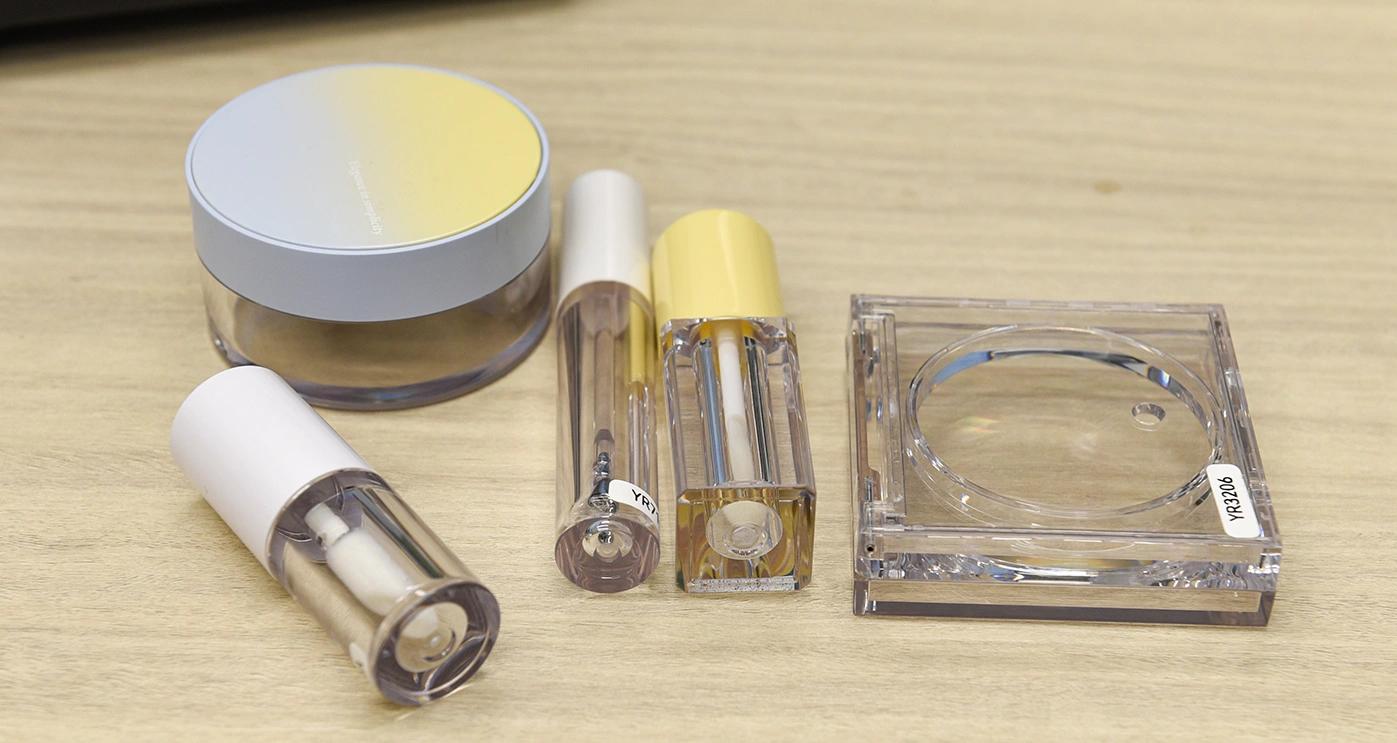
| Color Cosmetics | Foundation bottles, lipstick tubes, lip gloss tubes, mascara tubes, cushion compacts | |
| Fragrance | Perfume bottles, diffuser bottles, portable spray bottles, perfume sample tubes | |
| By Container Form | Bottles | Round bottles, square bottles, flat bottles, special-shaped bottles, long-neck bottles |
| Jars | Wide-mouth jars (cream jars), narrow-mouth jars, airless jars, double-wall jars | |
| Cases/Compacts | Eyeshadow palettes, pressed powder compacts, blush compacts, highlighter cases | |
| Tubes | Lip balm tubes, rigid mascara tubes, concealer tubes | |
| By Forming Process | Injection-molded parts | Thick-wall cream bottles, lipstick inner barrel/middle core, powder case base & lid, premium caps |
| Blow-molded parts | Toner bottles, large-capacity lotion bottles, personal care bottles | |
| By Functional Structure | System packaging | Airless pump bottles, press bottles, dropper bottles, roller bottles |
| Auxiliary components | Pump outer housings, spray shrouds/covers, caps, sealing plugs |
PETG Cosmetics Packaging: Core Component Application List
1) Container Bodies
- High-transparency serum bottles / ampoules: Use high transmittance to replace glass; drop-resistant with a premium feel, suitable for high-end skincare.
- Thick-wall cream jars: Common for face cream and eye cream; injection molding creates a thick-base “crystal-like” luxury effect.
- Airless bottles / lotion bottle bodies: Supports pump systems; anti-oxidation with strong chemical stability, compatible with active ingredients.
- Solvent-type containers: Makeup remover bottles and perfume samples; better alcohol resistance than acrylic, reducing long-term brittleness and cracking.
2) Color Cosmetics Housings
- Powder case lids (eyeshadow / pressed powder): Create a fully transparent “window” to clearly display the true shade; also less prone to scratching.
- Lipstick / lip glaze tubes: Common as transparent barrels or middle cores; resistant to oil/grease corrosion; smooth rotation and closure.
- Cushion compact housings: High gloss surface and strong drop resistance; protects delicate internal structures.
3) Functional Components
- Pump components: Such as pistons and pump cores; toughness supports thousands of presses without cracking or failure.
- Transparent dust covers: Outer caps for mist sprayers and perfume bottles; more compression-resistant than brittle PC/PMMA.
- Inner liners / core parts: Direct contact with highly active or alcohol-containing formulas; provide critical physical isolation and protection.
- Beauty accessories: Makeup brush handles and puff storage cases; excellent moldability enables complex special-shaped designs.
Core Forming Processes for PETG Cosmetics Packaging
1) Injection Stretch Blow Molding (ISBM) — Hollow Bottle Bodies
- Injection molding of preform (make a tubular preform)
- Axial stretching (stretch rod performs longitudinal stretching)
- Radial blow molding (compressed air expands the preform to fit the mold closely)
2) Injection Molding — Solid / Thick-Wall Parts
- Melt plasticization (PETG pellets are melted at high temperature)
- High-pressure injection (melt is injected into a precision mold cavity)
- Pack & cool (compensate shrinkage and cool to set shape)
3) Extrusion Blow Molding (EBM) — Large-Volume / Special-Shaped Bottles
- Extrude parison (extrude molten material into a tube)
- Close mold and blow (mold clamps the parison and air inflates it)
- Deflashing (trim excess material at the neck and bottom)
4) Sheet Thermoforming — Packaging Trays / Inserts
- Heat and soften (heat PETG sheets to a plastic state)
- Vacuum / pressure forming (form into shape using molds, vacuum forming/pressure forming)
- Punching & trimming (cut and trim into the final product)
What Surface Finishing Processes Can PETG Cosmetics Packaging Use?
1) Printing & Graphics (Basic Decoration)
- Screen printing: The most common method for logos and text.
- Pad printing: Fine printing on irregular curved surfaces such as caps and pumps.
- Hot stamping (gold/silver): Metallic-look graphics, including 3D hot stamping and holographic stamping.
- Heat transfer / water transfer: Transfer complex multicolor patterns or textures (e.g., wood grain, marble) onto the surface.
- Digital printing: Direct high-resolution full-color printing.
2) Visual Effects (Texture & Aesthetics Enhancement)
- Vacuum metallization: Creates bright gold/silver mirror-like metal textures.
- Spray coating: Includes solid color coating, translucent gradient coating, and pearlescent coating.
- Frosted finish: Chemical etching (uniform), sandblasting (flexible), and mold texturing (efficient).
- UV transfer: Creates micro-relief, brushed effects, or 3D depth textures on the surface.
- Laser engraving: Engraves fine anti-counterfeit marks or permanent graphics.
3) Performance Reinforcement (Functional Coatings)
- UV curing: Core process! Greatly improves PETG scratch resistance and surface hardness.
- Soft-touch coating: Provides a silky, rubber-like, or skin-like warm tactile feel.
- Anti-fingerprint coating: Resists oil stains and fingerprints; wipes clean easily.
- IMD/IML (In-Mold Decoration / In-Mold Labeling): Embeds patterns inside plastic for decorations that never wear off.
- Antibacterial / UV-resistant coatings: Adds functionality and protects the contents.
4) Critical Pretreatment (Anti-Peeling Technologies)
- Plasma treatment: Activates the surface; a “lifesaver process” for solving paint peeling and print flaking.
- Corona treatment: Increases surface tension and enhances ink adhesion.
- Flame treatment: Fast surface activation before large-area hot stamping.
Design & Mass Production Notes for PETG Cosmetics Packaging
1) Core Design Points for PETG Cosmetics Packaging
1. Structural Issues
- Mandatory large radii (R ≥ 1.5 mm): PETG strongly “fears sharp corners.” Without large radii at stress-bearing locations, filling alcohol-based products can quickly trigger Environmental Stress Cracking (ESC).
- Smooth wall-thickness transition: Sudden thickness changes are strictly prohibited. Thick/thin differences cause permanent residual internal stress, which may lead to spontaneous bottle cracking later.
- Reserve assembly clearance: The fit between cap and bottle neck should reserve 0.1–0.2 mm. PETG lacks toughness compensation; overly tight fit can directly burst the bottle mouth.
2. Mold Issues
- Increase draft angle (≥ 3°): PETG is extremely “sticky” when molten. A typical 1° draft may cause demolding drag marks, damaging the mirror effect of transparent parts.
- Anti-sticking mold treatment: Recommend nitriding or nano-coating on the cavity. This is key to solving PETG sticking and achieving “glass-like” gloss.
- Reinforced local cooling: Design independent cooling circuits for thick areas (e.g., bottle bottom). PETG dissipates heat slowly and has low heat resistance; insufficient cooling can cause demolding deformation.
3. Performance Issues
- Strictly prohibit hot filling: Design must avoid hot filling processes above 70°C, otherwise the bottle body may soften and collapse.
- Alcohol isolation layer: If the contents contain high-concentration alcohol or essential oils, design must add an inner-wall isolation coating or adopt a double-wall structure (PETG outer shell + PP inner liner).
How to Test Whether It Is PEGT Material
PEGT Authenticity Identification Comparison Table
| Identification Dimension | Test Item | Genuine Characteristics | Fake / Inferior Characteristics | Recommended Scenario |
|---|---|---|---|---|
| Sensory | Appearance / Dissolution | Uniform pellets; fully soluble in 80°C water | Impurities / spots; sediment remains after dissolution | On-site receiving inspection |
| Physical | Thermal Stability | No discoloration after baking at 180°C for 2 hours | Yellowing and embrittlement | Before mass production |
| Physical | Density | 1.05–1.08 g/cm³ | Lower (e.g., 1.02 g/cm³) | QC lab |
| Chemical | FTIR Spectrum | Strong ester peak at 1730 cm−1 | No such peak or irregular peak shape | Third-party testing |
| Microscopic | GPC (PDI) | Polydispersity index ≤ 1.2 | > 1.5 (wide molecular weight distribution) | When quality disputes occur |
Common FAQs About PETG Cosmetics Packaging
Can PETG Cosmetics Packaging Hold Alcohol?
Yes, but the solution must match the alcohol concentration.
- Low to medium concentration (< 60%): Such as toner and makeup remover. PETG is stable and can be used directly with confidence.
- High concentration (60%–85%): Such as perfume and disinfectant. Alcohol can easily trigger cracking or swelling.
- SamBound pitfall-avoidance recommendation: Must solve via thicker walls, de-sharpening geometry (large radii), or using alcohol-resistant modified grades.
- Ultimate solution: If the formula contains alcohol and many esters, it is recommended to adopt an inner-wall fluorination treatment or a double-layer structure (PETG outer shell + PE inner liner) recommended by SamBound, balancing premium appearance and compatibility.
What If PETG Parts Become Hazy and Cannot Reach a “Glass-Like” Transparency?
Optimization must be investigated from material, mold, and process perspectives.
- Material purity: Strictly prohibit mixing recycled material. PETG is extremely sensitive to purity; recycled content directly causes a cloudy appearance. Use virgin resin only.
- Mold precision: The cavity surface must be polished to a mirror finish. Oil contamination or insufficient surface finish is a direct cause of surface haze.
- Process adjustment: Precisely control cooling water temperature (e.g., adjust to 18°C) to reduce internal stress. Uneven internal stress can cause optical distortion and reduce clarity.
How Can PETG Cosmetics Packaging Meet EU REACH Requirements and Recyclability Targets?
The core lies in compliant raw materials and mono-material design.
- Material compliance: Use food-grade virgin resin and ensure third-party reports (e.g., SGS) proving no REACH-restricted substances.
- Mono-material structure: Use all-plastic design; avoid metal or other dissimilar material components to ensure 100% recyclability and prevent mixed materials from blocking recycling.
- Standard marking: The bottle bottom must be molded/engraved with clear recycling marks and material codes to meet overseas customs clearance and waste sorting requirements.