When brand owners approach us to discuss sustainable packaging, the first question is often, “You say all-PP lipstick tubes are more eco-friendly, but can they deliver the same feel and finish as ABS?”
The question itself reveals a key assumption: for most people, premium feel and sustainability seem to be at odds. ABS has been used in the industry for so many years that the equation of “electroplated mirror finish = premium look” is deeply embedded in both brand and consumer expectations. What all-PP is challenging is not just a material grade but an entire set of aesthetic habits.
That does not mean PP can never deliver a satisfying finish. The issue needs to be broken down: what does “premium feel” actually mean? Where do PP and ABS differ at the material level? How much can surface treatment make up for? In which applications is PP good enough, and when is ABS still the better choice?
ABS and PP: The Difference Goes Beyond the Name
Start with the basics of the two materials.
ABS (acrylonitrile butadiene styrene) is a long-established material in cosmetic packaging. The outer shell of a lipstick tube, the base of a compact, the flip lid of a cushion case—pick one up at random, and it is very likely ABS. It offers high rigidity, stable dimensions, and a naturally glossy surface. It can also go straight into vacuum metallization to produce a mirror finish. ABS did not become the industry default accidentally.
PP (polypropylene) is also widely used in packaging, but traditionally more often for structural parts that stay out of sight, such as inner cups and bottle bodies. PP covers a broad range of grades. Homopolymer PP tends to be more brittle. Copolymer PP has better toughness. High-clarity PP can produce a semi-transparent look. Nucleated modified PP can improve gloss. Even with these modifications, PP and ABS do not start from the same baseline: PP has a flexural modulus of 1.2 to 1.6 GPa, while ABS ranges from 2.2 to 2.8 GPa, nearly double the level of PP (ASTM D790). In simple terms, with the same wall thickness, an ABS tube feels much stiffer in the hand than a PP tube.
Another key difference is surface energy. PP is around 29 to 31 mN/m, while ABS is 34 to 38 mN/m (ASTM D2578). What do those few mN/m mean in practice? They mean paint and metallized layers do not “sit” on PP surfaces as easily. That becomes important when surface finishing enters the discussion.
| Parameter | All PP | ABS |
|---|---|---|
| Flexural modulus (ASTM D790) | 1.2–1.6 GPa | 2.2–2.8 GPa |
| Rockwell hardness (ASTM D785) | R80–95 | R100–110 |
| Surface energy (ASTM D2578) | 29–31 mN/m | 34–38 mN/m |
| Injection molding shrinkage (ISO 294-4) | 1.0–2.5% | 0.4–0.7% |
| Density | 0.90–0.91 g/cm³ | 1.04–1.06 g/cm³ |
“Premium Feel” Is Not Vague—It Comes Down to Four Things
When brand owners talk about “premium feel,” they are usually talking about four different things.
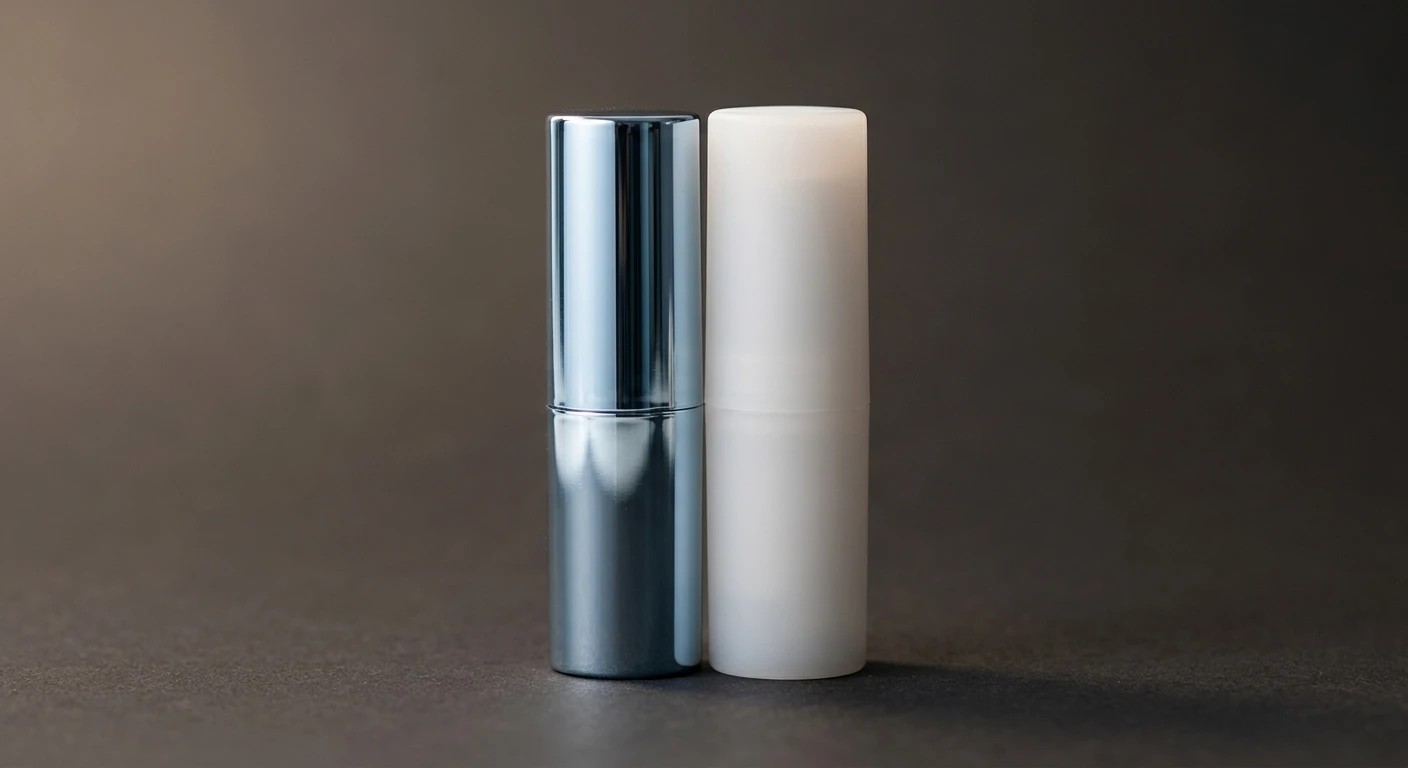
First: appearance. This is what the consumer sees at first glance when picking up the lipstick tube—gloss level, color uniformity, and visible defects. ABS has a built-in advantage here. Its natural surface gloss is typically 85 to 95 GU (ASTM D523), while untreated PP is typically only 70 to 85. The gap becomes even more obvious when the target is a true mirror finish.
Second: hand feel. This is the judgment made once the consumer holds the pack—weight, thermal feel, and surface touch. PP has a density of about 0.9, roughly 13% lighter than ABS, so the same structure in PP does feel lighter in the hand. Is that a weakness? It depends on positioning. For a lipstick designed around lightness and portability, lower weight can be a benefit. For a lipstick positioned around luxury and heft, lower weight becomes a shortcut to a “cheap” impression. In thermal feel, PP tends to feel warmer, while ABS feels cooler. That difference is neutral by itself—some users prefer a warmer touch, others like a cooler one.
Third: structural feel. This is the mechanical feedback during use—how the mechanism turns, how the cap clicks shut, and whether there is any looseness. ABS has low shrinkage, at 0.4% to 0.7%, so injection-molded parts naturally deliver better dimensional accuracy. Thread engagement is tighter, and the turning feel is smooth without drag. PP shrinks more, at 1.0% to 2.5%, and also shows stronger anisotropy. That increases the tendency of the tube body to go slightly oval. The threaded section needs more precise mold compensation to reach ABS-level accuracy. Based on practical experience from one contract manufacturing engineer, the thread draft angle on a PP lipstick tube should be at least 1.8°. Otherwise, thread scuffing during automatic demolding can jump from 2% to 12%.
Fourth: durability. This is whether the tube still looks “new” after three months of use. ABS has a harder surface, so fingernail scratches are less likely to show. PP is softer, and micro-scratches build up more easily over time. That said, on a lipstick tube used normally in the market for three months, the difference is often smaller than many people expect. Consumers are not testing the pack with a hardness meter. What they notice is the overall appearance.
Can Surface Finishing Close the Gap?
The root of PP’s disadvantage in perceived quality is its low surface energy. Paint, metallization, and similar finishes do not adhere as naturally as they do on ABS. But saying PP cannot be surface-finished is inaccurate. The more precise statement is this: surface finishing on PP comes with a higher cost and lower yield than on ABS. Some visual and tactile gaps can be narrowed. Some cannot.
Vacuum metallization (metallic look route): ABS can go directly into vacuum metallization and achieve a mirror-like metallic finish, with acceptable yield rates above 90%. That is why it is still the industry standard. PP does not have enough direct adhesion for this process. It first needs flame treatment or corona treatment to raise surface energy, followed by a dedicated primer before metallization. The final result is still a finished result, and experienced packaging engineers can spot subtle differences compared with metallized ABS, but average consumers may not. The trade-off is more process steps and higher cost.
Spray coating (matte/soft-touch/color route): This is where PP has more room to compete. For soft-touch coatings—moving toward a velvet-like feel—the naturally matte character of PP can actually help. The substrate is already less reflective, so it does not need to hide the original “plastic” look of ABS. The condition is proper pretreatment, with surface energy raised to above 38 mN/m and cross-hatch adhesion reaching 4B under ASTM D3359.
Coating-free solutions: This is PP’s distinct route. Copolymer PP with masterbatch can be injection molded directly into a matte or semi-matte finish, with no base coat and no spray coating. The process introduces no additional coating layer—single material and fully recyclable. The resulting look is not the “luxury mirror metal” feel associated with ABS. It aligns more with the restrained, soft aesthetic often preferred by Japanese brands. It is not imitating ABS. Likewise, it is defining a different version of premium.
In one sentence: PP can deliver a premium feel that is natural, soft, and controlled in matte form, but it is hard for PP to reproduce the mirror-metal luxury effect that ABS can deliver. These are not substitute aesthetics. They are two different design directions.
When to Choose PP and When to Stay with ABS
This brings the discussion back to the question brand owners care about most: which material should be used?
All-PP is enough—or even better—in the following situations:
- The brand story centers on eco-friendly and recyclable packaging, and the pack itself is part of the value proposition
- The lipstick formula contains a higher share of vegetable oils or botanical extracts, and PP’s chemical resistance is much better than ABS (ABS may develop stress cracking after long-term contact with oily contents)
- The target look is matte, semi-matte, or soft-touch restraint rather than mirror-metal shine
- The project is designed to meet EU PPWR requirements for packaging with 30% recycled content
ABS is still the better fit in the following situations:
- The brand positioning depends on a luxury metallic look, and a mirror electroplated finish is a core visual anchor
- The product has a complex thin-wall structure with tight dimensional tolerances, where ABS’s low shrinkage is a hard advantage
- The target customer uses in-hand weight as a quality cue
- The budget is tight and does not allow for extra surface-treatment cost
A hybrid structure is also common industry practice: an ABS outer shell for appearance and hand feel and a PP inner cup for direct formula contact and safety. That gives brands the advantages of both materials. When Sambound develops Lipstick Tubes for brand customers as a Cosmetic Packaging Manufacturer, the team often compares three routes based on brand positioning and budget: full ABS, full PP, and ABS+PP hybrid. There is no universal “better” option. There is only the option that fits the project better.
That is the real answer to the debate over all-PP and ABS lipstick tube texture and finish: PP is not trying to catch up by copying ABS. It is defining its own aesthetic standard. The goal is not to make them “the same.” The goal is to decide which path the brand wants to stand on.