Sollten Sie zuerst einen Lohnabfüller oder einen Verpackungshersteller kontaktieren?
Acht von zehn Personen, die zum ersten Mal eine Dekorativkosmetikmarke auf den Markt bringen, haben genau diese Frage in eine Suchleiste eingegeben. Dieselbe Formulierung, dieselbe Unsicherheit. Sie glauben, sie fragen nach der Reihenfolge – A zuerst oder B zuerst. Machen Sie es richtig und sparen Sie Geld. Machen Sie es falsch und verlieren Sie ein halbes Jahr.
Aber denken Sie sorgfältig darüber nach. Damit diese Frage überhaupt Sinn ergibt, muss eine Bedingung zuerst erfüllt sein: Ihr Produkt muss bereits definiert sein.
Die meisten, die diese Frage stellen, haben die Formulierung noch nicht für die Pilotphase festgelegt. Die Farbpalette ist noch eine Richtung. Das Hautgefühl ist noch eine Idee. Die Bulk-Formulierung ist noch die zweite Laborprobe. Zu diesem Zeitpunkt zu fragen, ob man zuerst die Abfüllung oder die Verpackung finden soll, ist, als würde man fragen, ob man zuerst das Sofa oder das Bett kaufen soll, wenn der Grundriss des Hauses noch nicht einmal gezeichnet wurde.
Das Problem ist nicht, wen Sie zuerst kontaktieren sollten. Das Problem ist, dass Sie den wichtigsten Schritt übersprungen haben.
Abfüllbetriebe kümmern sich nicht um Verpackungen, und Verpackungshersteller kümmern sich nicht um die Rezepturmasse
Definieren Sie zunächst, was diese beiden Fabriken tatsächlich tun. Zu viele Akteure in der Branche verwischen diese Grenze absichtlich. Ein Abfüllbetrieb behauptet, bei der Beschaffung von Verpackungen helfen zu können. Ein Verpackungshersteller sagt, er kenne Abfüllressourcen. Verkaufsargumente auf beiden Seiten versuchen, sich einem One-Stop-Modell anzunähern, aber was dieses Modell stützt, ist keine echte Kompetenz – es ist ein Wiederverkaufsaufschlag.
Ein Lohnabfüller generiert Einnahmen durch seine Abfüllanlagen. Kolbenfüller verarbeiten Lipgloss und Foundation. Heißabfüllanlagen sind für Lippenstifte und wachsbasierte Produkte zuständig. Aseptische Abfüllanlagen handhaben Seren. Diese Betriebe konzentrieren sich auf die GMPC- und ISO 22716-Zertifizierung. Die Kosten werden üblicherweise pro Abfülleinheit berechnet – $0.04 bis $0.22 pro Stück. Ihre Ausrüstung stellt strenge Anforderungen an die Verpackung: Gewindedurchmesser des Flaschenhalses, Pumpenhub und Ebenheit der Dichtfläche. Wenn die Verpackung die Spezifikationen nicht erfüllt, ist ein falsch ausgerichteter Abfüllkopf das geringere Problem. Das eigentliche Problem ist, die Hälfte des Produkts abzufüllen und die andere Hälfte auslaufen zu lassen.
Ein Verpackungshersteller generiert Einnahmen durch Formen und Spritzgießmaschinen. Eine Lippenstifthülse beginnt als ABS-Granulat und wird zu einer fertigen Verpackung, die den Lippenstiftstift heben und senken kann. Dazwischen durchläuft sie Spritzguss der Hülle, Aluminiumprägung, galvanisierte Dekorschichten, UV-Schutzlackierung und die Montage des Innenmechanismus. Eine Lippenstifthülse aus Standardform kostet typischerweise $0.15 bis $0.44. Eine Version aus kundenspezifischer Form kostet $0.44 bis $1.48. Eine Premium-Version aus Aluminium-Kunststoff-Verbundmaterial kostet $1.48 bis $2.96.
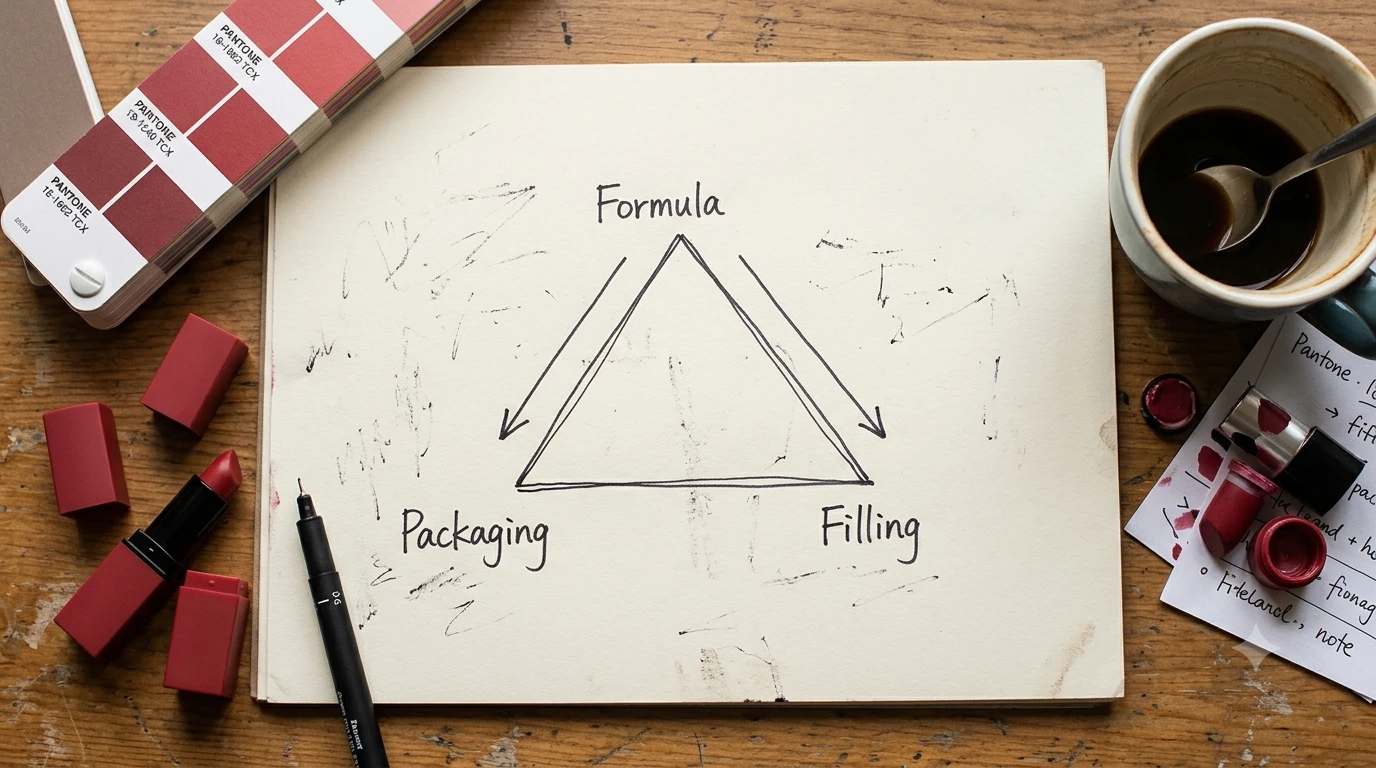
Dies sind zwei völlig unterschiedliche Arten von Betrieben. Sie als zweistufige Abfolge zu behandeln – zuerst der eine, dann der andere – ist von Anfang an das falsche Modell. Sie sind keine zwei Stationen in einer Linie. Sie sind zwei Basisecken eines Dreiecks. Die obere Ecke ist die Formulierung.
Die Frage „Wer kommt zuerst“ birgt drei Annahmen.
Kehren wir zu der Frage zurück: „Sollte ich zuerst einen Abfüllbetrieb oder zuerst einen Verpackungshersteller finden?“
Es verbirgt drei Annahmen. Lassen Sie uns diese einzeln aufschlüsseln.
Die erste Annahme ist, dass Ihr Produkt bereits definiert wurde. Ist die Masse wasserbasiert oder ölbasiert? Wie hoch ist die Viskosität in Centipoise? Welchen pH-Wert hat es? Enthält es Alkohol? Enthält es oxidationsempfindliche Wirkstoffe? Die Antworten bestimmen direkt, welche Verpackung Sie verwenden können. Eine wasserbasierte Formulierung kann mit PET funktionieren. Eine Formulierung mit hohem Alkoholgehalt erfordert möglicherweise eine speziell beschichtete Innenflasche oder Glas. Eine Formulierung mit hohem Ölanteil kann eine ABS-Innenkomponente nach dreimonatigem Kontakt aufquellen lassen. Wenn das Produkt nicht definiert ist, was genau bitten Sie dann die Verpackungsfabrik herzustellen?
Die zweite Annahme ist, dass Entscheidungen bezüglich Verpackung und Abfüllung unabhängig voneinander getroffen werden. Das sind sie nicht. Die von Ihnen gewählte Verpackung beeinflusst die Abfülleffizienz. Wenn der Tubendurchmesser um 0,5 mm abweicht, kann der Füllkopf möglicherweise nicht richtig ausgerichtet werden. Wenn die Federkraft der Pumpe nicht zur Viskosität der Formulierung passt, wird die Produktentnahme ungleichmäßig. Diese Probleme sollten nicht erst am Abfülltag entdeckt werden. Wenn Sie sie dann erst feststellen, ist es bereits zu spät.
Die dritte Annahme ist, dass Kostenvoranschläge beider Seiten einfach addiert werden können. „Der Abfüllbetrieb sagt $0.12 pro Einheit, und der Verpackungshersteller sagt $0.44 pro Set, also beträgt die Summe $0.56.“ So funktioniert das nicht. Der Abfüllbetrieb hat eine Abfüllgebühr angeboten. Der Verpackungshersteller hat einen reinen Verpackungspreis genannt. Dazwischen liegen Kompatibilitätstests, Transportverluste, Montagekosten und die Abfüllverlustrate – typischerweise 2% bis 5% in der Branche. Die Rechnung ist keine einfache Addition.
Sobald diese drei Annahmen beseitigt sind, geht es bei der eigentlichen Antwort nicht mehr darum, was zuerst kommt.
Ist die Formulierung nicht finalisiert, kann der Verpackungshersteller kaum helfen.
Die Logikkette funktioniert nur in eine Richtung: Formulierung → Verpackung → Abfüllung. Kehren Sie sie um, und jeder Schritt birgt Risiken.
Eine Marke entwickelte einen Lipgloss und verbrachte zunächst sechs Wochen damit, eine speziell geformte Tube anzupassen – ein klares PMMA-Gehäuse mit einer Metallpumpe. Sie sah auf dem Tisch so gut aus, dass niemand sie anfassen wollte. Erst danach brachten sie die Verpackung zu einem Abfüllbetrieb. Die Fabrik testete eine Tube. Der Produktaustrag war unregelmäßig. Ein Druck ergab einen Klecks, der nächste Druck nichts. Die Federrate der Pumpe war für eine wasserbasierte Rezeptur ausgelegt, aber das Produkt war ein hochviskoses ölbasiertes System.
Diese Verpackungscharge wurde später als unverkäuflicher Lagerbestand liquidiert.
Sie haben die 618-Verkaufssaison verpasst.
Dies ist kein Einzelfall. Wenn Sie zuerst die Verpackung festlegen und dann die Formulierung darum herum entwickeln, sind die Kosten nicht nur ein paar tausend Yuan höher. Die erste Bestellung kann sich um zwei Monate verzögern. Verpackung und Bulkware können sich als inkompatibel erweisen und die Verschrottung einer ganzen Charge erzwingen. Der Abfüllbetrieb kann Sie an seinen vorgeschriebenen Lieferanten binden und Ihnen Ihre Verhandlungsmacht entziehen.
Die richtige Reihenfolge ist eigentlich einfach. Zuerst die Rezeptur bis zur Pilotphase festlegen. Dann das Bulk-Muster an den Verpackungshersteller senden und einen 40 °C, 72-stündigen Kompatibilitätstest unter Tauchbedingungen durchführen, um Verformung, Verfärbung, Rissbildung oder extrahierbare Substanzen zu prüfen. Das Werkzeug erst nach bestandener Prüfung öffnen. Schließlich sowohl die Verpackung als auch das Bulk-Muster an den Lohnabfüller für einen Abfüllversuch senden.
Manche glauben, auf Kompatibilitätstests verzichten zu können. „Der Lieferant sagte, ABS sei in Ordnung.“ Aber welche ABS-Qualität? Verschiedene Hersteller verwenden unterschiedliche Additivpakete, unterschiedliche Rückstände von Trennmitteln und unterschiedliche Mahlgutanteile. Ist das Lieferanten-Datenblatt eine Garantie für Ihre exakte Rezeptur? Nein.
Der Lohnabfüller sagte, ABS würde funktionieren – Was nun?
Nicht jede Situation erfordert einen vollständigen Prozess zur Formulierungsfestlegung von Grund auf neu.
Wenn Ihre Formulierung ein konventionelles System ist – eine wasserbasierte Emulsion, ein grundlegendes Öl-Wachs-System, ohne hohen Alkoholgehalt und ohne saure Wirkstoffe – und Sie bereits den Abfüllbetrieb gefragt haben und dieser die Formulierung geprüft und klar gesagt hat: „Dieses System ist mit ABS, PP oder PETG kompatibel“, dann können Sie direkt zu einemFabrik für Kosmetikverpackungen.
Drei Schritte sind noch erforderlich. Erstens muss der Abfüllbetrieb eine schriftliche Bestätigung liefern – keine Sprachnachricht wie „das sollte passen“, sondern eine E-Mail, die besagt, dass das Formulierungssystem mit ABS, PMMA oder PP kompatibel ist. Zweitens muss der Verpackungshersteller Ihr Bulkwarenmuster erhalten, Kompatibilitätstests durchführen und einen Bericht erstellen. Drittens muss der Abfüllbetrieb das Verpackungsmuster erhalten und einen tatsächlichen Abfüllversuch durchführen – mit kontinuierlicher Entnahme, ohne Leckagen und mit ordnungsgemäßem Verschluss.
Sobald diese drei Schritte erledigt sind, können Sie direkt zur Verpackungsfabrik gehen.
Sind diese Schritte nicht erledigt, haben Sie nicht nur einen Schritt übersprungen. Es sind mehrere tausend Yuan an Nacharbeitskosten und ein zweimonatiges Markteinführungsfenster.
Drei Lieferkettenwege: Was Marken-Neugründer wählen sollten
Sobald Sie verstanden haben, dass die Rezeptur die Reihenfolge bestimmt, folgt die eigentliche Entscheidung: wie die Lieferkette aufgebaut werden soll. Die Frage ist nicht „wer zuerst“, sondern „welches Modell“.
Es gibt drei Wege.
Full-Service ODMSie liefern das Briefing – „magnetischer Lippenstiftverschluss, Aluminium-Kunststoff-Verbundgehäuse, gewichtete Haptik, sechs Farbtöne, Erstbestellung 5.000 Stück“ – und der Lieferant entwickelt die Lösung. Rezeptur, Verpackung, Abfüllung, Tests und Registrierung werden aus einer Hand erledigt. Kompatibilitätstests werden intern im System des Lieferanten durchgeführt, um Konflikte zwischen Verpackung und Abfüllung zu vermeiden. Eine einzige Kontaktperson koordiniert den gesamten Zeitplan. Der Kompromiss ist ein höherer Stückpreis, da die ODM-Servicegebühr bereits enthalten ist. Eine Erstbestellung umfasst typischerweise 3.000 bis 5.000 Einheiten pro Farbton, bei drei bis fünf SKUs. Die Gesamtinvestition beläuft sich in der Regel auf etwa $22,222 bis $44,444. Sie bezahlen dafür, dass jemand die gesamte Kette für Sie verwaltet.
Separate BeschaffungSie verwalten die Formulierungsentwicklung selbst, finden Ihre eigenen.Lieferant für Kosmetikverpackungen, und senden die Verpackung an eine Abfüllanlage. Die Verpackungsfabrik bietet $0.52 an, und die Abfüllanlage bietet $0.12 an, wodurch Sie die ODM-Servicegebühr vermeiden. Sie übernehmen jedoch die Kompatibilitätstests selbst. Sie koordinieren die Lieferzeiten zwischen drei Parteien selbst. Wenn der Abfülltermin erreicht ist und die Verpackung noch unterwegs ist, werden die Ausfallzeiten und Lagerkosten an der Abfülllinie nicht von der Abfüllanlage übernommen. Dieser Weg eignet sich für Teams mit Erfahrung in der Lieferkette. Für Marken, die zum ersten Mal starten, deckt das gesparte Geld möglicherweise nicht die Lehrkosten, die durch Fehler entstehen.
Verpackung, bezogen vom Abfüllbetrieb.Es klingt einfach – „Keine Sorge um die Verpackung. Wir haben Partnerlieferanten und können sie für Sie beschaffen.“ Das Problem ist, dass Sie den Aufschlag nicht sehen können. Die Abfüllfabrik bietet eine Lippenstifthülse für $0.74 an. Fragen Sie direkt bei der Verpackungsfabrik nach, erhalten Sie einen Preis von $0.52. Die Differenz von $0.22 ist die Einkaufsprovision. Der Lieferant ist zudem an die Abfüllfabrik gebunden. Wenn Sie die Oberflächenveredelung, das Material oder die Haptik ändern möchten, muss jede Änderung über einen Mittelsmann laufen. Bis das überarbeitete Muster bei Ihnen ankommt, kann ein Monat vergangen sein.
| Modell | Ideal für | Kompromiss |
|---|---|---|
| Full-Service ODM | Marken-Neulinge, kleine Teams, schnelle Markteinführung | Die Stückkosten sind 15%–30% höher. |
| Separate Beschaffung | Teams mit Erfahrung in der Lieferkette, Bestellvolumen über 5.000 Stück | Sie tragen die Koordinationskosten und das Risiko. |
| Abfüllbetrieb beschafft Verpackungen | Marken, denen das Verpackungsdesign gleichgültig ist | Undurchsichtige Preisaufschläge und eingeschränkte Designkontrolle |
Keiner dieser drei Wege ist von Natur aus richtig oder falsch.
Wenn dies Ihre erste Marke ist und Sie gerade erst den Unterschied zwischen einem Verpackungshersteller und einem Abfüllbetrieb verstanden haben, wählen Sie einen Full-Service-ODM. Nachdem Sie die erste Charge abgeschlossen, die meistverkaufte SKU identifiziert und echtes Kundenfeedback gesammelt haben, können Sie die Aufteilung der Lieferkette und die Eigenverwaltung in Betracht ziehen.
Für die erste Charge reichen Standardformen aus
Hier ist eine Zahl, die viele nicht kennen: Etwa die Hälfte der Details in einer Konstruktionszeichnung muss nach Beginn der Massenproduktion angepasst werden. Ein gekrümmter Übergangswinkel kann für eine vollständige Harzfüllung zu klein sein. Ist die Galvanisierungsfläche zu groß, kann die Ausbeute auf 60% sinken. Liegt die Positionstoleranz beim Heißprägen unter 0,1 mm, kann eine Ausrichtung unmöglich sein.
Deshalb reichen Standardformen für die erste Charge aus. Das ist keine Schande. Der wahre Fehler besteht darin, für die erste Charge ein kundenspezifisches Werkzeug zu eröffnen und dann nicht genügend Volumen zu generieren, um die Werkzeugkosten wieder hereinzuholen.
Ein kundenspezifischer Werkzeugsatz kostet in der Regel etwa $4.444 bis $22.222. Diese Ausgabe ist irreversibel. Es gibt nur eine Situation, in der dies sinnvoll ist: Sie haben die erste Charge bereits mit einem Standardwerkzeug validiert, wissen, welche SKU sich am besten verkauft, und verfügen über echtes Verbraucherfeedback.
Eine Marke machte einen klugen Schachzug. Sie verwendete ein Standardform-Gehäuse. Eine normale Sprühlackierung kostete $0.04 pro Stück. Ein Upgrade auf eine Soft-Touch-Beschichtung kostete $0.12 pro Stück, bei einer Erstbestellung von 5.000 Einheiten. Das bedeutete zusätzliche Ausgaben von $370. Wenn Verbraucher die Kappe aufdrehten, spürten ihre Finger einen gummiartigen Mikrodämpfungseffekt anstelle des glatten Gefühls von billigem Kunststoff. Das war der Moment, in dem sie sich an die Marke erinnerten.
Drei Änderungen erfordern keine Werkzeuganpassung: die Änderung der Oberflächenveredelung, das Hinzufügen eines Gewichtsblocks und die Heißprägung des Logos. Es fallen keinerlei Werkzeugkosten an. Die Markenbekanntheit kann sich verdoppeln.
Bei Fabrikaudits geht es nicht um den Showroom
Die Muster im Ausstellungsregal wurden für andere große Marken gefertigt. Galvanisierte Teile glänzen wie Spiegel. Die Montagespalten sind so eng, dass selbst Papier nicht hineinpasst.
Das ist nicht Ihr Produkt.
Was Sie sehen müssen, sind die Testmuster, die nach Ihren Anforderungen gefertigt wurden. Bitten Sie den Hersteller, Muster anzufertigen, bevor Sie sich entscheiden. Die Aussage „Wir haben bereits ähnliche Produkte hergestellt“ ist nicht ausreichend.
Eine Sache ist sogar noch wichtiger als das Betrachten von Mustern.
Fragen Sie nach der Ausbeute. Wie hoch ist die Ausbeute bei der Galvanisierung? Wie hoch ist die Beschichtungsausbeute? Wie hoch ist die Ausschussrate bei der Montage? Wenn die Antwort vage ist – „im Allgemeinen kein Problem“ – dann basiert die Qualitätskontrolle auf Hoffnung. Wenn die Fabrik Ihnen direkt sagen kann, dass die Ausbeute bei der ABS-Wasserelektroplattierung 92% bis 95% und die Ausbeute bei der Vakuumbedampfung 85% bis 90% beträgt, dann verwaltet zumindest jemand die Zahlen. Die Ausbeute beeinflusst direkt Ihre tatsächlichen Kosten. Ein Angebot von $0.30 pro Set bei einer Ausbeute von 85% bedeutet, dass Ihre tatsächlichen qualifizierten Kosten $0.35 pro Set betragen.
Bevor Sie eine Bestellung aufgeben, sollten REACH-Prüfberichte, RoHS-Konformitätserklärungen und Materialzertifikate bereits vorliegen. Dies sind die Eintrittskarten der Fabrik in den Markt, keine zusätzliche Dienstleistung, für deren Erstellung Sie bezahlen sollten. „Geben Sie zuerst die Bestellung auf, dann kümmern wir uns darum“ ist eine Aussage für sich. Eine weitere Berücksichtigung dieser Fabrik ist nicht nötig.
Sollten Sie also zuerst einen Lohnabfüller oder einen Verpackungshersteller finden?
Jetzt ist die Antwort klar – es gibt keine Standardantwort. Aber es gibt einen Standard-Ausgangspunkt.
Definieren Sie zuerst das Produkt. Legen Sie die Rezeptur bis zur Pilotphase fest. Bestimmen Sie, ob Ihre Masse öl- oder wasserbasiert ist, welche Viskosität sie hat und ob sie Alkohol enthält. Dann wird Ihnen die Rezeptur vorgeben, welche Verpackung zu verwenden ist. Die Verpackung wiederum wird Ihnen sagen, welchen Abfüllbetrieb Sie kontaktieren sollten.
Es ist nicht „A zuerst oder B zuerst.“ Es ist „1 → 2 → 3.“ Wenn Schritt 1 nicht abgeschlossen ist, denken Sie nicht über Schritt 2 nach.
Dies ist das Rahmenwerk, das Sambounds ODM-Team täglich für Gründer anwendet, die zum ersten Mal eine Marke auf den Markt bringen. Von der Formulierungskoordination bis hin zuKosmetikverpackungsherstellerVon der Planung bis zur Abfüllung kann eine Person den Prozess über einen einzigen Ansprechpartner steuern. Sie müssen lediglich Ihre Idee klar darlegen – der Rest folgt der richtigen Reihenfolge.